Home / What Is Semantic Search? Meaning, How It Works and Examples
What Is Semantic Search? Meaning, How It Works and Examples
Semantic search is an information retrieval method that ranks results by interpreted meaning, intent, and context rather than literal word overlap alone. It may use query analysis, vector embeddings, entity relationships, filters, and reranking. These techniques help a search system connect paraphrases and disambiguate language, but they do not remove the need for exact terms or evaluation. Semantic search differs from keyword search because meaning is the target, while vector search is only one implementation technique. A useful system therefore combines suitable retrieval methods, tests them on judged queries, and measures relevance, latency, and failure patterns.
Semantic search in four facts
- Semantic search retrieves information by interpreted meaning rather than exact word overlap alone.
- Embeddings encode queries and documents as vectors whose distance represents modelled similarity.
- Semantic search and vector search are related, but they are not identical concepts.
- Judged queries determine whether semantic retrieval improves a particular search system.
What does semantic search mean?
Semantic search means retrieving and ranking information by interpreted meaning, search intent, and context rather than exact word overlap alone. Weaviate documentation describes vector search as similarity-based retrieval using embeddings. Google Cloud defines semantic search as a technique that focuses on contextual meaning and intent. Together, those definitions establish a goal and one common mechanism: the system tries to return conceptually relevant material even when query and document use different language.
Meaning may come from learned representations, explicit relationships, or both. An embedding model places text in a numeric space where modelled similarities become distances. A knowledge graph represents named entities and their relationships. Query understanding may also identify intent, entities, spelling variants, and constraints before retrieval begins. Semantic search is therefore a system property, not the name of one algorithm.
Context has several meanings in search. Textual context changes how a word is interpreted inside a phrase. Collection context changes which documents count as relevant. User context may include location, language, permissions, or prior interactions. Google Cloud distinguishes intrinsic query meaning from external contextual signals. Personalization may use those external signals, but personalized search is not required for retrieval to be semantic.
How does semantic search work?
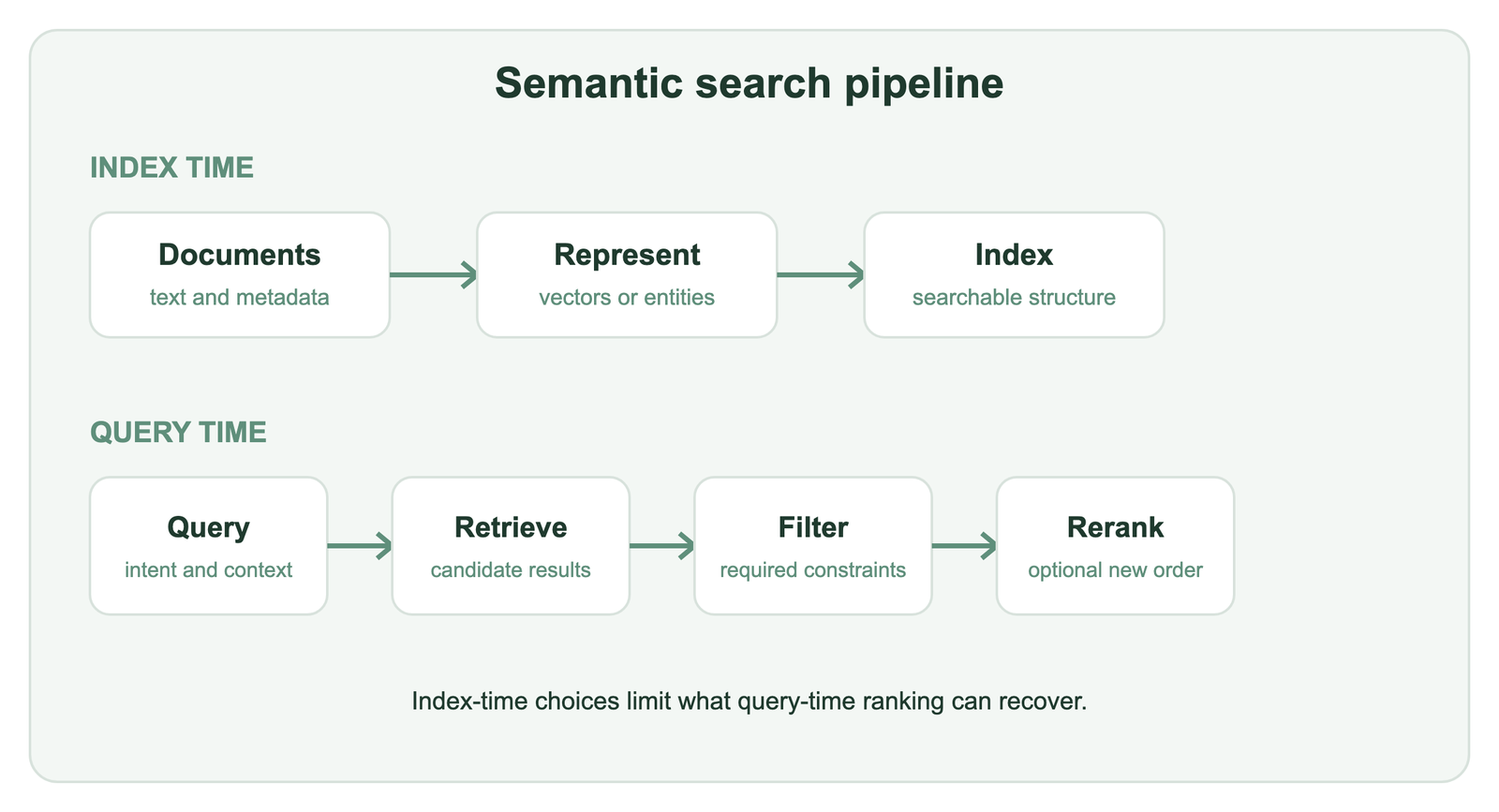
Semantic search works by interpreting a query, representing its meaning, retrieving candidates, applying constraints, and optionally reranking the result list. Weaviate documentation separates first-stage search from optional filtering and reranking. Google Cloud names query analysis, knowledge graph integration, content analysis, and retrieval as common stages. The complete semantic search workflow depends on the representation and retrieval model selected for a corpus.
A common embedding pipeline uses the same compatible model for documents and queries. The model converts each input into a numeric vector. A vector index then finds stored vectors near the query vector under a selected distance metric. Weaviate documentation lists cosine, dot product, and Euclidean distance as supported choices and warns that search should use the metric expected by the model. The guide to embeddings explains what those numeric representations preserve and omit.
Representation does not finish the retrieval task. Metadata filtering enforces conditions such as language, access rights, product availability, or publication date. A first-stage retriever returns a candidate set. Reranking then applies another model to selected candidates and changes their order. The family of retrieval models includes lexical, sparse neural, dense, late-interaction, and multi-stage approaches.
Sentence-BERT shows why representation and retrieval architecture matter. Nils Reimers and Iryna Gurevych reported in their 2019 EMNLP-IJCNLP paper that comparing all pairs in a collection of 10,000 sentences took about 65 hours with BERT or RoBERTa. Their Sentence-BERT method reduced that comparison to about 5 seconds by producing reusable sentence embeddings for cosine comparison. That result belongs to the paper’s experiment, not every semantic-search deployment.
How does semantic search differ from keyword search?
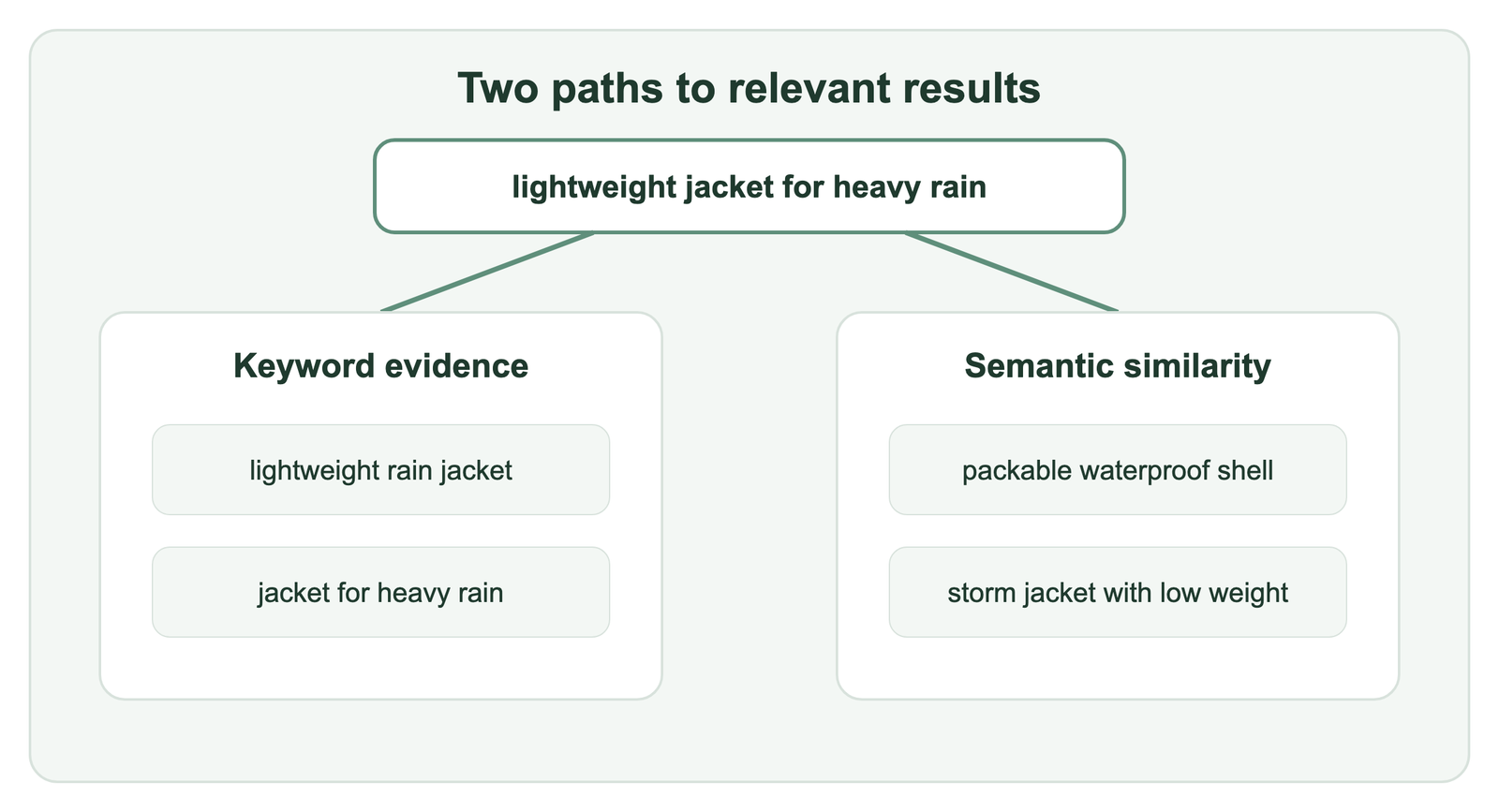
Semantic search matches inferred meaning, while keyword search ranks textual evidence such as terms, phrases, and their collection statistics. A keyword search may excel when a query contains an exact model number, error code, quotation, or proper name. Semantic retrieval may excel when a relevant document expresses the same intent with a paraphrase. Neither evidence type is universally stronger.
Consider the illustrative query “lightweight jacket for heavy rain.” A keyword retriever rewards documents containing those terms or configured variants. A semantic retriever may also surface “packable waterproof shell” because an embedding model represents those phrases as related. That example demonstrates intended behavior, not a measured ranking. Actual results depend on corpus language, model training, indexing, candidate depth, and relevance policy.
- Lightweight jackets for heavy rain
- Best lightweight rain jackets
- Heavy rain jacket buying guide
| Attribute | Semantic search | Keyword search |
|---|---|---|
| Primary evidence | Modelled meaning or entity relationships | Terms, phrases, and corpus statistics |
| Useful query | Paraphrase or natural-language need | Exact identifier or quoted wording |
| Typical failure | Conceptually similar but wrong result | Relevant result written with different words |
Production search often preserves both evidence types. Hybrid search runs semantic and lexical retrieval, then combines their candidates. Combination helps only when each branch contributes relevant material and fusion keeps the useful order. Exact lookup traffic may not need semantic retrieval. Paraphrase-heavy traffic may gain little from a second lexical branch.
Is semantic search the same as vector search?
Semantic search is not the same as vector search: semantic search is a retrieval goal, while vector search is a similarity technique that may implement that goal. Weaviate documentation calls vector search “semantic search” when embeddings capture semantic meaning, yet it also states that vector search applies to images, video, and audio. Similar vectors do not automatically represent linguistic meaning.
Google Cloud describes semantic search as broader than vector search because semantic systems may combine query analysis, knowledge representation, embeddings, and contextual signals. An image-similarity engine can use vector search without interpreting a text query. A knowledge-graph system can answer meaning-oriented queries without using dense vector nearest neighbors as its only retrieval method.
Elasticsearch is a search platform, while semantic search is a behavior or capability. A platform may provide keyword retrieval, vector retrieval, filters, and reranking. Calling the platform “semantic search” hides those separate choices. The useful comparison asks which representation, index, scoring method, and evaluation process a deployment uses.
Where does semantic search help?
Semantic search helps when relevant documents express a query’s intent with different words or when language is ambiguous. A support user may describe an account locked after a phone change. The answer may describe two-factor authentication recovery. A shopper may request shoes for wet trails, while catalog text says waterproof trail runners. These examples contain vocabulary gaps that literal overlap alone may miss.
Semantic retrieval also supports natural-language questions, multilingual representations, and concept-based discovery when the model covers those conditions. OpenAI’s 2022 embeddings documentation defines embeddings as numerical representations of concepts and describes text search as semantic information retrieval. Reimers and Gurevych’s Sentence-BERT paper shows that reusable sentence embeddings can make large similarity comparisons practical.
Benefits remain conditional. A model may understand a common paraphrase but miss proprietary jargon. A conceptually related result may violate a hard filter. An apparently natural answer may come from an irrelevant source. Detailed semantic search use cases separate product discovery, support, enterprise knowledge, code, and multimodal retrieval because each has a different relevance standard.
Where does semantic search fail?
Semantic search fails when its representation misses domain meaning, exact strings matter more, or operational constraints outweigh relevance gains. Dense models may confuse similar product identifiers, legal citations, or internal abbreviations. Short queries provide little context for intent inference. Biased or incomplete training data may also place the wrong concepts near one another.
BEIR demonstrates that model success does not transfer uniformly across tasks. Nandan Thakur, Nils Reimers, Andreas Rücklé, Abhishek Srivastava, and Iryna Gurevych evaluated 10 retrieval systems across 18 datasets in their 2021 NeurIPS benchmark. They reported BM25 as a robust baseline and found dense retrieval often underperformed other approaches in zero-shot settings. One benchmark does not select a production model, but it rejects universal superiority claims.
Operational failures include stale embeddings, mismatched query and document models, filters applied at the wrong stage, insufficient candidate depth, and latency beyond the interface budget. Scaling semantic search balances recall, throughput, memory, and freshness. Semantic caching may reuse results for meaning-similar requests, but its similarity threshold creates another correctness boundary.
Hybrid retrieval is one response to complementary failures, not a guaranteed repair. Exact evidence from a lexical branch may protect codes and names. Semantic evidence may recover paraphrases. Fusion may still promote noise or suppress a strong single branch. Evaluation must compare keyword-only, semantic-only, and hybrid variants on the same judgments.
Where is semantic search used?
Semantic search is used in product discovery, enterprise knowledge retrieval, customer support, retrieval-augmented generation, code search, and multimodal discovery. Google Cloud gives e-commerce and enterprise search as representative applications. MongoDB’s semantic-search overview adds healthcare, financial services, customer support, RAG, and cross-modal retrieval. Each use case searches different objects under a different definition of relevance.
Product discovery connects descriptive needs with catalog language. Enterprise search connects employee questions with policies, messages, and documents while respecting permissions. Support search connects symptoms with known resolutions. Code search connects natural-language tasks with functions or snippets. Image and video search may connect text and media when a multimodal embedding model maps both into a compatible space.
RAG uses retrieval to supply external context to a generative model. Semantic search may serve that retrieval stage, but the two terms are not synonyms. Retrieval quality limits which evidence reaches generation, while generation introduces separate grounding and answer-quality risks. Use-case design begins with the user’s task and the unit being retrieved, such as a product, passage, ticket, or code block.
Does Google use semantic search?
Google Search uses semantic techniques, but Google Search is a larger retrieval and ranking system than one semantic-search method. Google Fellow Pandu Nayak wrote in 2019 that BERT models consider words before and after a term to understand query intent. Amit Singhal’s 2012 Knowledge Graph announcement described a model of real-world entities and their relationships, summarized as “things, not strings.”
Those official descriptions support a precise answer: Google uses language understanding and entity relationships to interpret meaning. They do not mean every result comes from dense vector similarity or that lexical evidence disappeared. Google also documents spelling systems, structured data, ranking systems, and other signals. “Google is semantic search” collapses a multi-system product into one property.
Does ChatGPT use semantic search?
OpenAI documents semantic retrieval techniques, but public documentation does not establish that every ChatGPT response runs one semantic-search pipeline. OpenAI’s 2022 embeddings announcement names semantic information retrieval as an embeddings use case. It states that document and query embeddings can be produced separately and compared with cosine similarity.
ChatGPT may answer from model parameters, use web search, retrieve connected information, or work with uploaded material depending on product mode and configuration. “ChatGPT uses semantic search” is therefore too broad without naming the feature. A defensible statement is that OpenAI provides embedding technology for semantic retrieval and that retrieval may be part of some ChatGPT workflows.
How do you build semantic search?
Building semantic search requires a corpus, a representation method, an index, retrieval logic, filters, and a relevance test. First define the searchable unit and user task. Then prepare content, choose a query and document representation, create the appropriate index, retrieve candidates, apply required metadata rules, and measure results. The end-to-end semantic search build guide covers Python and production implementation choices.
Model selection belongs inside evaluation, not before it. A general embedding model may miss specialist language. A domain model may cost more or perform worse on broad queries. The comparison of semantic search tools separates model services, search engines, and vector databases instead of treating unlike products as interchangeable.
- Define the task with real query types, corpus boundaries, and a retrieval unit.
- Prepare content by cleaning text, selecting fields, and preserving required metadata.
- Choose representations for queries and documents under one compatibility plan.
- Index searchable objects with a structure suited to collection size, filters, and latency.
- Evaluate results against judged queries before changing production traffic.
Implementation details follow the representation. Dense retrieval needs embeddings and a vector index. Knowledge-graph retrieval needs entity extraction, relations, and graph queries. Hybrid retrieval needs lexical and semantic candidates plus a fusion rule. Every route also needs an update plan so searchable representations remain aligned with source content.
How do you measure semantic search quality?
Semantic search quality is measured on judged queries with retrieval metrics, segmented errors, latency, and production behavior. Use the same corpus, filters, result depth, and relevance judgments when comparing keyword, semantic, and hybrid variants. Information retrieval metrics such as Recall@k, nDCG@k, and mean reciprocal rank answer different ranking questions.
Segmenting queries reveals failures hidden by one average. Useful groups include exact identifiers, paraphrases, ambiguous short queries, natural-language questions, and domain jargon. BEIR’s 18 datasets span diverse tasks and domains, which is why the benchmark is evidence for heterogeneous testing rather than a universal winner. The detailed guide to evaluating semantic search covers judgment design, offline comparison, and online validation.
Production measures complete the test. Latency, zero-result rate, reformulation, task completion, and clicked-result quality expose different costs. A higher offline score does not justify a slower or less trustworthy experience by itself. Search teams should inspect named failures, change one component, and rerun the same query set.
Semantic search retrieves by interpreted meaning, intent, and context, but its value remains an empirical result. Embeddings, knowledge graphs, filters, reranking, and hybrid retrieval are implementation choices. The correct choice is the simplest tested system that returns relevant evidence for real queries within required latency, freshness, privacy, and access constraints.