Home / Semantic Search Benefits and Limitations: When It Helps and When It Fails
ExplainerSemantic Search Benefits and Limitations: When It Helps and When It Fails
Semantic search helps most when people describe what they want in their own words: it matches meaning rather than exact terms, so questions, paraphrases and synonyms find the right content. It also works across languages and media, and it supplies relevant context to AI assistants through retrieval-augmented generation. Its limits are just as real. It is weak on exact identifiers such as product codes, SKUs and part numbers. It can miss rare or new terms the model never learned, and it blurs small but decisive details such as negation and numbers. Its similarity scores are hard to explain or threshold. It costs memory to store vectors, and the whole collection must be re-embedded when the model changes. Most of these limits are covered by pairing semantic search with keyword search in a hybrid setup, plus filters and reranking. Measured on your own queries, that combination usually beats either approach alone.
Semantic search benefits and limitations in four facts
- The main benefit is solving vocabulary mismatch: relevant documents are found even when they use different words.
- The main weakness is exact matching of codes, SKUs, names and quoted phrases.
- Similarity scores rank well within one model but are not calibrated measures of relevance.
- Hybrid search, filters and reranking cover most limitations, which is why they are common defaults.
What are the benefits and limitations of semantic search?
The benefits of semantic search are better matching of meaning, natural-language queries, cross-language and cross-media search, and good context for AI answers; its limitations are weak exact matching, rare-term gaps, opaque scores and storage cost. Both follow from how embeddings work.
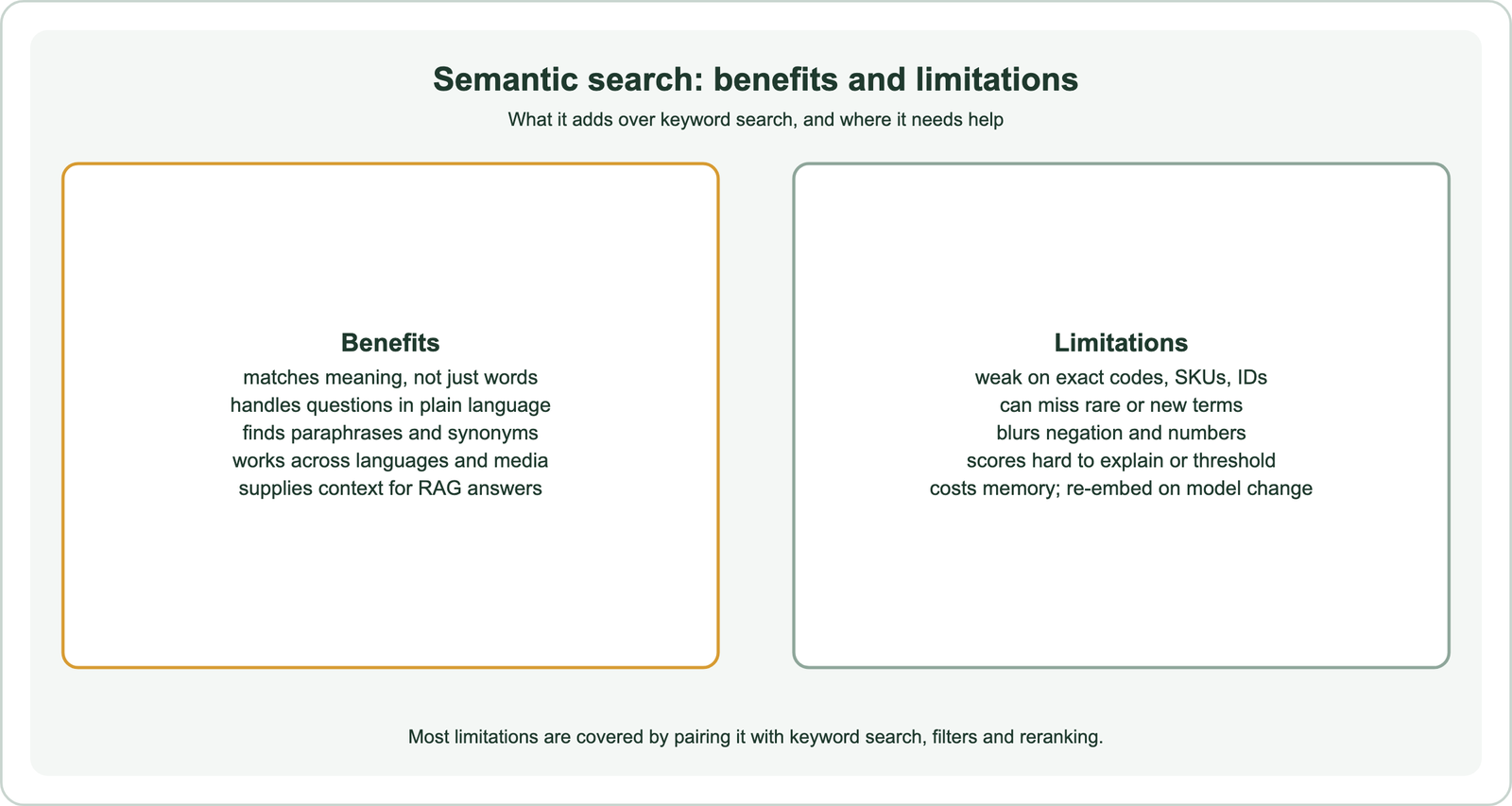
Semantic search turns queries and documents into embeddings, vectors that place similar meanings close together, as explained in what is semantic search and how semantic search works. Comparing vectors instead of words is what gives it its strengths. It is also the source of its weaknesses, because a single vector summarises a text and smooths over exact details.
Neither side is fixed. Model choice, chunking, hybrid search and reranking shift the balance. The useful question is not whether semantic search is better than keyword search in general, but which parts of your search traffic it improves and which it harms.
Why is semantic relevance important to search results?
Semantic relevance is important to search results because people rarely use the same words as the documents that answer them, and a search that matches only words misses those answers. This is the vocabulary mismatch problem.
A visitor typing “laptop won’t turn on” needs the page titled “Troubleshooting power issues”. Keyword search finds it only if the words overlap or someone wrote a synonym rule. Semantic search finds it because the two are close in meaning. Information retrieval research has long documented this mismatch, covered in the vocabulary mismatch problem, and semantic search is the most direct fix.
Relevance by meaning also matters for AI answers. A language model in a RAG system can only use the passages retrieved for it, so missing the right passage leads straight to a poor answer. Semantic search vs RAG explains that dependency.
What are the benefits of vector search?
The benefits of vector search are meaning-based matching, robustness to wording, support for any content that can be embedded, cross-language retrieval and fast nearest-neighbour lookup at scale. It turns similarity into geometry.
Because queries and documents become vectors, anything an embedding model can handle becomes searchable the same way: text, images, audio, code, even products described by several fields. Multilingual models put many languages in one space, so a query in one language finds documents in another, as covered in multilingual and cross-lingual semantic search. Recommendations come almost for free, by finding items near ones a user liked.
Vector search is also fast. Approximate nearest neighbour indexes such as HNSW answer queries over millions of vectors in milliseconds; Weaviate’s published ANN benchmark reports mean latencies of a few milliseconds on collections of 1 to 10 million vectors. Semantic search vs vector search separates the experience from the mechanism.
Where does semantic search fall short?
Semantic search falls short on exact identifiers, rare and new terms, small decisive details such as negation and numbers, and situations that need a clear explanation of why a result matched. It also brings operational costs.
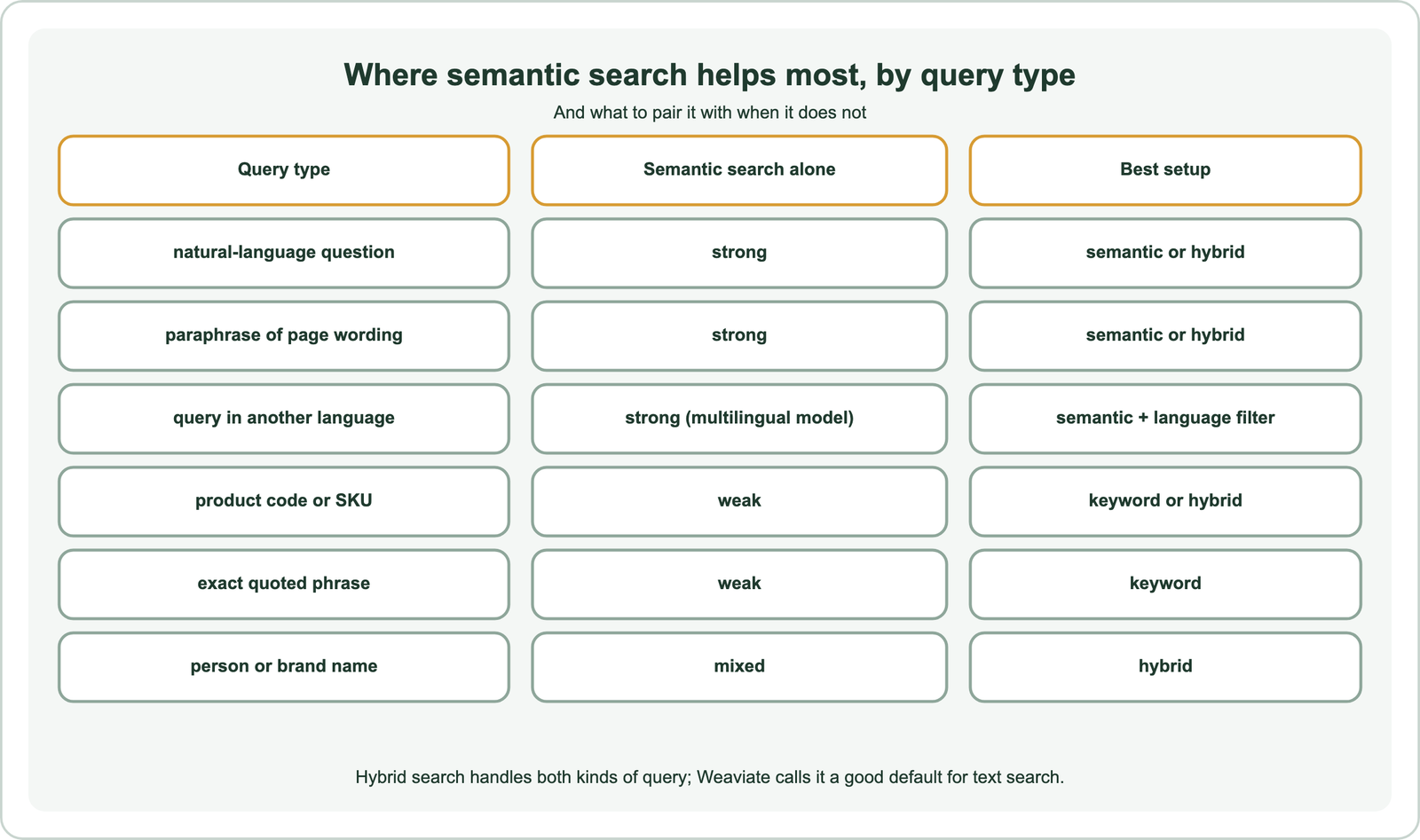
A product code such as “XK-2000” means nothing semantically, and an embedding may place it close to “XK-200” or other codes. Exact quoted phrases and legal clauses need literal matching. Names the model has never seen may be split into fragments and matched loosely. “With sugar” and “without sugar” share almost every word and can land close together. Research on the BEIR benchmark also found that BM25 stays a strong baseline outside the domains dense models were trained on.
Operationally, vectors take memory, and an index must be rebuilt when the embedding model changes, as described in re-embedding when the model changes. Scores differ by model and query, so fixed thresholds misbehave. Results are harder to explain than keyword matches, where the matched words can be highlighted.
How do you get the benefits without the limitations?
You get the benefits without most limitations by combining semantic search with keyword search in hybrid search, structured filters for exact facts, and a reranker for precision at the top. Each fix targets a specific weakness.
Hybrid search runs BM25 and vector search together and fuses the results, so exact codes and names still match while paraphrases are handled by vectors. It is covered in what is hybrid search. Store dates, prices, versions and categories as properties and filter on them, as described in metadata filtering. A cross-encoder reranker reads query and candidates together and handles negation and word order better, covered in what is reranking.
On the query side, rewriting and expansion help vague or very short queries, as covered in query understanding. For explanation, show the matching passage as a snippet so users can see why a result appeared. Keyword search basics are in what is keyword search.
How does semantic search affect explainability and trust?
Semantic search affects explainability because a result can match without sharing any words with the query, which surprises users and makes errors harder to diagnose. Good presentation and logging restore trust.
With keyword search, a user can see the matched words highlighted and understand why a page appeared. With semantic search, the reason is closeness in a vector space, which nobody can read directly. When a result is right, that feels like magic; when it is wrong, it feels arbitrary. Showing the passage that matched, rather than only the page title, lets users judge relevance for themselves.
For teams, explainability means being able to trace a bad result. Log the query, the scores of each retrieval leg in hybrid search, and the passage that matched. Weaviate can return a score explanation for hybrid queries, which shows how keyword and vector parts contributed. Regulated domains may also need to document how results are produced, which favours setups that combine explainable keyword matching with semantic recall.
When is semantic search worth adopting?
Semantic search is worth adopting when users search in natural language, when content uses different vocabulary from its readers, when results feed an AI assistant, or when search spans languages or media. It is less useful for pure code and ID lookups.
Help centres, documentation, research archives, content sites and RAG assistants gain the most, because their users ask questions and their documents rarely repeat the question’s wording. Product catalogues gain on descriptive queries but must keep exact matching for codes and brands. Systems used mainly to look up records by ID need little semantic search at all. Semantic search use cases surveys where it fits.
Measure before and after. Build a set of real queries with judged results. Compare keyword, semantic and hybrid setups with the methods in how to evaluate semantic search and information retrieval metrics, and look at which query types each wins. The numbers decide where semantic search belongs in your system.
What does semantic search cost to run?
Semantic search costs embedding computation for every document and query, memory for vectors and indexes, and maintenance when models change. These costs scale with collection size and traffic.
Every document must be embedded at import, and every query at search time, either with a hosted API or a local model. Vectors and their index usually live in memory for speed, so a large collection needs substantial RAM, which compression reduces. Changing models means re-embedding everything. Scaling semantic search and semantic caching cover ways to keep costs in check.
Against these costs, weigh the gain in successful searches and better AI answers. For many text-heavy products the gain is clear, but it is worth confirming with a pilot. How to build semantic search and semantic search tools compared help plan one. Model and retrieval choices are explained in what are embeddings and retrieval models explained.
Semantic search finds content by meaning, which solves vocabulary mismatch, handles natural-language and cross-language queries, and gives AI assistants better context. It is weaker on exact codes, rare terms, negation and numbers, its scores are hard to threshold, and it costs memory and re-embedding. Pair it with keyword search in hybrid search, filters for exact facts and a reranker for precision. Measure on your own queries to see which query types it improves, and use it where users describe what they need in their own words.