Home / Comparisons / Semantic Search vs Similarity Search
ComparisonSemantic Search vs Similarity Search
Similarity search finds the items closest to a query under some measure of likeness. Semantic search is similarity search where the representation captures meaning, so items close in meaning are returned even when their words differ. Similarity search is the broader idea. It covers near-duplicate detection with hashes, fuzzy name matching with edit distance, and visual or audio matching with embeddings. Semantic search narrows it to meaning, usually by comparing text embeddings with cosine similarity. In practice it also adds language-aware parts that are not pure similarity, such as keyword matching for exact terms, query rewriting, filters and reranking. So all semantic search relies on similarity search, but most similarity search is not semantic. The difference lies in what the vectors or features encode, not in the nearest-neighbour step itself.
Semantic search vs similarity search in four facts
- Similarity search returns the nearest items under a chosen representation and distance measure.
- Semantic search is similarity search over representations that encode meaning, usually text embeddings.
- The same vector index can serve both; the embedding model decides whether the matches are semantic.
- Production semantic search also uses keyword matching, filters and reranking, which go beyond similarity.
What is the difference between semantic search and similarity search?
The difference between semantic search and similarity search is scope: similarity search is any nearest-match lookup, while semantic search is the subset that matches by meaning. One is a technique, the other an application of it.
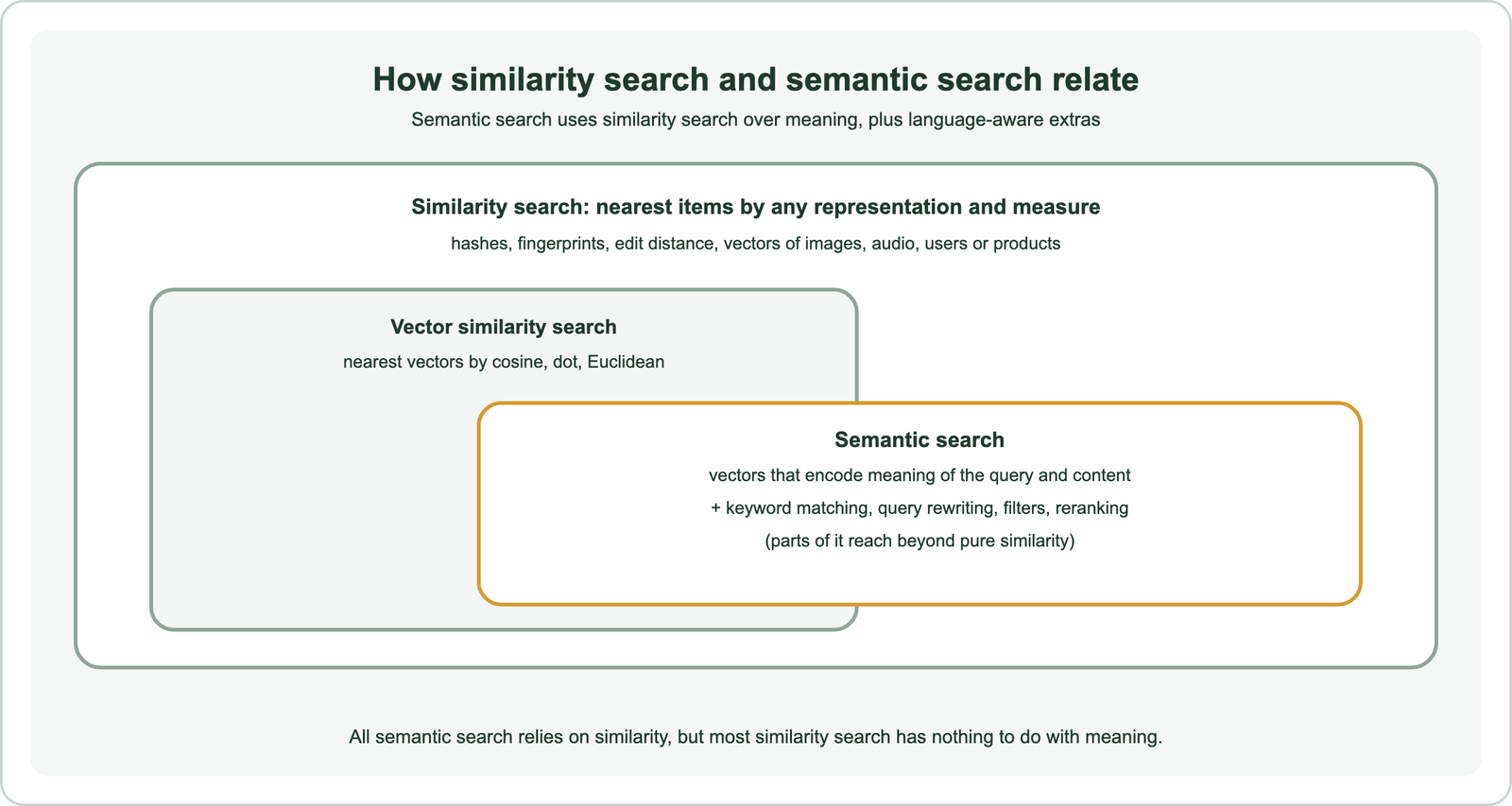
Similarity search asks a general question: which stored items are closest to this one? The answer depends entirely on how items are represented and how distance is measured. Two web pages can be close because they share most of their text, two photos because their pixels look alike, two names because they differ by one letter. None of that needs meaning.
Semantic search asks a narrower question: which items mean what the query means? It answers by representing text with embeddings trained so that meaning, not spelling or surface overlap, decides closeness. Similarity search covers the general technique, and what is semantic search covers the application.
Which tasks are similarity search?
Similarity search tasks include any search that returns the nearest items to a query under a defined measure, whether the items are text, images, audio, users or records. Many of these uses have nothing to do with meaning.
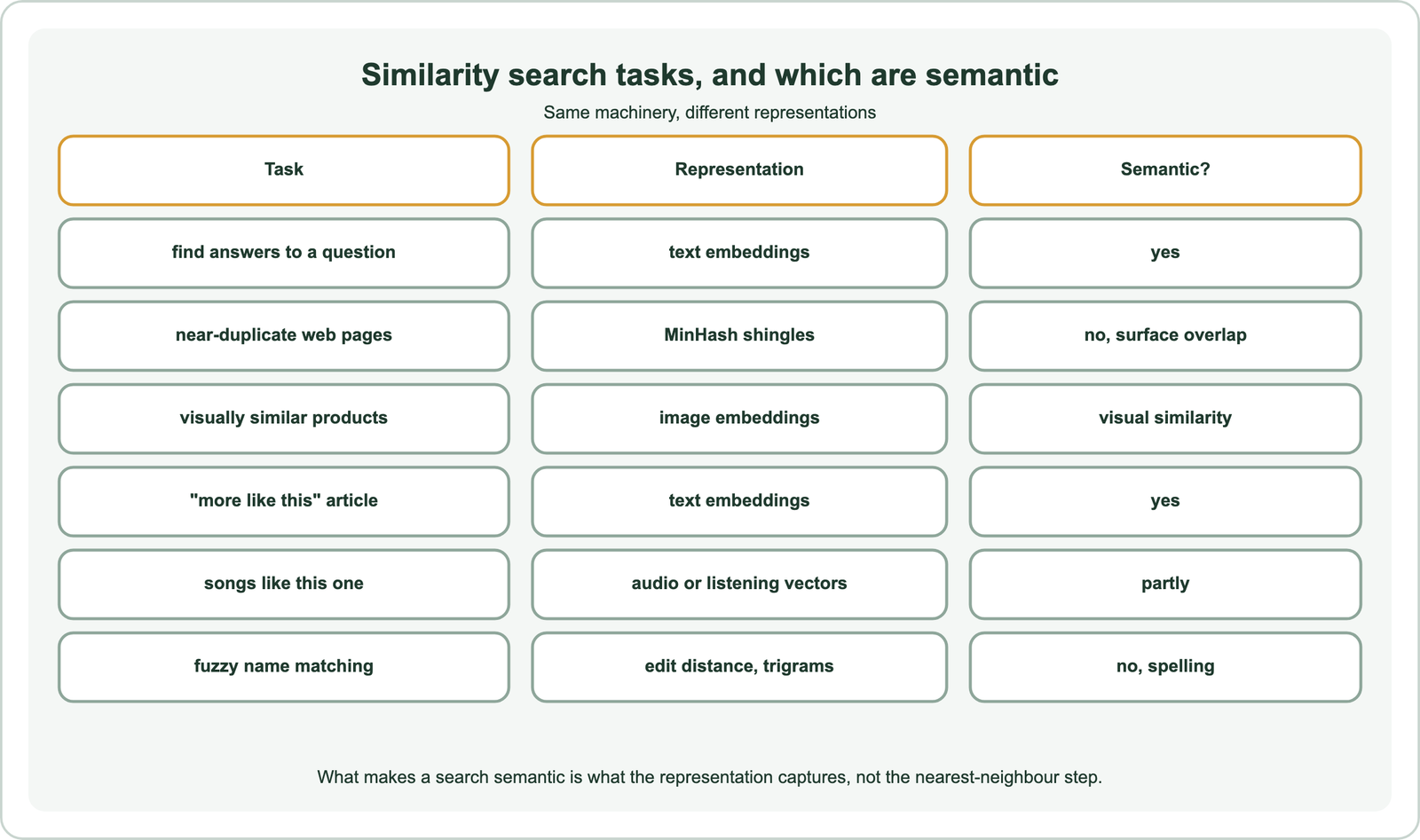
Near-duplicate detection compares sets of overlapping word sequences, often with MinHash, a technique Broder described in 1997 for estimating resemblance between documents. It finds copies and light edits, not paraphrases. Fuzzy matching of names and addresses uses edit distance or character trigrams to catch typos. Image search by visual likeness compares image embeddings that capture shapes and colours. Recommendation systems compare user and item vectors learned from behaviour.
All of these use the same pattern: represent items, measure distance, return the nearest. Many use the same index structures as semantic search, such as HNSW graphs or locality-sensitive hashing. Approximate nearest neighbor search covers the shared machinery.
When is a search semantic?
A search is semantic when its representations place texts with the same meaning close together, regardless of wording, and when it interprets queries by intent rather than literal terms. The embedding model provides most of that.
Sentence embedding models are trained on pairs of texts that mean the same thing or answer each other, so “how do I get my money back” lands near “refund policy”. A MinHash representation of the same two texts would place them far apart, because they share no word sequences. Both searches would run nearest-neighbour lookups; only one is semantic. Semantic matching explains how meaning is compared.
Semantic search systems also add steps that are not similarity at all. Keyword matching finds exact codes and names. Query rewriting turns vague questions into better searches. Filters enforce hard constraints. Rerankers read the query and each candidate together. Those layers are why semantic search is a product category, not just a distance function, as shown in semantic search vs vector search.
Can the same database do both?
The same vector database can do both, because it stores vectors and finds nearest neighbours without knowing what the vectors mean. The embedding model you choose decides the kind of similarity.
Weaviate stores any vectors you give it and searches them with the distance metric configured on the collection. Text embeddings make that semantic search; image embeddings make it visual search; behaviour vectors make it recommendation. A near_object query, which searches with an existing object’s vector, gives “more like this” results in any of these spaces. Named vectors let one collection hold several kinds of vector side by side, as covered in multi-vector search.
What changes between uses is everything around the index: the model, the distance metric, the evaluation, and whether keyword search and filters are needed. Treat “similarity” as a mechanism and “semantic” as a goal, and choose the representation that serves the goal.
Evaluation follows the same split. A semantic search test set pairs real questions with the passages that answer them, while a duplicate-detection test pairs documents with their known copies. Measuring one with the other’s test set produces misleading numbers. Keep a separate judged set for each similarity task the system performs, and track each with the metric that fits it, such as recall for retrieval or precision for deduplication.
Which similarity measures do semantic search systems use?
Semantic search systems usually use cosine similarity, dot product or Euclidean distance on text embeddings, choosing the one the embedding model was trained with. Other similarity tasks use other measures.
For normalised embeddings, cosine similarity, dot product and Euclidean distance give the same ranking, so the choice mostly follows the model’s documentation. Weaviate defaults to cosine distance, defined as 1 minus cosine similarity. Non-semantic tasks use measures suited to their data: Jaccard similarity for sets of shingles, Hamming distance for binary codes, edit distance for strings. Cosine vs dot product vs Euclidean distance compares the vector measures.
Scores from different measures and models are not comparable. A cosine similarity of 0.8 from one model says nothing about a Jaccard score of 0.8 from MinHash. Keep each kind of similarity in its own field or collection, and evaluate each with its own judged examples.
When do you need semantic search rather than plain similarity search?
You need semantic search when people search by describing what they want in their own words; plain similarity search is enough when you need copies, near-duplicates, spelling matches or look-alike items. Many systems use both.
A help centre, document archive or RAG assistant needs semantic search, because questions rarely repeat the documents’ wording. Deduplicating a crawl, matching customer records, or finding visually similar products needs other similarity methods. A content platform might use MinHash to remove duplicate articles, semantic search to answer reader questions, and item vectors to recommend related reading.
Exact-term needs remain in either case. Codes, names and quoted phrases are handled best by keyword search, compared in semantic search vs keyword search and BM25 vs vector search. Questions phrased as sentences are covered in natural language search.
How can semantic and other similarity methods work together?
Semantic and other similarity methods can work together in one pipeline, each handling the job it does best: deduplication, spelling correction, retrieval by meaning and visual matching. They complement rather than replace each other.
Before indexing, near-duplicate detection removes copies so that search results and RAG context are not filled with the same passage several times. At query time, fuzzy matching against a list of product or person names can correct a misspelled query before semantic search runs. After retrieval, a similarity check between the top results can drop near-identical passages, so the language model sees varied evidence. Image or audio similarity can run beside text search when items have pictures or recordings.
Each step needs its own threshold and its own test. A deduplication threshold that is too loose merges distinct documents; one that is too strict leaves copies. Tune each on examples from your data, and keep the steps separate in code so their effects can be measured one at a time. Semantic search vs vector search covers the retrieval side in more detail.
How does semantic vs similarity search relate to other search comparisons?
Semantic vs similarity search sits beside other comparisons that separate the goal of a search from its mechanism: semantic vs vector search, semantic search vs RAG, and search engines vs vector databases. Each clarifies a different boundary.
Semantic search vs RAG separates retrieval from answer generation. Search engine vs vector database and pgvector vs dedicated vector database cover where similarity search runs. Semantic search vs knowledge graph search contrasts learned similarity with explicit relationships, and semantic search vs the semantic web covers an older meaning of “semantic”.
The common thread is precise vocabulary. Teams that say “similarity search” when they mean “semantic search” may pick the wrong model or skip keyword matching. Naming the goal first makes the technical choices clearer.
Similarity search returns the nearest items under any representation and measure, from MinHash and edit distance to image and behaviour vectors. Semantic search is the part of similarity search that matches by meaning, usually by comparing text embeddings with cosine similarity, plus keyword matching, filters and reranking. The same vector database can serve both, because the embedding model decides what closeness means. Use semantic search when people describe what they want in their own words, and other similarity methods for duplicates, spelling matches or look-alike items.