Home / How it works / How Semantic Search Handles Synonyms and Related Terms
ExplainerHow Semantic Search Handles Synonyms and Related Terms
Semantic search handles synonyms by comparing embeddings, which place words and phrases that appear in similar contexts close together, so “couch” finds “sofa” without anyone writing a synonym list. Embedding models learn this closeness from large amounts of text, following the distributional idea that words used in the same contexts tend to mean similar things. The same mechanism also matches paraphrases, broader terms and related concepts. The weakness is that context similarity is not meaning equivalence. Related but different terms, such as “laptop” and “laptop charger”, and even antonyms, such as “increase” and “decrease”, can sit close together. Ambiguous words depend on surrounding context. Keyword search with explicit synonym lists handles exact equivalence and identifiers more precisely. Hybrid search combines the two, and rerankers or filters separate related terms that embeddings blur.
Synonyms in semantic search in four facts
- Embeddings match synonyms because synonyms appear in similar contexts during training.
- Keyword search matches synonyms only through hand-maintained lists or query expansion.
- Antonyms and related-but-different terms can also sit close in embedding space.
- Hybrid search, filters and rerankers correct most of the cases embeddings blur.
How does semantic search handle synonyms?
Semantic search handles synonyms by encoding the query and the documents as embeddings and ranking documents by vector similarity, so texts with the same meaning in different words score as close. No list of equivalent words is needed.
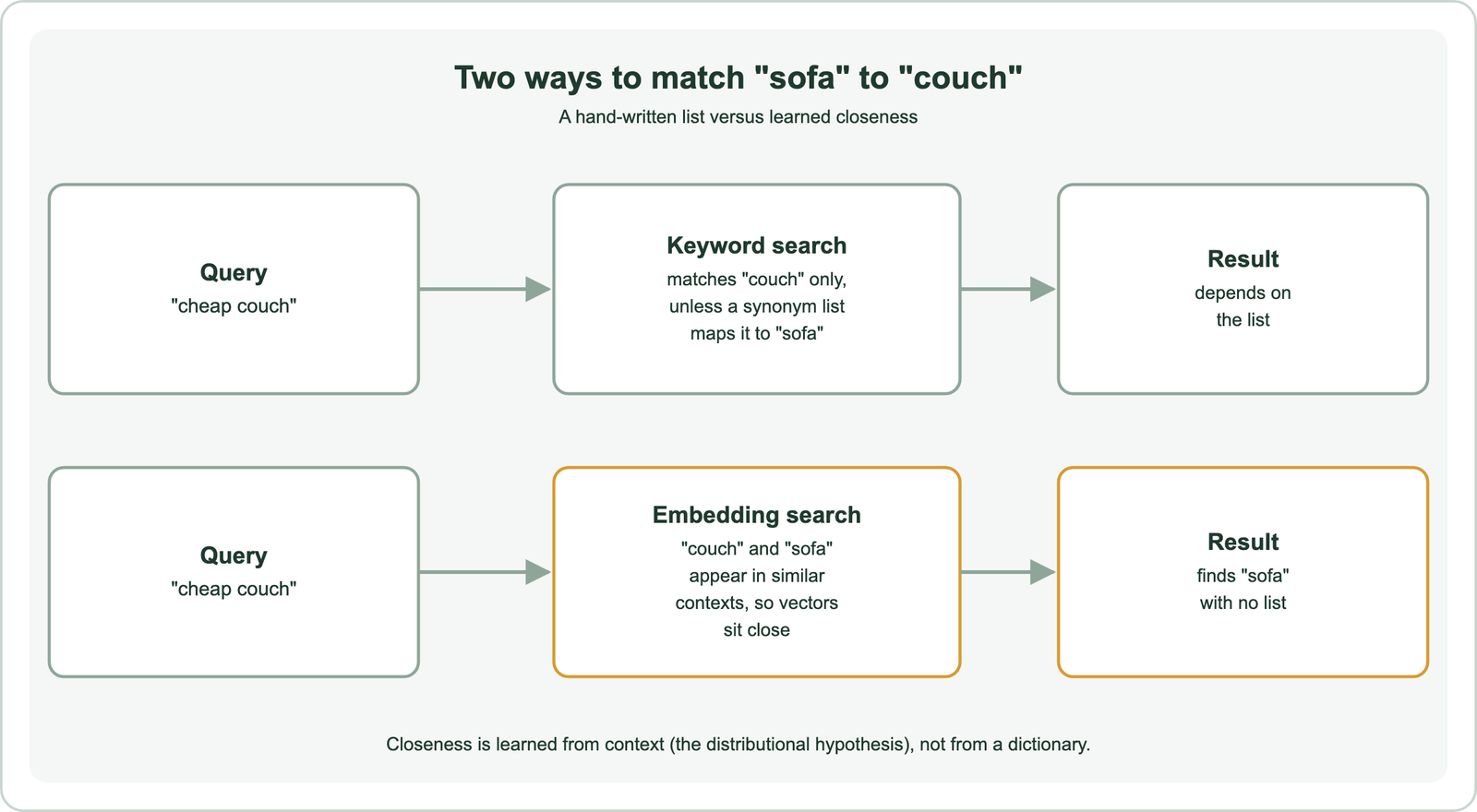
A keyword engine looks up the exact terms of the query in an inverted index. A document about a “sofa” contains no “couch” token, so it is invisible to the query “cheap couch”. An embedding model turns both texts into vectors. Because “couch” and “sofa” occur in nearly identical sentences in its training data, their vectors, and the vectors of texts containing them, end up close.
The effect works at every level: single words, phrases and whole sentences. “Can’t sign in” sits near “login fails”, and “cheap flights” near “budget airfare”. The mechanism is described more fully in how semantic search works and semantic matching.
Why do embeddings place synonyms close together?
Embeddings place synonyms close together because they are trained to predict or reconstruct text from context, and synonyms share contexts. This is the distributional hypothesis put into practice.
Linguists Zellig Harris in 1954 and J. R. Firth in 1957 described the idea that words occurring in similar contexts have similar meanings; Firth’s line “You shall know a word by the company it keeps” is often quoted. Word2vec and GloVe learned word vectors from co-occurrence, which made synonyms neighbours, as covered in word2vec and GloVe.
Modern sentence embedding models go further. They are fine-tuned on pairs of texts that mean the same thing, such as paraphrases and questions with their answers, and pushed apart from unrelated texts. That training directly rewards placing equivalent wordings close together. The geometry is explained in dense vectors.
The result depends on the training data. A model that rarely saw your field’s vocabulary has no contexts from which to learn that two of its terms are equivalent. Internal product names, abbreviations and new coinages are common blind spots. That is why synonym handling should be tested on your own vocabulary rather than assumed from general benchmarks.
How does keyword search handle synonyms?
Keyword search handles synonyms through explicit mechanisms: synonym lists applied in the text analyzer, query expansion with a thesaurus, or stemming that merges word forms. Each must be built and maintained by hand or by rules.
Search engines commonly let administrators define synonym sets, such as “couch, sofa, settee”, applied at index or query time. Query expansion adds related terms from a thesaurus such as WordNet, a lexical database from Princeton led by George Miller. Stemming reduces “running” and “runs” to “run”, but only handles word forms, not different words.
These methods are precise and predictable, which matters for brand names and regulated terms. They also miss whatever the list does not cover, and lists drift as products and language change. Domain-specific synonyms, internal jargon and new slang are typical gaps. The broader comparison is in semantic search vs keyword search.
Where do embeddings confuse related but different terms?
Embeddings confuse related but different terms when the terms share contexts but not meaning, for example accessories and products, parts and wholes, or competing options in the same category. Closeness in the vector space signals relatedness, not equivalence.
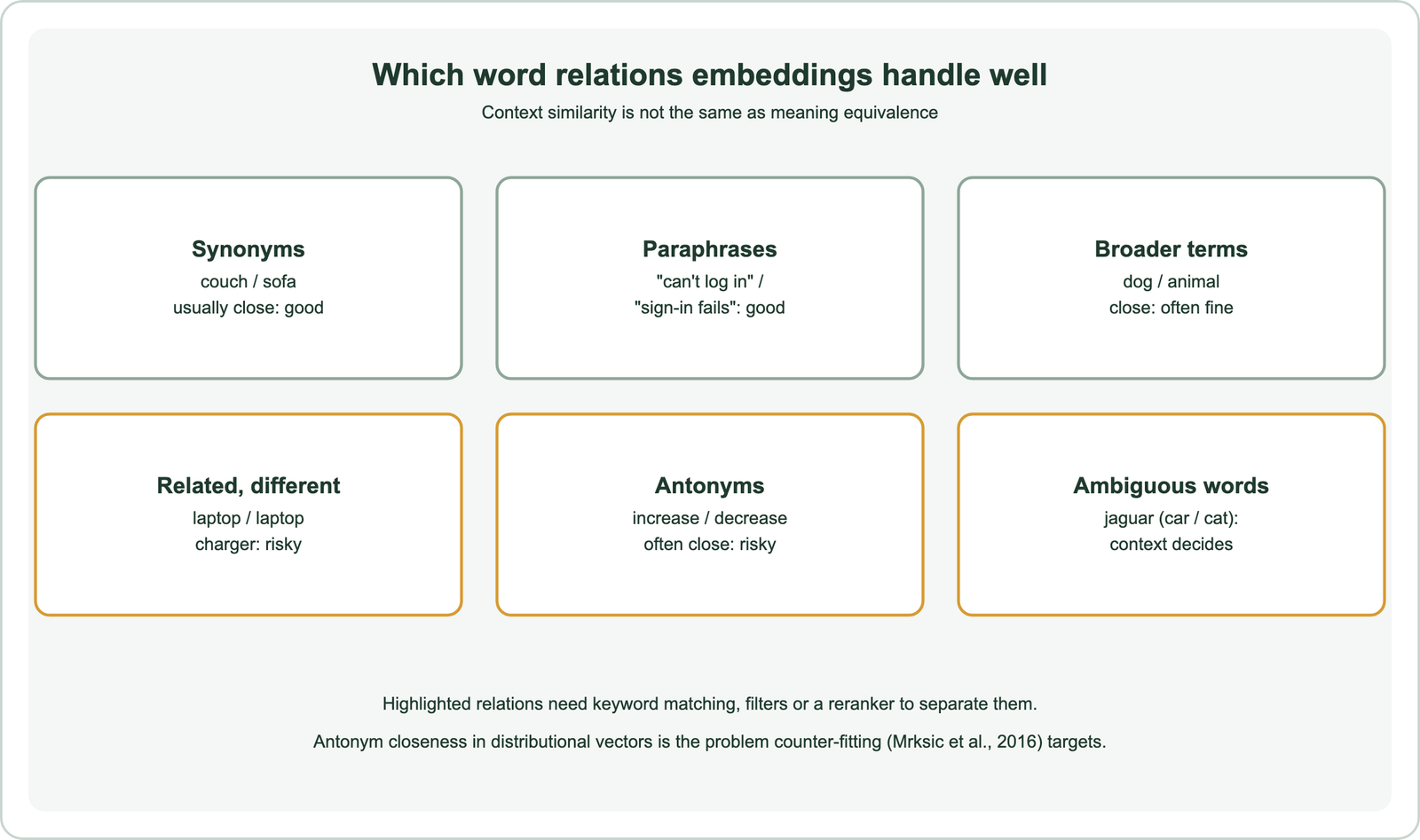
A shopper searching for “laptop” may see laptop chargers and sleeves rank alongside laptops, because those texts talk about the same things. A query for “Python” may surface results about Java, since programming languages appear in similar sentences. In each case the result is related, but not what was asked.
The distinction between similarity and relatedness is a long-standing topic in semantics, covered in semantic similarity vs relatedness. Product search is especially exposed, which is why semantic product search for ecommerce relies on category filters and attributes alongside embeddings.
Why can antonyms appear close in embedding space?
Antonyms can appear close in embedding space because they occur in nearly the same contexts: “the price will increase” and “the price will decrease” differ by one word. Distributional learning sees two words that fit the same slots.
This was a well-known issue for word vectors. Mrkšić and colleagues proposed counter-fitting in 2016, a post-processing step that pushes antonyms apart and pulls synonyms together using lexical resources. Sentence embedding models trained on natural language inference data, where contradiction pairs are pushed apart, reduce the problem but do not remove it.
In search, the practical risk is opposite meanings in otherwise similar sentences: “allowed” versus “not allowed”, “includes” versus “excludes”. Negation is a related weakness. A cross-encoder reranker, which reads query and document together, handles these cases better, as covered in cross-encoders. For policy and legal content, test such pairs explicitly.
How do embeddings handle words with several meanings?
Contextual embeddings handle words with several meanings by encoding each occurrence with its surrounding words, so “jaguar” in a car review and in a wildlife article get different vectors. Short queries give the model little context to work with.
Older static word vectors gave each word one vector, which mixed all its senses. Transformer models such as BERT produce a vector for each token in context, as described in transformers and BERT in search. A document clearly about cars places “jaguar” in the car region.
A one-word query such as “jaguar” remains ambiguous, and results may mix senses. Interfaces can help with facets or clarifying suggestions. Logged behaviour also helps: if most users who search a term click car results, a reranker or boost can learn that preference.
How can you improve synonym handling in semantic search?
Improve synonym handling by combining embeddings with keyword search, adding domain synonyms where needed, filtering by structured attributes and reranking the shortlist. Each fixes a different weakness.
Hybrid search runs BM25 and vector search together and fuses their scores, so exact terms and meaning both count. In Weaviate this is one hybrid query with an alpha weight, explained in hybrid search. Filters on category, type or product line stop related-but-different items from crowding results. A reranker reads the query and each candidate together and catches negation and antonyms.
For domains with heavy jargon, consider a domain-trained or fine-tuned embedding model, trained on pairs that encode your own notion of equivalence. Test with a set of synonym, related-term and antonym query pairs from your domain, and check that true synonyms match while near misses rank lower. The options are in domain-specific embeddings.
Do embeddings handle synonyms across languages?
Multilingual embedding models handle synonyms across languages by placing translations close together, so “sofa” in English can match “canapé” in French. The same strengths and weaknesses apply across languages.
Multilingual models are trained on parallel and translated text so that equivalent sentences in different languages share a region of the space. Cross-lingual retrieval works the same way as monolingual synonym matching, with the language as one more surface difference. Details are in multilingual and cross-lingual semantic search.
Language-specific keyword search needs its own synonym lists and analyzers per language, which multiplies maintenance. Embeddings reduce that work, though quality varies by language. Check results in each language you serve rather than assuming parity.
Where does synonym matching fit in the search pipeline?
Synonym matching happens mainly in first-stage retrieval, where embeddings or expanded keyword queries decide which candidates enter the shortlist. Later stages refine the order but cannot recover documents the first stage missed.
The first stage retrieves the top k candidates by vector similarity, often through an approximate index, as covered in top-k retrieval and approximate nearest neighbour search. The similarity measure itself is compared in cosine vs dot product vs Euclidean distance, and the scores in relevance scores.
Sparse methods can also learn expansion: models such as SPLADE add weighted related terms to documents, covered in sparse vectors and dense vs sparse vectors. Chunk size affects how much context each vector carries, as explained in chunking for semantic search. The surrounding system is laid out in semantic search architecture, semantic indexing and vector indexes, vector search, similarity search and exact vs approximate search.
Semantic search handles synonyms by placing texts with the same meaning close together in embedding space, learned from shared contexts rather than from a hand-written list. That also matches paraphrases, translations and broader terms. The same mechanism can blur related but different terms and even antonyms, because they share contexts too, and short ambiguous queries mix senses. Combine embeddings with keyword search in a hybrid query, filter by structured attributes, and rerank with a cross-encoder to separate close but wrong results. Test with real synonym, related-term and antonym pairs from your own domain.