Home / Tools / Best Open-Source Semantic Search Engines
ComparisonBest Open-Source Semantic Search Engines
Open-source semantic search engines are self-hostable systems that index embeddings and rank results by meaning, usually alongside keyword search, under a licence that lets you run and inspect the code. They come in three families. Vector databases, such as Weaviate, Qdrant, Milvus and Chroma, are built around vector search and add hybrid search, filters and multi-tenancy. Search engines, such as OpenSearch, Vespa, Meilisearch and Typesense, started with text search and added vectors. Database extensions, chiefly pgvector for PostgreSQL, put vectors inside an existing relational database. The right choice depends on whether the workload is mainly AI retrieval, mainly text search, or mainly relational data with some similarity search, and on the operational work you can take on. Licences differ, so check the terms before building a product on one.
Open-source semantic search engines in four facts
- Weaviate is released under the BSD 3-Clause licence and runs vector, BM25 and hybrid search in one query.
- OpenSearch began in 2021 as an Apache 2.0 fork of Elasticsearch 7.10.2.
- pgvector adds vector types, distance operators and HNSW and IVFFlat indexes to PostgreSQL.
- Most open-source engines also offer a managed cloud service run by the project’s company.
What is an open-source semantic search engine?
An open-source semantic search engine is software you can download, run and modify that stores embedding vectors and returns results ranked by similarity of meaning. Most also run keyword search, so they can combine both.
The engine handles indexing, approximate nearest neighbour search, filters and scaling. You supply the embeddings, either computed in your application or created by the engine through a model integration. Open source matters here for three reasons: data can stay on your own infrastructure, there is no per-query licence fee, and you can inspect how ranking works. The trade-off is that you operate it, unless you use the vendor’s managed service.
The engines differ less in core vector search, which most implement with HNSW graphs, than in what surrounds it. Hybrid search, filtering design, multi-tenancy, model integrations and operations vary widely. Semantic search tools compared covers the wider tool landscape, including hosted APIs. The three families explain most of the differences.
What types of open-source semantic search engines are there?
The types of open-source semantic search engines are vector databases, search engines with vector support, and vector extensions for general databases. Each starts from a different core and adds the rest.
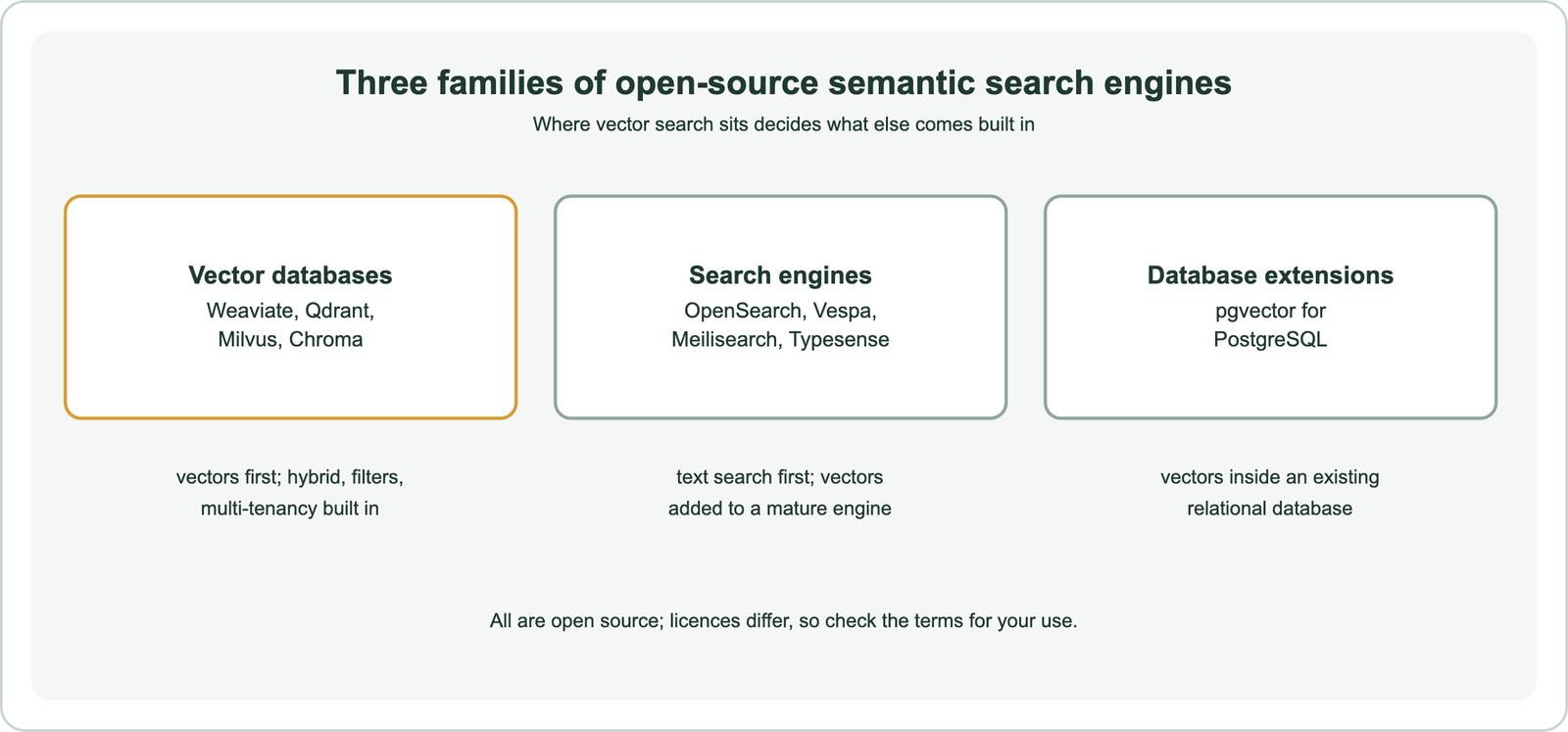
Vector databases treat embeddings as the primary data. They offer vector indexes with compression, filtered vector search, and increasingly keyword and hybrid search, plus integrations that embed text automatically. Search engines started as full-text systems with analyzers, aggregations and relevance tuning, and added vector fields and kNN queries; they suit teams whose main workload is still text search. Database extensions add vector types and indexes to a database you already run, trading search features for having one system.
The families overlap more each year, as vector databases add keyword search and search engines add vector features. The defaults and depth of each feature still reflect where the engine started. A closer look at each engine follows.
How do the main open-source semantic search engines compare?
The main open-source semantic search engines compare on licence, implementation language and how they combine keyword and vector results. The table summarises each, with Weaviate first, as of October 2026.
| Engine | Family | Licence | Written in | Keyword and vector together |
|---|---|---|---|---|
| Weaviate | Vector database | BSD 3-Clause | Go | Built-in hybrid: BM25F plus vectors, relative score or ranked fusion |
| Qdrant | Vector database | Apache 2.0 | Rust | Sparse plus dense vectors, fused with RRF or DBSF |
| Milvus | Vector database | Apache 2.0 | Go and C++ | Sparse vectors with a built-in BM25 function, RRF or weighted ranker |
| Chroma | Vector database | Apache 2.0 | Python and Rust | Vector search with metadata and document filters |
| OpenSearch | Search engine | Apache 2.0 | Java | Hybrid query with score normalization in a search pipeline |
| Vespa | Search engine | Apache 2.0 | Java and C++ | Custom rank profiles combining text and vector scores |
| Meilisearch | Search engine | MIT (community edition) | Rust | Hybrid search with a semantic ratio |
| pgvector | Database extension | PostgreSQL licence | C | Written in SQL with Postgres full-text search |
The table shows that hybrid search is now common, but implemented differently. Weaviate fuses an inverted-index BM25F search with vector search in one call. Qdrant and Milvus represent keywords as sparse vectors. OpenSearch normalizes scores in a pipeline. pgvector leaves fusion to SQL. Databases that support hybrid search covers each method in detail.
Licences change over time and some projects offer several, so confirm the current licence for your version before relying on it. Language matters mainly for contributing and debugging, less for use. The vector databases come first.
Which open-source vector databases are best for semantic search?
Open-source vector databases that are best for semantic search include Weaviate, Qdrant, Milvus and Chroma, which differ mostly in hybrid search design, scaling model and how much they do for you. All four can be self-hosted or used as managed services.
Weaviate combines vector search, BM25F keyword search and hybrid fusion in one query. It adds model integrations that embed text at import and query time, reranker modules, native multi-tenancy with one shard per tenant, and vector quantization. Its filtered search uses an allow-list with the ACORN strategy by default since version 1.34. Semantic search with Weaviate walks through it.
Qdrant, written in Rust, emphasises filtering with payload indexes and stores sparse and dense vectors side by side. Milvus is designed for large distributed deployments, with storage and compute separated and many index types. Chroma focuses on a simple Python developer experience and is common in prototypes and notebooks. Each has a tutorial: Qdrant, Milvus and Chroma. Search engines take a different path.
Which open-source search engines support semantic search?
Open-source search engines that support semantic search include OpenSearch, Vespa, Meilisearch and Typesense, each adding vector fields and kNN search to an established text engine. They suit workloads where text search remains central.
OpenSearch, the Apache 2.0 fork of Elasticsearch, offers a k-NN plugin, neural search that can call embedding models, and hybrid queries with normalization processors. Vespa, open-sourced by Yahoo, is built for large-scale serving with rich rank expressions that combine text, vector and business signals. Its flexibility comes with a steeper learning curve. Semantic search with OpenSearch covers the first.
Meilisearch and Typesense target site and app search, with fast typo-tolerant keyword search and hybrid modes that blend in vectors. They are quick to set up and suit product catalogues and documentation, as compared in semantic site search tools. Elasticsearch itself has offered an AGPL option alongside its other licences since 2024, which brings it back into some open-source evaluations. The third family needs no new engine at all.
When is a database extension like pgvector enough?
A database extension like pgvector is enough when the data already lives in PostgreSQL, the collection fits comfortably on one instance, and transactions with relational data matter more than specialised search features. It avoids running a second system.
pgvector adds vector types, distance operators and HNSW and IVFFlat indexes to Postgres. Filters are WHERE clauses, and hybrid search is a SQL query that fuses vector results with Postgres full-text search. Its README notes that filters on approximate indexes apply after the scan unless iterative scans, added in version 0.8.0, are enabled. Semantic search with Postgres and pgvector covers the setup.
The limits appear with scale and search features: large collections, heavy filtering, many tenants or a need for BM25 hybrid search and model integrations built in. pgvector vs a dedicated vector database walks through the decision. With the options laid out, the choice follows from the workload.
What does running an open-source semantic search engine involve?
Running an open-source semantic search engine involves deployment, capacity planning, backups, upgrades, monitoring and access control, all of which a managed service would otherwise handle. The software is free; the operations are not.
Deployment usually starts with Docker for development and moves to Kubernetes for production. Weaviate, for example, publishes a Helm chart and Docker images, and its model and reranker integrations can run as extra containers. Capacity planning centres on memory, since HNSW indexes keep vectors in RAM; Weaviate’s resource planning rule of thumb is about twice the raw vector size, and the vector storage and memory calculator applies it. Sharding and replication then decide how the load spreads.
Day-two work is where costs hide. Backups need a destination and a tested restore. Upgrades need a plan for index format changes and rolling restarts, which replication makes possible without downtime. Monitoring needs metrics such as memory, query latency and import throughput, which Weaviate exposes for Prometheus. Access control needs authentication and roles; Weaviate’s role-based access control has been generally available since version 1.29. Teams without that capacity often start on a managed service and keep self-hosting as an option. The choice of engine follows from all of this.
How do you choose an open-source semantic search engine?
You choose an open-source semantic search engine by matching its family to your main workload, then testing your own queries, filters and data size on two or three candidates. Operational fit decides as often as features.
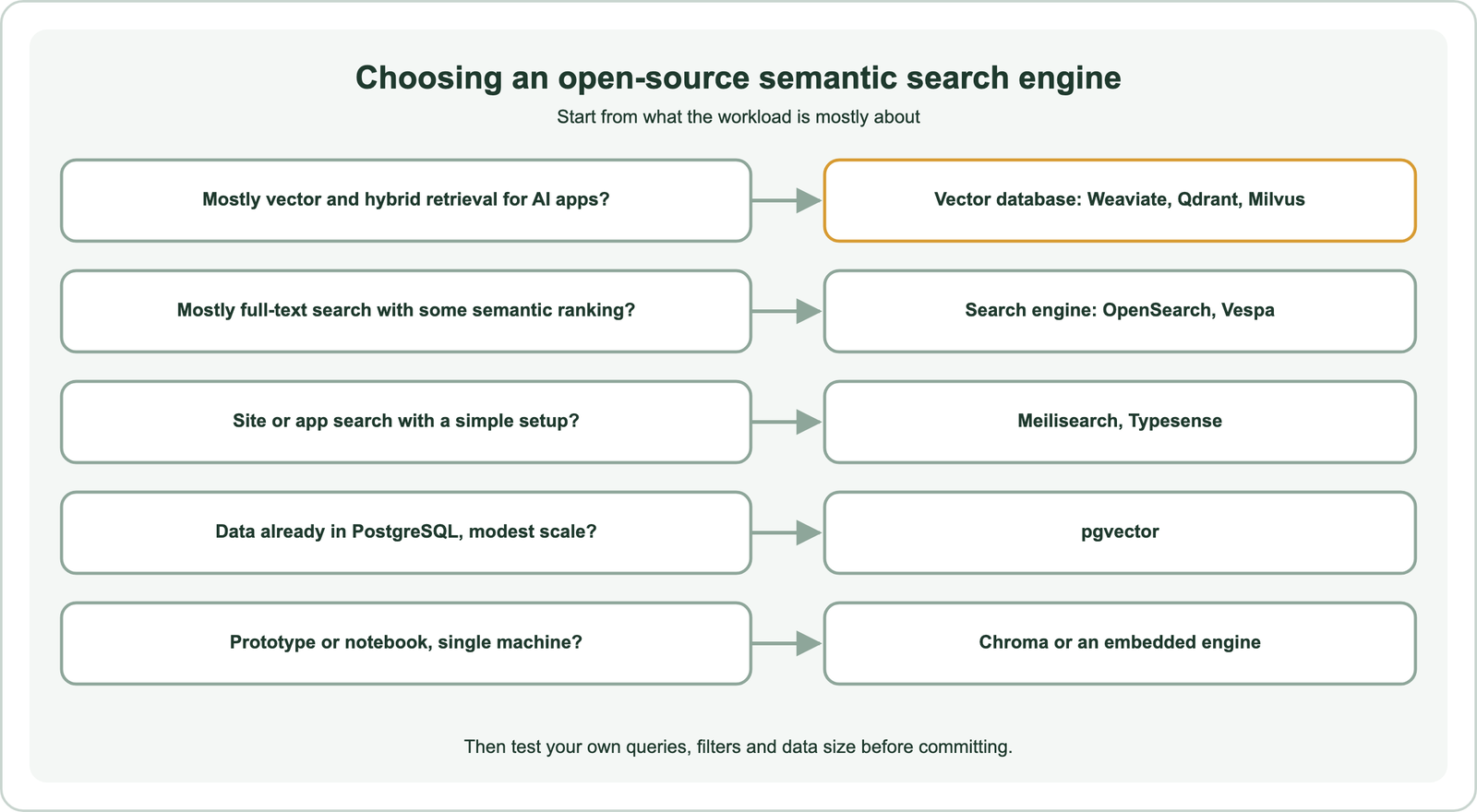
Beyond features, weigh operations. Ask how the engine scales: by shards and replicas, by separated storage and compute, or by a single instance. Ask what monitoring, backups and upgrades require, and whether your team already knows the stack. A managed service from the same project removes much of that work while keeping the option to self-host later. Enterprise semantic search platforms covers packaged products, and semantic search APIs covers fully hosted options.
Run a short evaluation before committing: load a representative sample, run real queries with their filters, and measure recall and latency at the settings you plan to use. Choosing a vector database for semantic search lists the questions to ask.
Open-source semantic search engines let you run meaning-based search on your own infrastructure, in three families. Vector databases such as Weaviate, Qdrant, Milvus and Chroma put vectors first and add hybrid search, filters and multi-tenancy. Search engines such as OpenSearch, Vespa, Meilisearch and Typesense add vectors to mature text search. pgvector puts vectors inside PostgreSQL. Match the family to your workload, check each licence, and test two or three candidates on your own queries, filters and data. Keep the managed service in mind if operations become the bottleneck.