Home / Comparisons / Semantic Search vs Knowledge Graph Search
ComparisonSemantic Search vs Knowledge Graph Search
Semantic search finds text whose meaning matches a query by comparing embeddings, while knowledge graph search finds entities and facts by following explicit, named relationships stored in a graph. Semantic search works on unstructured content such as documents, help articles and product descriptions. It handles fuzzy wording well and returns ranked passages that a person or language model must read. Knowledge graph search works on structured data: typed entities connected by edges such as madeBy or reportsTo. It answers exact relationship questions, returns complete lists of connected things and can explain every result by the path that produced it. Its weakness is coverage, since it only knows the facts someone stored. Semantic search’s weakness is precision on exact relationships and multi-step questions. Most production systems combine them. Vector search, for example in Weaviate, finds the entities a question is about, and a graph lookup or reference filter then follows their relationships.
Semantic search vs knowledge graph search in four facts
- Semantic search matches meaning in unstructured text; knowledge graph search follows stored relationships between entities.
- Semantic search returns ranked passages, while knowledge graph search returns entities, facts and complete lists.
- Weaviate cross-references do not affect vectors, so a vector search cannot filter on a referenced object’s text directly.
- Weaviate’s documentation suggests a two-stage query: vector search first, then a filter across the reference.
What is the difference between semantic search and knowledge graph search?
The difference between semantic search and knowledge graph search is the kind of knowledge each uses: semantic search uses meaning encoded in text embeddings, and knowledge graph search uses relationships stated as edges between entities. One is implicit and fuzzy, the other explicit and exact.
Semantic search turns a query into a vector and finds stored content with nearby vectors. It does not know what any word refers to. It knows that “get my money back” and “refund policy” mean similar things because an embedding model learned that from text. The method and its relatives are compared in semantic search vs vector search and semantic search vs similarity search.
Knowledge graph search starts from entities. A query is mapped to nodes in a graph, such as a brand or a person, and the search follows named edges to connected nodes. The answer is whatever the edges lead to. The graph does not need to understand paraphrase, but it needs the relationship to exist as data. The structure is introduced in knowledge graphs in search.
The two are often confused with older ideas. The semantic web was a project to publish linked, machine-readable data across the internet, closer to knowledge graphs than to embeddings, as explained in semantic search vs the semantic web. The clearest way to see the difference is one question taken both ways.
How do semantic search and knowledge graph search answer the same question?
Semantic search answers a question by retrieving passages close in meaning and hoping one states the answer, while knowledge graph search links the question to an entity and traverses edges to the answer. Each route has a different point of failure.
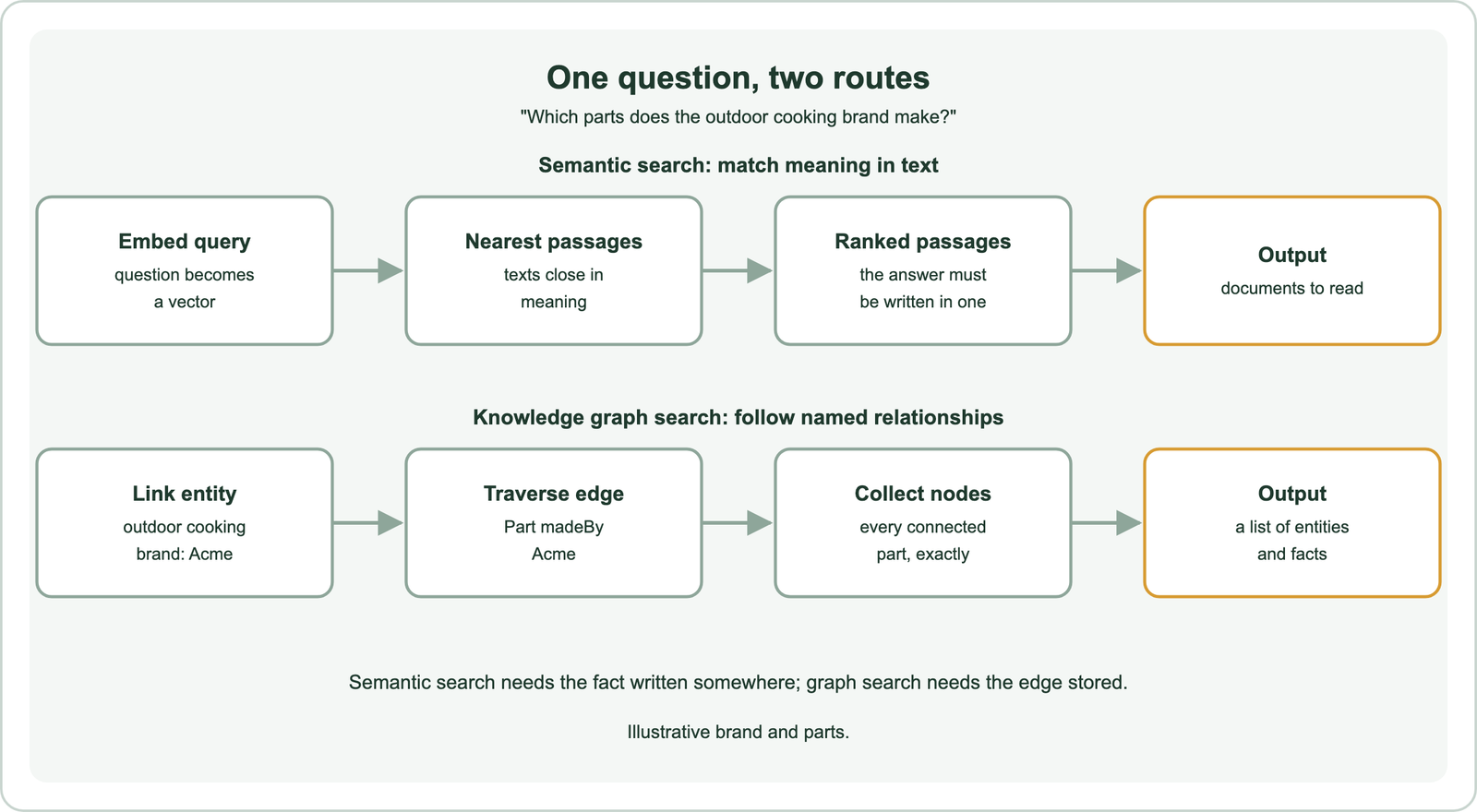
Take “which parts does the outdoor cooking brand make”. Semantic search embeds the question and retrieves passages about outdoor cooking brands and parts. If a catalogue page lists the brand’s parts, it will probably rank well. If the parts are spread over many pages, the top results may list only some of them, and nothing tells the reader the list is incomplete.
Knowledge graph search first links “the outdoor cooking brand” to an entity, here the illustrative brand Acme. It then follows every madeBy edge pointing to Acme and returns the parts. The list is complete as far as the graph is, and each result can be explained: this part has a madeBy edge to Acme.
The failure points differ. Semantic search fails when no single passage holds the answer or when wording is too far from the documents. Graph search fails when entity linking picks the wrong node or the edge was never recorded. The pattern suggests which question shapes favour each method.
Which questions does each method answer best?
Semantic search answers best when questions are phrased loosely and answers live in prose, while knowledge graph search answers best when questions ask for exact relationships or complete sets of connected things. Many questions need both.
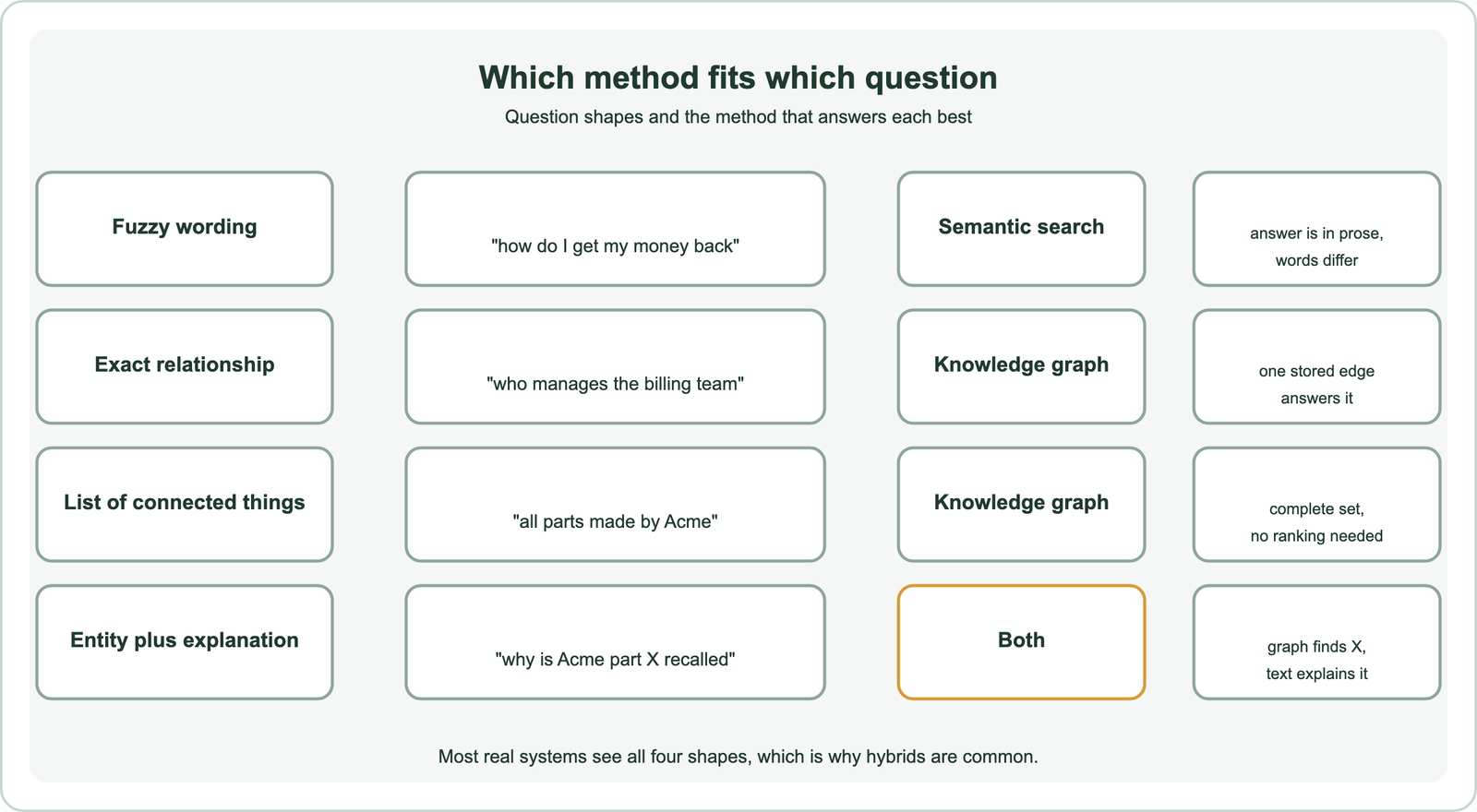
Loosely worded questions favour semantic search. A user who types “my order never came” needs the delivery problems article, whatever words it uses. A graph has no edge for that. The same strength appears against keyword search, as explained in semantic search vs keyword search and BM25 vs vector search.
Exact relationships favour the graph. “Who manages the billing team” is one edge lookup. Semantic search might retrieve an org chart page, or a meeting note that mentions the manager in passing, or an outdated page. Lists favour the graph too, because traversal returns every connected node rather than the top k most similar passages.
Many real questions mix the two. “Why was Acme’s grill grate recalled” needs the entity, which a graph pins down, and the explanation, which lives in a notice or article. Natural-language interfaces that accept such questions are discussed in natural language search. The mixed case is why combinations are common.
How do semantic search and knowledge graphs work together?
Semantic search and knowledge graphs work together by using vector search to find the entities or passages a question is about, then using graph relationships to expand, filter or explain the results. Each method covers the other’s gap.
The common pattern is entry by vector, expansion by graph. Weaviate’s article on RAG and GraphRAG describes a local search pipeline. Weaviate’s semantic search finds the entities most relevant to a question. A Neo4j graph traversal then collects connected entities and community context for a language model. This is one form of GraphRAG, discussed with plain RAG in semantic search vs RAG.
A simpler version needs only one database. Weaviate links objects with cross-references, and its documentation describes a two-stage query. A vector search first finds matching objects in one collection. A second query then filters a related collection on those objects through the reference. The documentation notes that cross-references do not affect vectors, so this two-step approach is how meaning and relationships combine.
Graphs can also feed the vector side. Entity names and relationship facts can be written into an object’s text before embedding, so a semantic search on “outdoor cooking gear” also matches parts whose brand has that description. Weaviate’s documentation recommends embedding related information in objects instead of cross-referencing where possible. The two-stage query is short in code.
How do you combine vector search and relationships in Weaviate?
You combine vector search and relationships in Weaviate by running a vector search on one collection to find entities, then filtering a related collection by those entities through a cross-reference. The first stage handles meaning; the second follows the edge.
from weaviate.classes.query import Filter

brands = client.collections.use("Brand")
parts = client.collections.use("Part")      # Part has a madeBy reference to Brand

# Stage 1: vector search finds the brand that matches the meaning of the query
hits = brands.query.near_vector(near_vector=query_vector, limit=1)
names = [o.properties["name"] for o in hits.objects]

# Stage 2: follow the madeBy relationship with a reference filter
res = parts.query.fetch_objects(
    filters=Filter.by_ref(link_on="madeBy").by_property("name").contains_any(names),
)
print([o.properties["name"] for o in res.objects])
query_vector is the embedding of the question, or a near_text call can replace near_vector when a vectorizer is configured. The first query finds the brand whose description is closest to “outdoor cooking”. The second returns every part with a madeBy edge to that brand. The pattern was run on a toy collection of two brands and two parts as an API check, and returned the grill grate made by the matching brand.
Deep, multi-step traversals are a better fit for a dedicated graph database. Weaviate’s documentation warns that queries involving cross-references can be slower at scale. A vector database and a graph database each have their strengths, a question related to search engine vs vector database. Building either side has a cost.
What does each approach cost to build and maintain?
Semantic search costs embedding compute and a vector index, with little manual work, while a knowledge graph costs schema design, entity extraction and continuous curation to keep facts correct. The graph’s cost is mostly people and review.
Semantic search needs an embedding model, a pipeline to embed content and queries, and an index. New documents are embedded as they arrive. No one has to decide in advance which relationships matter. Storage choices, such as adding vectors to an existing relational database, are compared in pgvector vs a dedicated vector database.
A knowledge graph needs a schema of entity types and relationships, a way to populate it, and ongoing maintenance. Structured sources, such as a product database, convert to graphs cheaply. Unstructured text needs extraction, today often done with language models, as in Microsoft’s GraphRAG, which Weaviate’s GraphRAG article describes. Extracted edges need review, because a wrong edge produces a confident wrong answer.
Freshness is a cost for both. Embeddings go stale when the model changes; graph edges go stale when the world changes, such as a person moving jobs. Graph edges usually need dates or versions. A decision depends on which costs your organisation can carry.
Should you use semantic search or knowledge graph search?
You should use semantic search when most content is unstructured text and questions are loosely phrased, and add a knowledge graph when questions depend on exact relationships between well-defined entities. Start with semantic search unless the data is already a graph.
Semantic search is the faster start for document collections, help centres and RAG assistants. It works the day content is embedded and degrades gracefully when wording varies. Hybrid search, which adds keyword matching, covers names and codes.
A knowledge graph earns its cost when entities and their links are central: product compatibility, organisational structure, supply chains, research citations or regulatory relationships. If the data already lives in tables with foreign keys, much of the graph exists. Properties and filters may cover it without a separate graph database.
Test with real questions. Sort a sample by shape: fuzzy, exact relationship, list or mixed. If most are fuzzy, semantic search alone serves them. If many are relationship or list questions, add structured relationships, starting with properties and reference filters, and move to a graph database when traversals get deep.
Semantic search matches meaning in text with embeddings and returns ranked passages. Knowledge graph search follows stored relationships between entities and returns exact facts and complete lists. Semantic search handles fuzzy wording and needs little curation. Knowledge graph search handles exact relationships and lists but only knows what was stored and kept current. The two combine well: vector search finds the entities a question is about, and relationships expand, filter or explain the results. In Weaviate, run a vector search to find entities, then filter related objects through a cross-reference, and use a dedicated graph for deep traversals.