Home / Foundations / How Google Uses Semantic Search: Hummingbird to MUM
ExplainerHow Google Uses Semantic Search: Hummingbird to MUM
Google Search has moved steadily from matching strings to modelling meaning through a series of publicly announced systems. They are the Knowledge Graph in 2012, Hummingbird in 2013, RankBrain in 2015, BERT in 2019, MUM in 2021 and AI Overviews in 2024. The Knowledge Graph taught Search about entities, “things, not strings”. Hummingbird rewrote the core algorithm to consider the meaning of whole queries. RankBrain brought machine learning to queries Google had never seen. BERT let Search read each word in the context of the others, so small words such as “to” changed results. MUM added multitask and multimodal understanding across many languages, and AI Overviews added generated summaries with links. Google publishes only high-level descriptions, so this account sticks to what Google has said. The same building blocks, embeddings, transformers and knowledge structures, now power semantic search in vector databases such as Weaviate.
Semantic search at Google in four facts
- Google introduced the Knowledge Graph in 2012 with the phrase “things, not strings”.
- Google described RankBrain in 2015 as a machine-learning system for interpreting unfamiliar queries.
- Google said BERT affected about one in ten English searches in the U.S. when it launched in 2019.
- Google described MUM in 2021 as 1,000 times more powerful than BERT and trained across 75 languages.
What does semantic search mean at Google?
Semantic search at Google means understanding what a query and a page are about, including entities, intent and context, rather than only matching the words typed. Google has described this shift in its own announcements for more than a decade.
Early web search ranked pages largely by matching query terms and by links between pages. That worked well when people typed short keyword queries and pages used the same words. It worked less well for questions, for queries with unusual phrasing, and for words with several meanings.
Each of the milestones that followed addressed one of those gaps. Some added knowledge about the world, some changed how queries are interpreted, and some changed how pages are read. Together they mirror the wider history of retrieval, from the vector space model and latent semantic indexing to neural embeddings.
One caution applies throughout. Google rarely publishes technical details of its ranking systems. The descriptions here come from Google’s public announcements and statements, and they say what each system does, not exactly how it is built.
Which milestones does Google’s move to semantic search include?
Google’s move to semantic search includes six public milestones: the Knowledge Graph, Hummingbird, RankBrain, BERT, MUM and AI Overviews, each announced by Google with examples of what changed. They span roughly twelve years.
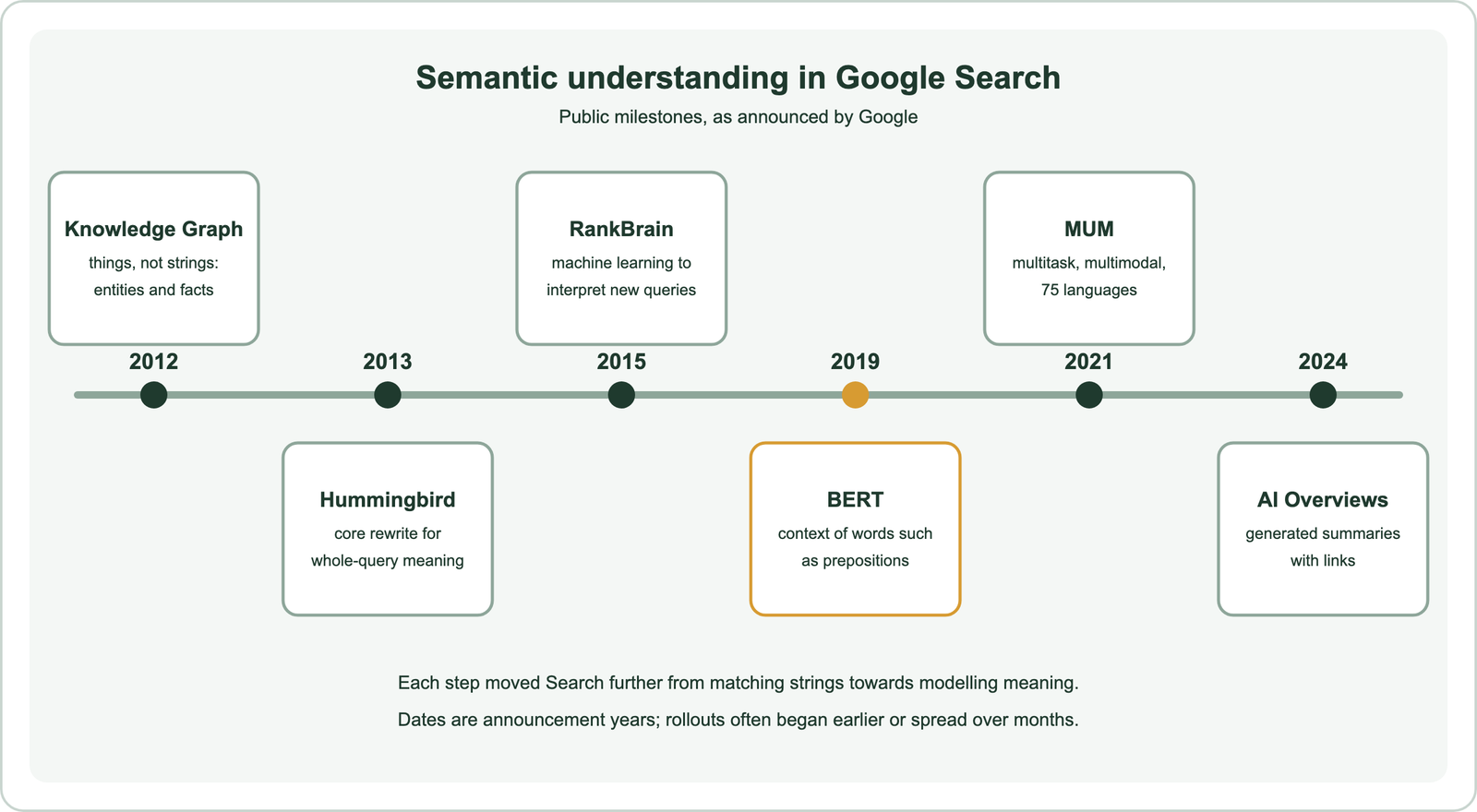
The sequence shows a pattern. First Google added structured knowledge about entities. Then it changed how queries are parsed, then applied machine learning to interpret them, then adopted transformer models that read language in context. The latest steps use larger multitask models and generative summaries.
The same steps happened across the industry. Weaviate’s article on the AI-first database ecosystem calls RankBrain a key early milestone for machine-learning-based search. The models behind BERT came from Google’s own research, and they became the basis of the embedding models used in vector search today.
What did the Knowledge Graph change?
The Knowledge Graph changed Google Search by adding a database of entities, such as people, places and organisations, and the facts linking them, so Search could recognise what a query refers to. Google announced it in 2012.
Google’s announcement summed it up as “things, not strings”. A query for a famous person or landmark could now be recognised as a reference to a specific entity, not just a sequence of characters. Results began to show panels of facts about the entity, and ambiguous names could be told apart.
Entities also help with ambiguity in queries. A name shared by a city, a person and a company can be resolved by the other words in the query or by what most searchers mean. The results can then group information about the intended entity. That kind of disambiguation is hard for keyword matching alone.
Structured knowledge complements statistical matching. A knowledge graph states facts explicitly, while embeddings infer similarity from text. The relationship between the two is discussed in knowledge graphs in search.
How did Hummingbird and RankBrain change query understanding?
Hummingbird rewrote Google’s core algorithm in 2013 to consider the meaning of whole queries, and RankBrain added machine learning in 2015 to interpret queries Google had not seen before. Both focused on the query side.
Hummingbird was announced in 2013 as a new core algorithm designed for longer, conversational queries. Instead of treating a query as a bag of keywords, it aimed to understand the request as a whole, which mattered more as people began to search by voice and in full questions.
RankBrain was revealed in 2015. Google described it as a machine-learning system that helps interpret queries, especially ones it has never seen, by relating them to familiar queries with similar meaning. Google has repeatedly said that a meaningful share of daily searches, often cited as 15%, are new. Relating new queries to known ones by meaning is a form of the vector matching described in high-dimensional vector space.
What did BERT change in Google Search?
BERT changed Google Search by letting it read each word of a query in the context of the words around it, in both directions, so small words such as prepositions could change the results. Google applied it to Search in 2019.
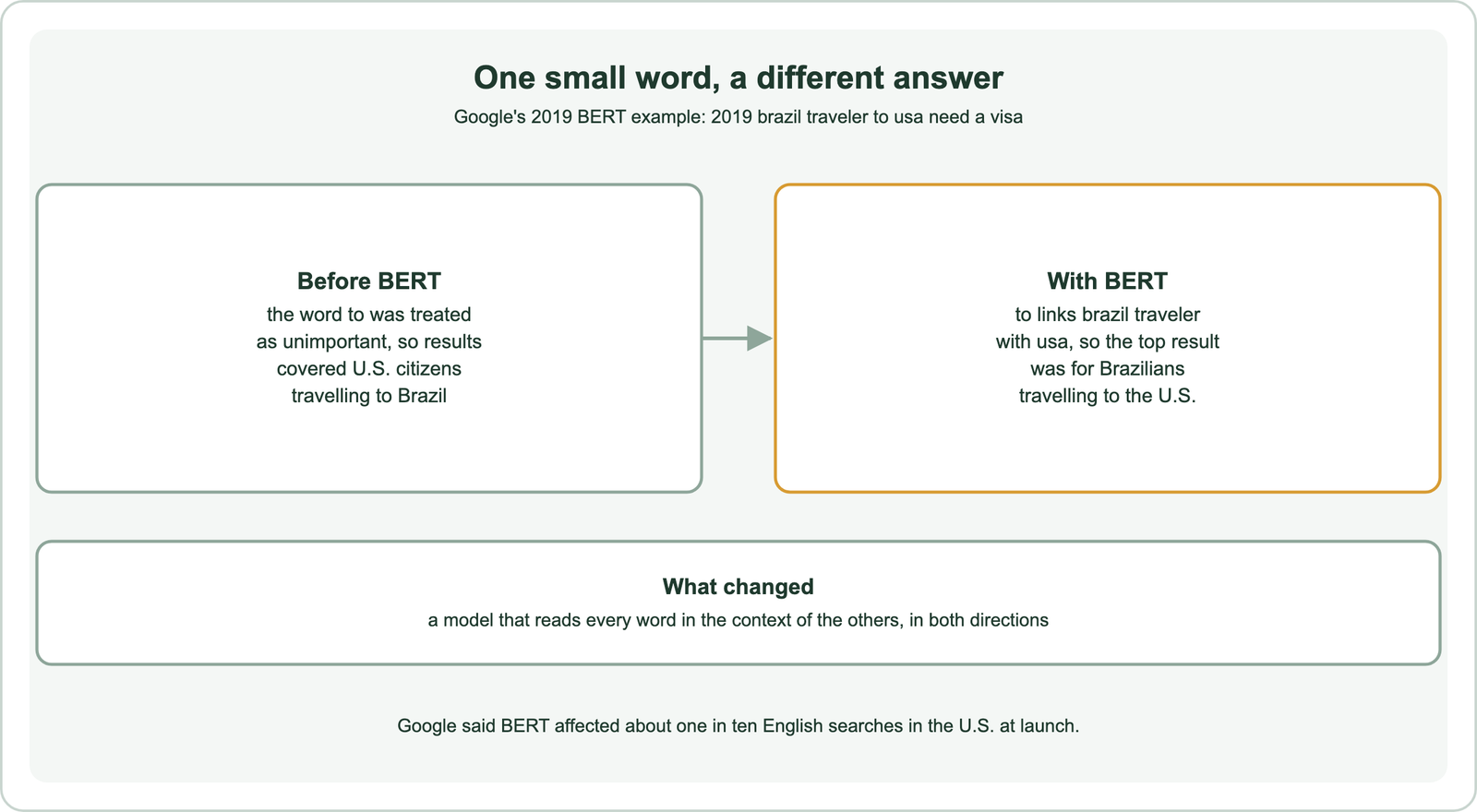
Google’s announcement gave a now well-known example. For the query “2019 brazil traveler to usa need a visa”, earlier systems underweighted the word “to” and returned results about U.S. citizens travelling to Brazil. With BERT, Search understood the direction of travel and returned information for Brazilians visiting the United States. Google said BERT affected about one in ten English searches in the U.S. at launch.
BERT itself was published by Google researchers in 2018, building on the transformer architecture introduced by Google researchers in 2017. The same architecture underlies the bi-encoders and cross-encoders used in semantic search, as described in transformers and BERT in search and Sentence-BERT.
What is the MUM model and how does MUM extend BERT?
MUM, the Multitask Unified Model, is a model Google announced in 2021 that it described as 1,000 times more powerful than BERT, trained across 75 languages and able to understand text and images. It targets complex, multi-step questions.
Google’s example was a hiker who had climbed one mountain and wanted to know how to prepare for another. Such a question would normally need several searches. MUM was designed to draw on information across languages and formats to address it. Google applied MUM to specific features rather than describing it as a ranking system for all queries.
Multilingual understanding is a theme of modern embeddings too. A query in one language can match a document in another when both are mapped to a shared space, as described in multilingual and cross-lingual semantic search.
How do AI Overviews fit into semantic search?
AI Overviews fit into semantic search as a generation step on top of retrieval: Search finds relevant pages, and a language model writes a summary with links to them. Google launched them broadly in the U.S. in 2024.
The pattern resembles retrieval-augmented generation, in which a system retrieves passages and a model answers from them. The quality of the summary depends on the quality of what is retrieved, which is why semantic retrieval matters more, not less, when answers are generated. The relationship between the two is covered in semantic search vs RAG.
For site owners, the lesson from every milestone has been consistent: Google increasingly evaluates what a page means and whether it answers a question, not whether it repeats the query’s words. Claims about specific signals, such as “LSI keywords”, are not supported by Google’s statements, as discussed in latent semantic indexing.
What can you learn from Google for your own semantic search?
The lesson from Google for your own semantic search is to combine signals: entities and structured data, exact keyword matching, contextual embeddings and, where useful, generated answers. No single method covers every query.
Google never replaced earlier systems outright; each new system was added alongside the others. The same layering works at smaller scale. Hybrid search combines keyword and vector retrieval, filters apply structured knowledge, and rerankers apply a deeper model to the top results. Vector databases such as Weaviate provide these pieces for applications that are not web search engines.
Meaning has limits that Google’s examples also show. Embeddings capture relatedness as well as similarity, a distinction covered in semantic similarity vs relatedness. The models’ word-level ancestors are described in word2vec and GloVe, the geometry they rely on in the curse of dimensionality, and the field’s foundations in what is information retrieval. Systems issues such as caching are covered in cache hits and misses.
Google’s public history shows search moving from strings to meaning in steps. The Knowledge Graph in 2012 added entities, Hummingbird in 2013 considered whole queries and RankBrain in 2015 used machine learning for new queries. BERT in 2019 read words in context and affected about one in ten U.S. English searches, MUM in 2021 added multitask and multilingual understanding, and AI Overviews in 2024 added generated summaries. Google describes these systems only at a high level. Their common lesson for any semantic search system is to layer entities, keywords, contextual embeddings and reranking rather than rely on one method.