Home / Comparisons / Natural Language Search vs Keyword Search
ComparisonNatural Language Search vs Keyword Search
Natural language search lets people type a full request in everyday language, such as “comfortable red running shoes, men’s 10, on sale if possible”, and returns results that match its meaning and conditions. Keyword search, by contrast, matches the words in a query against the words in documents and ranks by how well they overlap. Natural language search usually works by parsing the request into hard conditions, preferences and a description. Conditions become filters, preferences become boosts, and the description is searched by meaning, often with hybrid keyword and vector search. Semantic search is the core technique behind it, but natural language search is broader: it is an interface style that also needs query understanding and ranking. Keyword search remains better for exact codes, names and quoted phrases. Most modern search boxes combine the two.
Natural language search vs keyword search in four facts
- Keyword search matches query words to document words; natural language search interprets the request.
- Natural language queries mix hard conditions, soft preferences and a description of what is wanted.
- Semantic search handles the description; filters and boosts handle conditions and preferences.
- Keyword matching is still needed for codes, names and exact phrases, so most systems combine both.
What is the difference between natural language search and keyword search?
The difference is how the query is treated: keyword search treats it as a set of words to find, while natural language search treats it as a request whose meaning and conditions must be understood. The interfaces can look identical.
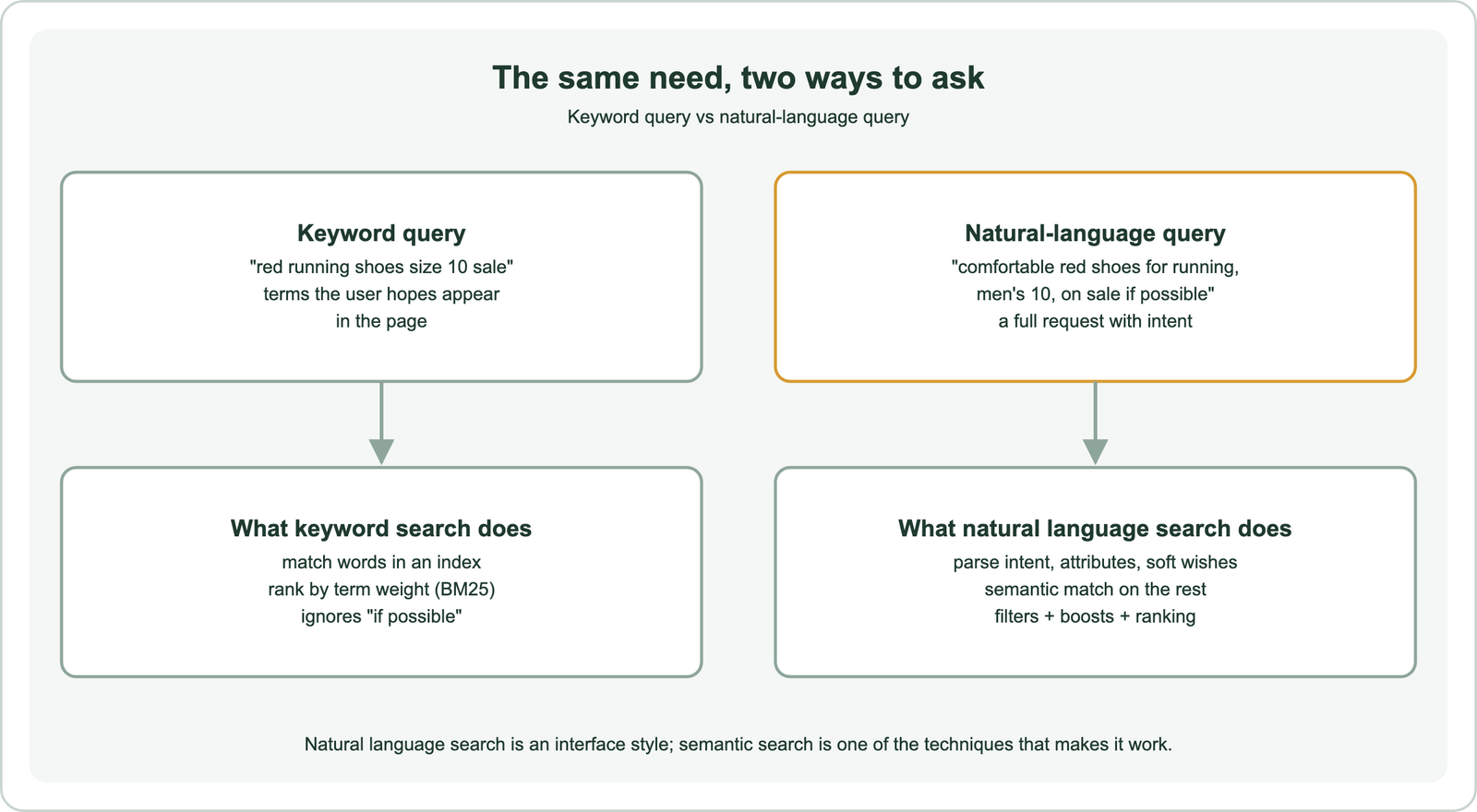
A keyword engine looks up each word in an inverted index and scores documents with a formula such as BM25, as covered in BM25 vs vector search. It has no notion that “size 10” is a constraint, that “if possible” is a preference, or that “comfortable” describes a quality rather than a word that must appear. People adapted to this by typing short strings of likely words.
Natural language search lets them stop adapting. It accepts questions and descriptions as people would phrase them to a shop assistant. That requires understanding what each part of the query is for, which is where semantic search, query parsing and ranking come in.
How does natural language search relate to semantic search?
Natural language search relates to semantic search as an interface relates to an engine: natural language search is what the user experiences, and semantic search is the main technique that matches meaning behind it. The terms overlap but are not identical.
Semantic search compares the meaning of the query with the meaning of documents using embeddings, so “comfortable running shoes” can match a product described as “cushioned trainers for jogging”. That handles the descriptive part of a natural-language query. Semantic search vs keyword search compares the two matching approaches in depth.
A natural language search system needs more than semantic matching. It must recognise numbers, sizes, dates and categories and turn them into exact constraints. It must also treat soft wishes as ranking signals and handle exact names or codes. Semantic search alone would blur “size 10” into the description, because embeddings do not treat numbers as constraints.
How is a natural-language query processed?
A natural-language query is processed by parsing it into conditions, preferences and description, applying conditions as filters and preferences as boosts, and searching the description semantically. Then results are fused and ranked.
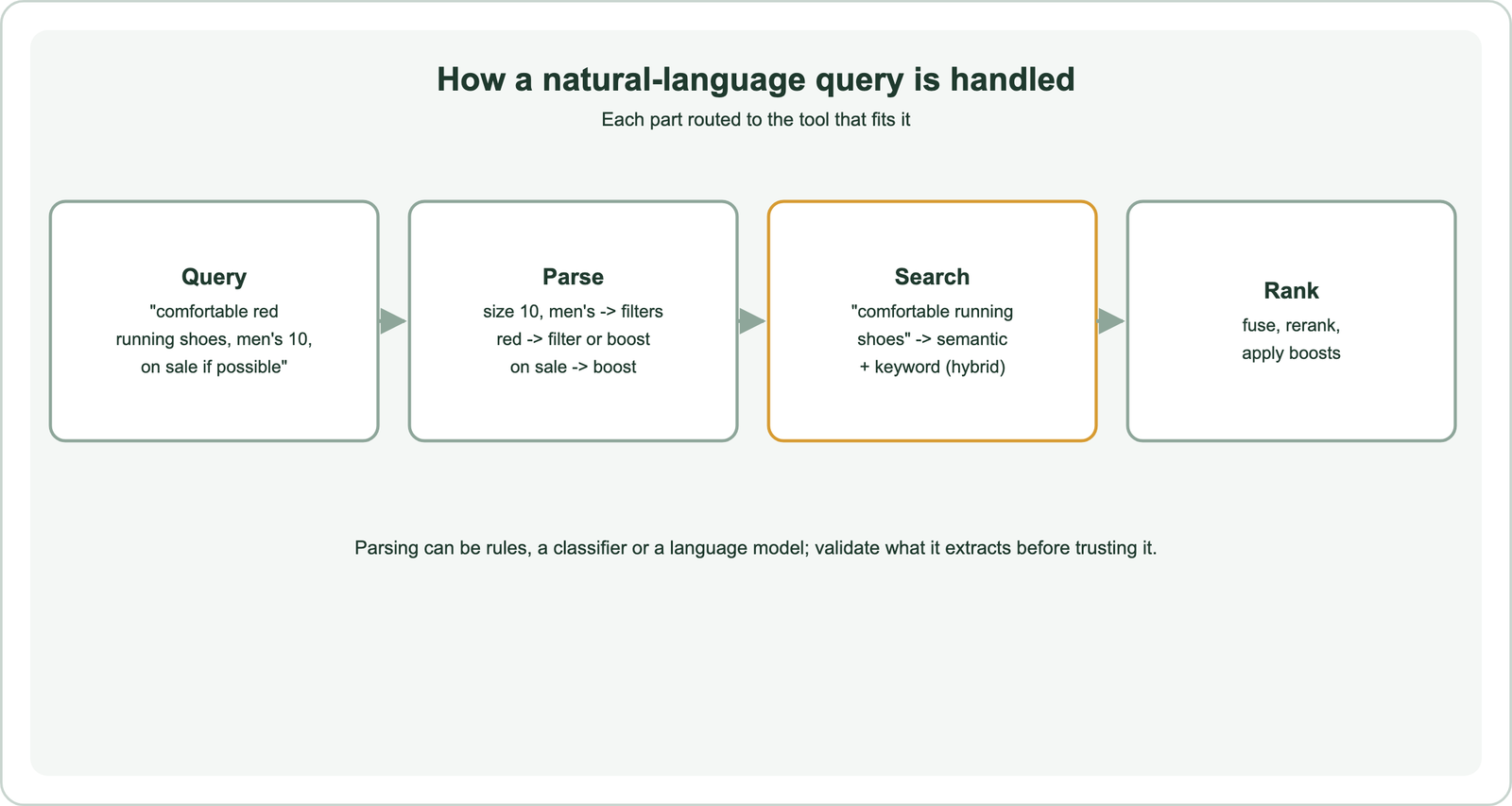
Parsing can use simple rules, a trained classifier or a language model asked to output structured fields. Language models make this much easier than it used to be, but they can invent conditions, so validate extracted values against known categories and ranges. Query understanding covers the techniques, and searching vs filtering explains which parts belong in a filter.
Weaviate’s Query Agent, a Weaviate Cloud service, takes a natural-language question and decides which collections to search, with which filters and search types. Teams building their own pipeline do the same with a parser in front of hybrid search. Either way, the database still runs filtered vector and keyword queries underneath.
When is keyword search still the better choice?
Keyword search is still the better choice for exact identifiers, quoted phrases, rare names and searches where users know the exact words they want. It is also simpler and fully explainable.
A support engineer pasting an error code, a buyer entering a part number, or a researcher searching a quoted phrase needs exact matches. Keyword search delivers them reliably and can highlight the matched words, which helps users trust results. Semantic matching can blur codes and names into similar-looking ones. Users who have learned to type short keyword strings also get good results from keyword search, so it should not be removed.
That is why the practical answer is usually both. Hybrid search runs keyword and vector search together, so natural-language descriptions and exact terms are both handled in one query. Semantic search vs vector search and semantic search vs similarity search separate the related terms.
What does natural language search add for users?
Natural language search adds the ability to ask in your own words, combine several conditions in one request, and get relevant results without guessing the catalogue’s vocabulary. It suits complex and vague needs.
Users no longer need to know that the shop calls them “trainers” and not “sneakers”, or that a help article is titled “Ending your subscription” rather than “cancel”. They can express several needs at once, such as a size, a price limit and a use, and still get focused results. Voice assistants and chat interfaces produce long natural-language queries by default, so search behind them must handle that style.
The same ability powers question answering. When the system answers directly from retrieved passages, natural language search becomes retrieval-augmented generation, compared in semantic search vs RAG. Structured questions over linked facts may suit a graph better, as in semantic search vs knowledge graph search.
How does natural language search handle questions?
Natural language search handles questions by matching them to passages that answer them, not to passages that repeat the question’s words. This is where semantic matching helps most.
A question such as “why does my laptop shut down when I unplug it” rarely shares many words with the help article that answers it, which may talk about battery health and power settings. Embedding models trained on question-answer pairs place the two close together. Keyword search would rank pages that repeat “laptop” and “unplug” first, even if they do not explain anything. Models built for asymmetric search, with separate handling of short queries and long passages, suit this case, as covered in asymmetric vs symmetric semantic search.
Questions also invite direct answers. A search system can show the passage that answers the question as a highlighted snippet, or pass the top passages to a language model to write a short answer with citations. Either way, retrieval quality decides whether the answer is right, so evaluate the retrieval step on real questions before adding generation.
What can go wrong with natural language search?
Natural language search can go wrong when the parser misreads a condition, when soft wishes are treated as hard filters, or when results are hard to explain to users. Each needs a guard.
A parser that turns “under 100” into a filter for exactly 100, or reads “not leather” as “leather”, produces confidently wrong results. Treating “if possible” as a filter can empty the page. Users who cannot see why a result appeared may lose trust, especially when no query word appears in it. Show the interpreted conditions, such as “Size 10, On sale”, so users can correct them.
Measure with real queries of both styles, short keyword strings and full sentences, and compare natural language handling with plain hybrid search. Track how often parsed conditions empty the result list, and review a sample of parsed queries each week to catch new phrasings the parser misreads. How to evaluate semantic search covers the method.
How do you build natural language search?
You build natural language search by indexing structured fields for filters, text for keyword and vector search, adding a query parser, and combining parsed filters with hybrid search. Start simple and add parsing only where measurements show it helps.
Begin with hybrid search over descriptive text, which already handles many natural-language queries well. Add structured fields for the attributes users mention most, such as size, price and category. Then add a parser for those attributes, test it on logged queries, and pass its output as filters and boosts. Where it fits, a search engine and a vector database can work together, as discussed in search engine vs vector database and pgvector vs dedicated vector database.
The older idea of machine-readable meaning, described in semantic search vs the semantic web, tried to make documents structured. Natural language search takes the opposite route: it lets people write freely and puts the structure into the search system.
Natural language search accepts full requests in everyday language and returns results that match their meaning and conditions; keyword search matches query words against document words. Natural language search works by parsing a request into conditions, preferences and description. It then applies filters and boosts and searches the description semantically, usually with hybrid search. Semantic search is its main engine but not the whole system. Keyword search still wins for codes, names and quoted phrases, so the strongest search boxes combine both and show users how their request was interpreted.