Home / Hybrid search / What Is Hybrid Search? Keyword Plus Vector Search Explained
What Is Hybrid Search? Keyword Plus Vector Search Explained
Hybrid search is an information retrieval method that runs keyword and vector searches for one query, then fuses their candidates into one ranked list. Keyword retrieval preserves exact strings, while vector retrieval finds related meaning in different words. Fusion rewards evidence from both routes without treating their raw scores as directly comparable. The method helps most when queries mix intent with names, codes, or specialist terms. It adds little value when one retriever already handles every important query. A valid deployment therefore measures relevance, latency, and cost against keyword-only and vector-only baselines.
Hybrid search in four facts
- Hybrid search usually combines a lexical result list with a semantic vector result list.
- Reciprocal rank fusion scores positions instead of comparing incompatible raw relevance scores.
- Exact identifiers and paraphrased intent create the strongest case for two complementary retrievers.
- A relevance test, not a product default, determines whether hybrid retrieval improves a particular search system.
What does hybrid search combine?
Hybrid search combines two or more retrieval methods, most often lexical keyword search and semantic vector search. Lexical retrieval reads tokens through an inverted index and ranks matches with a formula such as BM25. Semantic retrieval embeds the query and documents, then finds nearby vectors. Each route produces candidates in its own order. A fusion stage converts those separate lists into one order. Google Cloud described this dense-plus-sparse pattern in its Vector Search documentation, read October 8, 2026.
Hybrid retrieval is broader than one dense-plus-sparse implementation. A system may fuse several vector models, image and text retrieval, or business signals with search results. “Blended search” is sometimes used for that wider idea. The common text pattern still starts with keyword search and vector search. Keyword retrieval protects literal evidence. Vector retrieval crosses vocabulary gaps. Fusion decides how much evidence from each route survives.
Lexical scores and vector scores describe different evidence. BM25 depends on term statistics within a collection. Vector similarity depends on an embedding space and its distance function. Equal numeric values therefore do not imply equal relevance. Hybrid search needs a rule that respects ranks or calibrates score distributions. That requirement separates genuine fusion from concatenating two lists or adding unprocessed scores.
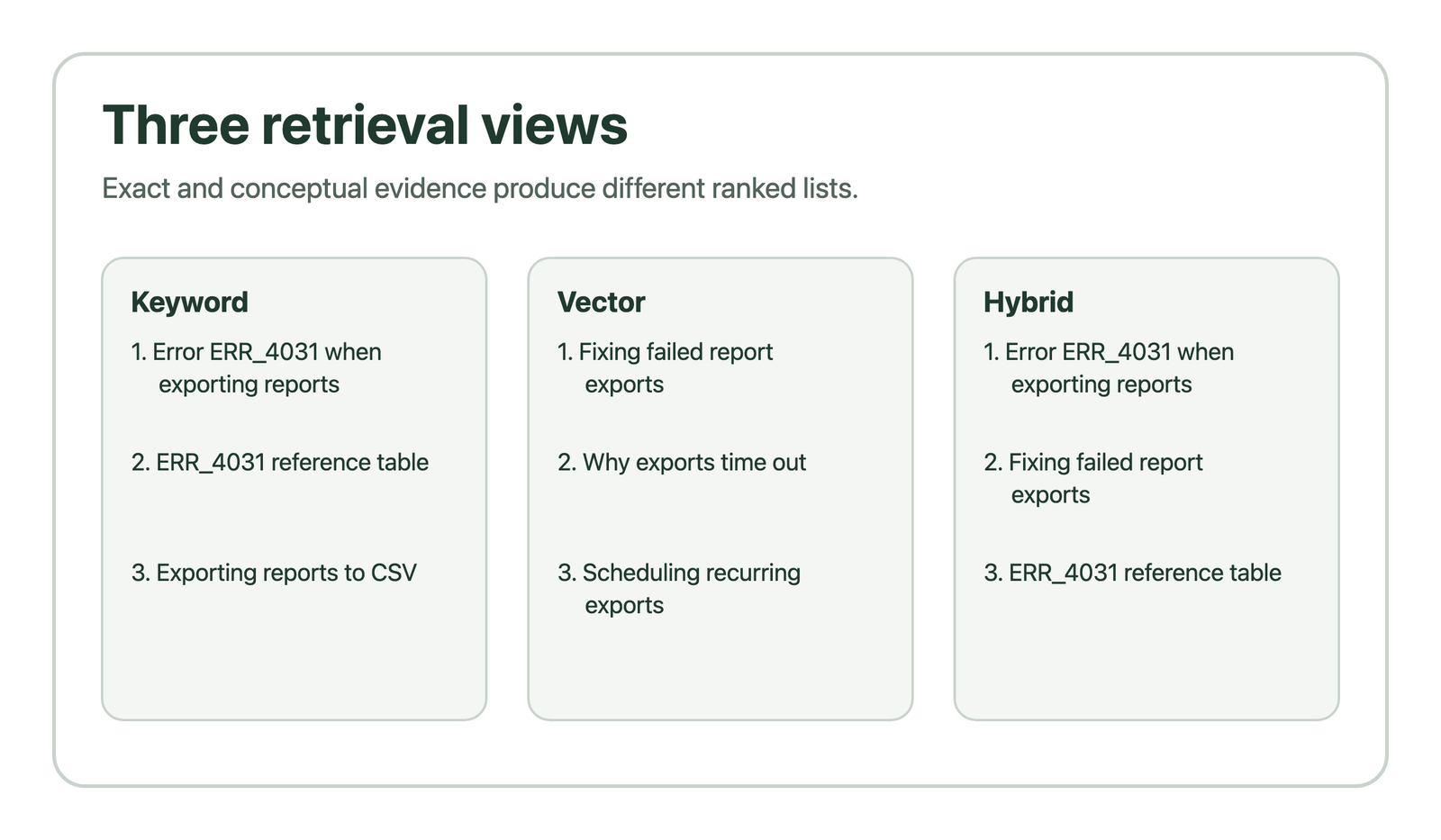
- Error ERR_4031 when exporting reports
- Fixing failed report exports
- ERR_4031 reference table
Why does hybrid search exist?
Hybrid search exists because lexical and semantic retrievers make different mistakes. A lexical engine finds a rare part number or quoted clause when its characters match the index. It may miss a relevant passage written with different vocabulary. A vector retriever finds paraphrases and related concepts. It may blur two similar identifiers or misunderstand a term outside its model’s training data. Google Cloud’s hybrid search documentation names SKUs, new product names, and proprietary codenames as examples of out-of-domain data.
The difference is visible across collections, not only in hand-picked examples. Nandan Thakur and four coauthors introduced BEIR at the NeurIPS 2021 Datasets and Benchmarks track. BEIR evaluates zero-shot retrieval across heterogeneous tasks and domains. Its purpose matters more here than any single leaderboard value: retrieval quality changes with corpus and query type. Combining retrievers creates a larger candidate pool, but does not guarantee a better order. The practical comparison remains hybrid search versus vector search on the queries the application receives.
Complementarity has two requirements. Each retriever must find some relevant material the other misses. Fusion must then place that material high enough to matter. If both branches return the same documents in nearly the same order, hybrid retrieval adds work without adding recall. If one branch returns mostly noise, equal fusion may lower precision. Query-level evaluation exposes both cases.
How does hybrid search work from query to ranking?
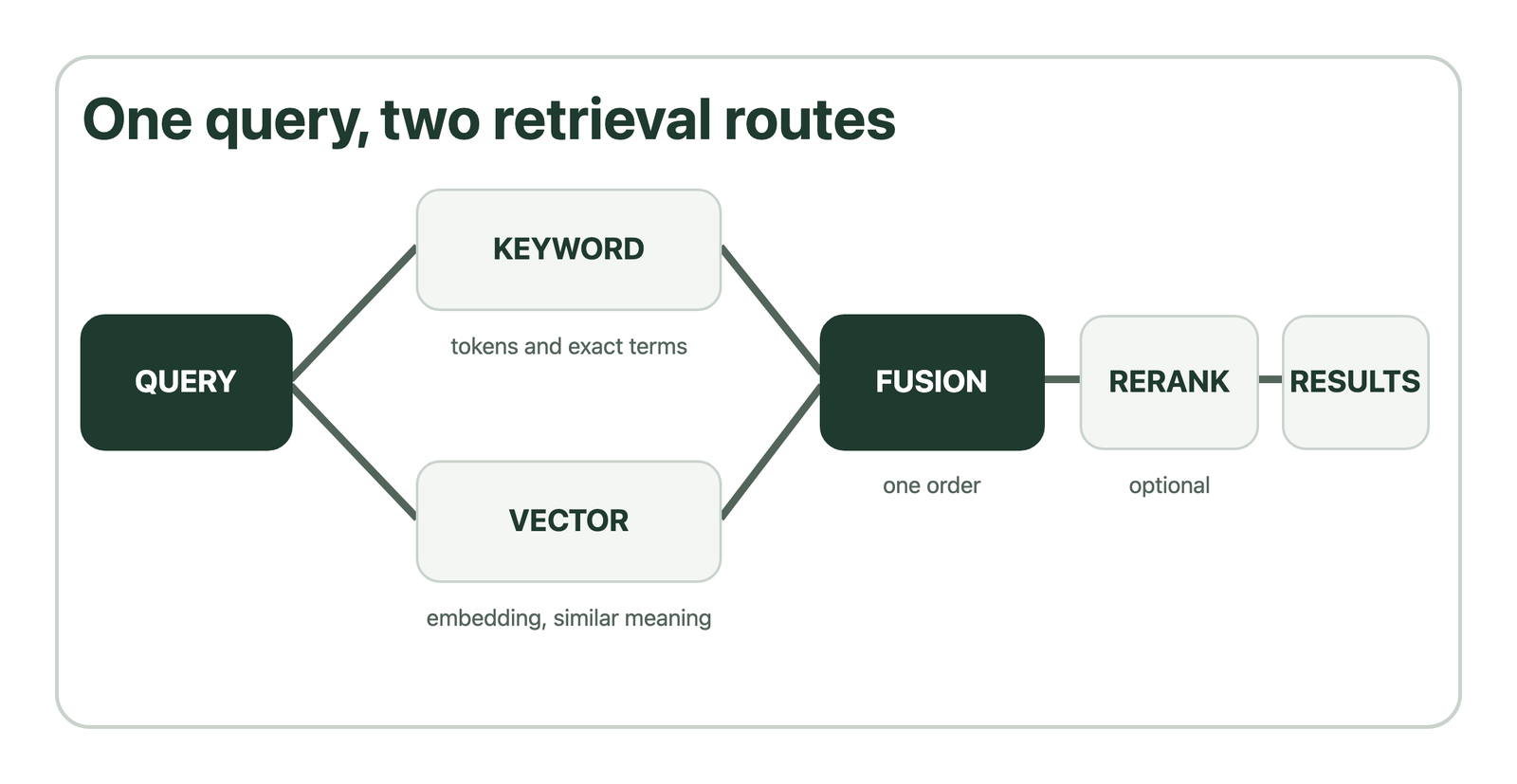
Hybrid search works by preparing two query representations, retrieving candidates, fusing their lists, and optionally reranking the best candidates. The lexical branch tokenizes the query for an inverted or sparse index. The semantic branch embeds the same query for nearest-neighbor search. Both branches may run in parallel. Azure AI Search documented this parallel execution and RRF merge in its hybrid search overview, read October 8, 2026.
Candidate depth limits what fusion may recover. A relevant document omitted from both branch lists cannot appear in the fused list. Elasticsearch calls each branch limit a rank window in its RRF reference. Larger windows expose more candidates but require more work. Filters also need consistent treatment across branches. The complete hybrid search workflow covers query encoding, candidate generation, filtering, and fusion in mechanism depth.
Candidate identity also needs a stable join key. Fusion recognizes that one document appeared in both lists only when both branches return the same identifier. Chunked document systems need the same unit on each side. Fusing a whole-document lexical result with a passage-level vector result creates an ambiguous match. A stable document or passage identifier makes overlap explicit and keeps the final score interpretable.
- Represent the hybrid query as tokens and an embedding.
- Retrieve lexical candidates with exact term evidence.
- Retrieve vector candidates with semantic similarity evidence.
- Fuse both candidate lists with ranks or normalized scores.
- Rerank selected candidates when extra precision warrants added latency.
Fusion and reranking are separate operations. Fusion reconciles evidence from multiple first-stage retrievers. A reranker reads the query and selected documents again, then changes their order. Google Cloud documents this multi-stage pattern after RRF. The guide to reranking explains that later stage and its latency tradeoff.
How does hybrid search fuse two result lists?
Hybrid search fuses two result lists with rank-based or score-based methods. Reciprocal rank fusion (RRF) ignores raw scores. For document d, it adds 1 / (k + rank) for every list containing that document. Gordon Cormack, Charles Clarke, and Stefan Büttcher introduced RRF at SIGIR 2009. A document appearing near the top of both lists gains two contributions. A document absent from one list gains none from that list.
The constant k smooths differences between adjacent positions. Weaviate offers ranked fusion and relative-score fusion; relative-score has been its default since version 1.24, and its alpha control runs from 0 for keyword-only retrieval to 1 for vector-only retrieval. Elasticsearch documents a default rank_constant of 60 as of October 8, 2026. Its RRF retriever gives child retrievers equal weight. Qdrant documents a different default constant of 2, which proves defaults are product choices rather than universal rules. The full reciprocal rank fusion guide covers the formula, rank windows, ties, and tuning.
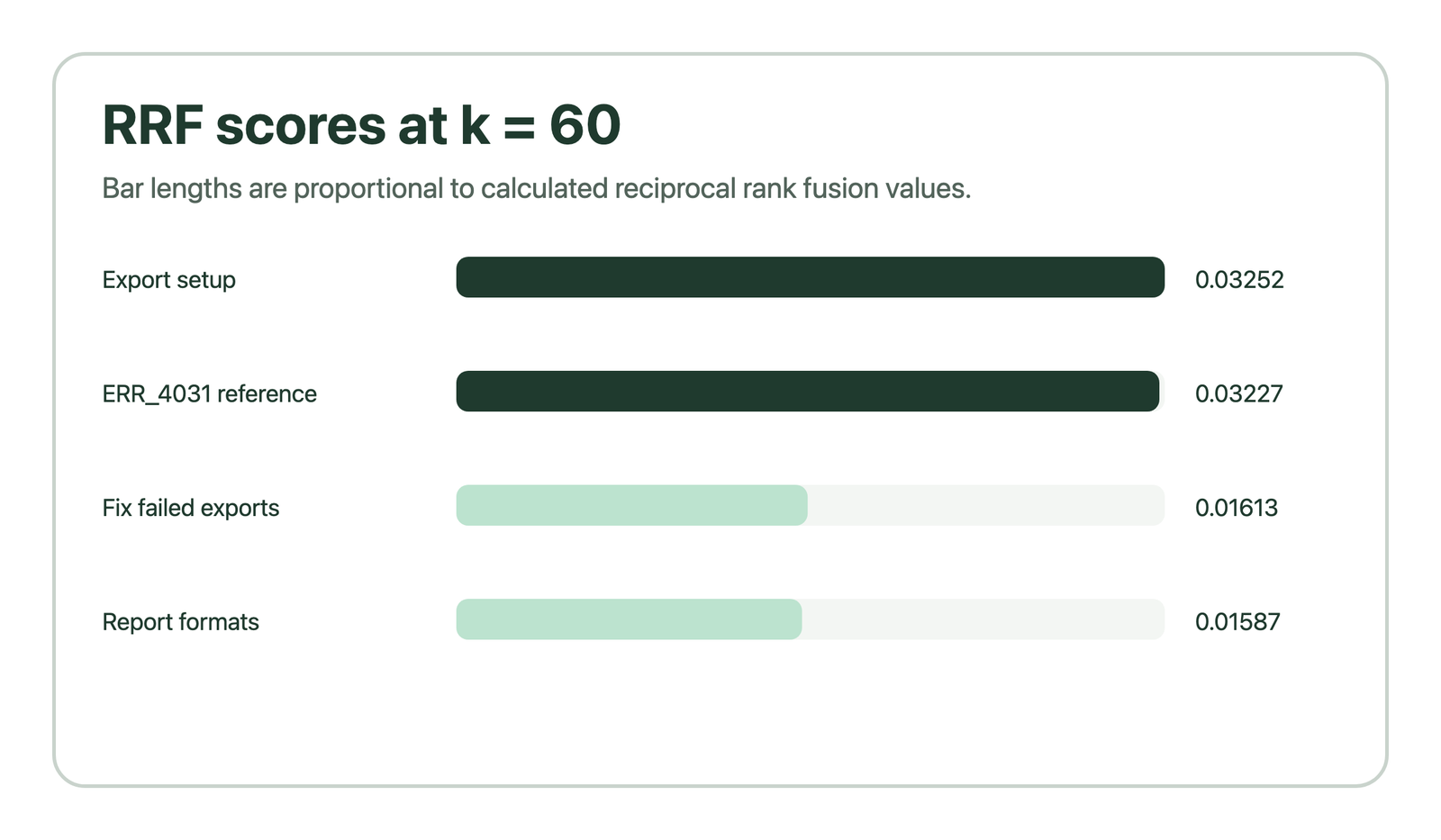
- ERR_4031 reference
- Export setup
- Report formats
- Export setup
- Fix failed exports
- ERR_4031 reference
Score fusion keeps magnitude information, but it must first make scores comparable. OpenSearch documents min-max, L2, and z-score normalization in its search pipeline. These controls lead to three deeper topics: relative score fusion, score normalization, and balancing keyword and vector scores.
No fusion method dominates every dataset. RRF avoids calibration and preserves agreement across lists. Normalized score fusion preserves confidence gaps that ranks discard. Outliers may distort min-max normalization, while a shallow RRF window may hide useful candidates. The comparison of hybrid score fusion methods turns those properties into a selection rule.
Weighting changes influence, not underlying retrieval quality. A larger vector weight promotes candidates already supplied by the vector branch. It does not recover a relevant document outside that branch’s candidate window. The same limit applies to keyword weights. Tune candidate depth before interpreting a fusion weight. Otherwise, a weight may compensate for missing evidence in a way that fails on another query segment.
Which query types does hybrid search improve?
Hybrid search improves queries that mix conceptual intent with exact strings. “Replacement battery for camera ZX-410” contains a strict model code and a broad product need. “ERR_4031 when exporting a quarterly report” combines an identifier with a described task. Lexical retrieval protects the code. Vector retrieval finds documents about replacement compatibility or failed exports, even when wording differs.
Names, acronyms, legal citations, and internal jargon create the same split. New terms may be absent from embedding training data. Their literal forms still exist in the keyword index. Conversational queries without rare strings may gain little from the lexical branch. Exact lookup queries may gain little from vectors. The decision guide for when to use hybrid search starts with query logs rather than a generic feature list.
| Query pattern | Example | Likely useful route |
|---|---|---|
| Exact identifier | ZX-410 | Keyword first |
| Conceptual paraphrase | camera loses power quickly | Vector first |
| Mixed intent and identifier | replacement battery for ZX-410 | Hybrid |
| Specialist phrase | Rule 10b-5 scienter standard | Test hybrid against keyword |
Labels such as “keyword first” describe a testable expectation, not a guaranteed winner. Corpus wording, analyzers, embedding model, and judgment policy change outcomes. One segment may favor lexical results while another favors vector results. A hybrid system earns its extra complexity only when combined performance improves important segments without hiding exact matches.
Query length alone does not select a route. A long query may quote an exact error message. A two-word query may express a broad concept. Useful routing features include identifier patterns, quotation marks, recognized entities, and the confidence of each retriever. Static hybrid fusion runs both paths for every query. Adaptive retrieval first predicts which evidence the query needs, but prediction errors become another failure source.
When does hybrid search fail to improve retrieval?
Hybrid search fails to improve retrieval when its second branch adds no relevant candidates or fusion weakens a reliable first branch. A catalog searched only by exact part numbers may need lexical lookup and filters. A collection searched only with broad conceptual questions may work with vector retrieval alone. Supabase uses similar contrasts in its official hybrid search guide. Two indexes and fusion add complexity without creating relevance evidence.
Hybrid retrieval also inherits failures from both branches. Weak embeddings still return weak semantic candidates. Incorrect tokenization still damages lexical recall. A small candidate window prevents fusion from seeing relevant documents. Stale indexes create mismatched evidence. Score fusion may let one scale dominate unless normalization works. RRF may ignore a large confidence gap because it sees positions only. None of these defects disappears because a query uses two retrievers.
Distributed execution introduces another boundary. Per-shard fusion and global fusion do not always produce the same candidate order. Qdrant’s hybrid query documentation, read October 8, 2026, warns that fusion inside a prefetch remains local to each shard. The detailed distributed hybrid search guide covers global candidate collection, network cost, and shard imbalance.
Operational cost completes the decision. Hybrid search stores another representation, runs another retrieval path, and adds a fusion stage. Parallel work does not mean free work. Latency includes query embedding time, both retrieval branches, coordination, and optional reranking. A simpler retriever remains correct when measured relevance already meets the product’s requirement.
Freshness can differ between indexes. A newly added document may reach the text index before its embedding is available. Deletion may also propagate at different speeds. Fusion then compares lists built from different corpus states. Production monitoring needs branch-level timestamps or indexing status, especially where recent policies, prices, or incidents matter. Retrieval quality includes whether both branches search the intended version of the corpus.
Which systems support hybrid search?
Search engines, vector databases, and PostgreSQL stacks support hybrid search through different query and fusion models. Weaviate exposes keyword-vector weighting and two fusion modes. Elasticsearch provides RRF and linear fusion paths. OpenSearch uses search pipelines for normalization and combination. Vespa combines nearest-neighbor and lexical operators through ranking expressions. These capabilities were checked in official documentation on October 8, 2026.
Qdrant provides RRF and distribution-based score fusion. Milvus provides RRF and normalized weighted rankers. Azure AI Search runs full-text and vector queries in one request, then merges with RRF. pgvector’s project documentation combines PostgreSQL full-text search with vector retrieval, then suggests RRF or a cross-encoder. The comparison of databases supporting hybrid search tracks product details without treating unlike controls as equivalents.
| System | Documented approach | Important control |
|---|---|---|
| Weaviate | Relative-score or ranked fusion | alpha |
| Elasticsearch | RRF or linear fusion | rank_constant and rank window |
| OpenSearch | Normalized score combination | Normalization and weights |
| Vespa | Rank expressions and global phase | Candidate depth and rank profile |
| Qdrant | RRF or DBSF | Prefetch depth and fusion placement |
| Milvus | RRF or weighted ranker | RRF k or route weights |
| Azure AI Search | Parallel text and vector retrieval with RRF | Vector query weight and k |
| pgvector | PostgreSQL text and vector retrieval | Application or SQL fusion |
Native support reduces client orchestration, but architecture still matters. PostgreSQL can keep relational data, full-text fields, and vectors together. The guide to hybrid search in SQL databases shows that pattern. Teams wanting an end-to-end implementation can follow the hybrid search tutorial after choosing an engine.
Product names do not define equivalent behavior. One engine may fuse globally after distributed retrieval. Another may normalize scores within a returned sample. Defaults for RRF constants, candidate counts, and vector weights also differ. A portable design records the formula, depth, normalization, filters, and tie policy. Those settings describe behavior more reliably than the label “hybrid search.”
Where is hybrid search used?
Hybrid search is used in RAG, enterprise search, commerce, customer support, and code retrieval. Each use case mixes vocabulary mismatch with exact evidence. A support query may contain an error code and a symptom. A product query may contain a model number and intended use. A code query may contain a function name and a conceptual task. Hybrid retrieval gives both forms a route into the candidate set.
Retrieval-augmented generation (RAG) is not another name for hybrid search. RAG is a generation architecture that retrieves context before producing an answer. Hybrid search is one possible retrieval method inside that architecture. The guide to hybrid search for RAG covers candidate retrieval, context selection, and answer grounding without claiming that fusion fixes generation errors.
Enterprise collections contain acronyms, policy numbers, employee vocabulary, and natural-language questions. Access controls also restrict which candidates may appear. Hybrid retrieval may improve candidate coverage, while permission filtering protects scope. The guide to hybrid search for enterprise search treats those requirements together.
Use cases do not prove improvement by themselves. A commerce site with short, standardized SKU queries may favor keyword retrieval. A help center with varied problem descriptions may favor vectors. A mixed workload may justify hybrid retrieval. Query distribution and relevance judgments decide which description matches the deployed system.
How do you prove hybrid search helped?
Prove hybrid search helped by comparing keyword-only, vector-only, and fused rankings on the same judged queries. Keep index contents, filters, result depth, and judgments constant. Measure an outcome aligned with the interface. Recall@k checks whether relevant documents entered the candidate set. nDCG@k rewards relevant documents placed nearer the top. Mean reciprocal rank fits tasks with one expected first answer.
Segment results before averaging them. Useful groups include identifier queries, paraphrases, mixed queries, and short ambiguous queries. A single average may hide damage to exact lookups behind gains on conversational searches. BEIR’s heterogeneous design supports the same principle: retrieval methods need testing across domains and tasks. The guide to evaluating semantic search covers judgments, metrics, and confidence in more depth.
- Sample real queries without selecting only successful examples.
- Judge candidate relevance under one written policy.
- Run three variants with comparable candidate and result depths.
- Compare relevance and latency for every query segment.
- Inspect regressions before choosing fusion settings.
Online behavior then tests whether offline gains survive production. Reformulation rate, zero-result rate, successful task completion, and latency reveal different failure modes. Changes need controlled rollout because ranking changes which results users see and select. No fixed weight, RRF constant, or engine default replaces that evidence.
Preserve evaluation failures as named cases. A regression list may contain lost exact identifiers, irrelevant semantic neighbors, and documents promoted only by list overlap. Those cases guide analyzer changes, embedding changes, or fusion changes. Retuning one global weight without inspecting failures may trade one segment’s gains for another segment’s losses.
Hybrid search remains a method for combining complementary retrieval evidence, not a guarantee of better results. Exact terms justify the lexical branch. Vocabulary gaps justify the vector branch. Fusion reconciles their candidate lists. Evaluation decides whether that larger system earns its storage, latency, and tuning cost.