Home / How AI Powers Semantic Search: NLP and Machine Learning Explained
ExplainerHow AI Powers Semantic Search: NLP and Machine Learning Explained
AI powers semantic search through language models that turn queries and documents into representations of meaning, so a search can match what people mean rather than the exact words they type. Natural language processing, or NLP, supplies the methods: splitting text into tokens, recognizing names, and above all learning embeddings that place related meanings close together. Machine learning trains those models on large amounts of text. The field moved in steps, from latent semantic indexing in 1990 to word vectors in 2013 and BERT in 2018. Google said in 2019 that BERT helped it understand one in 10 English searches in the US. Today a semantic search system uses several models at once: an embedding model to retrieve, often a cross-encoder to rerank, and sometimes a large language model to rewrite queries or write answers.
AI in semantic search in four facts
- Embedding models are the core AI component, turning text into vectors that encode meaning.
- Google said in 2019 that BERT helped it understand one in 10 English searches in the US.
- No single embedding model dominated every task across the MTEB benchmark’s 58 datasets.
- Large language models now rewrite queries and generate answers around the retrieval step.
What role do AI and NLP play in semantic search?
AI and NLP play the role of interpreting language, so semantic search can compare meanings instead of character strings. Without them, a search engine can only count shared words. With them, it can connect “cheap flights” to “low-cost airfare” and tell a jaguar the car from a jaguar the animal.
The two terms overlap. NLP is the field that studies how computers process human language. Machine learning is the method most NLP now uses: models learn patterns from large amounts of text rather than following hand-written rules. AI is the umbrella over both. In semantic search, all three point to the same practical thing, which is trained models that read text.
Those models do different jobs at different stages. Some prepare the query, some represent content, and some order results. The semantic search pipeline shows where each stage sits. The broader idea of searching by meaning is covered in what semantic search is.
Weaviate’s vector search documentation notes that vector search is often called semantic search, and that the same approach also works for images, video, and audio. That reach comes from the models, not the database. The database stores and compares vectors. The models decide what those vectors mean. Seeing how that works starts with what “semantic” means in NLP.
What is semantic search in NLP?
Semantic search in NLP is the use of language models to retrieve text whose meaning matches a query, even when the wording differs. In NLP, “semantic” refers to meaning, as opposed to syntax, which is structure. A semantic task asks what text says, not only how it is built.
A simple NLP example makes the difference clear. A user searches for how to fix a slow laptop. A useful article is titled Speed up an aging computer. A word-matching system sees almost no overlap. An NLP model has learned from millions of sentences that “slow” relates to “speed up” and “laptop” relates to “computer,” so it places the two texts close together.
That closeness is measured as similarity between vectors. Semantic search and similarity search are related but not the same. Similarity search is the general task of finding the nearest items in a vector space, for any kind of data. Semantic search is the application of that task to meaning in language, usually wrapped with filters, keyword matching, and ranking. Vector search is the database operation underneath both, and the semantic search versus vector search comparison draws the boundary.
NLP also supports smaller steps: tokenizing text, recognizing named entities, and classifying intent. Those are covered in query understanding. The main shift, though, came from better ways to represent meaning, and that history explains today’s systems.
How did NLP models change semantic search over time?
NLP models changed semantic search in four steps: statistical concept spaces, word vectors, contextual language models, and sentence-level retrieval models. Each step captured more meaning than the one before.
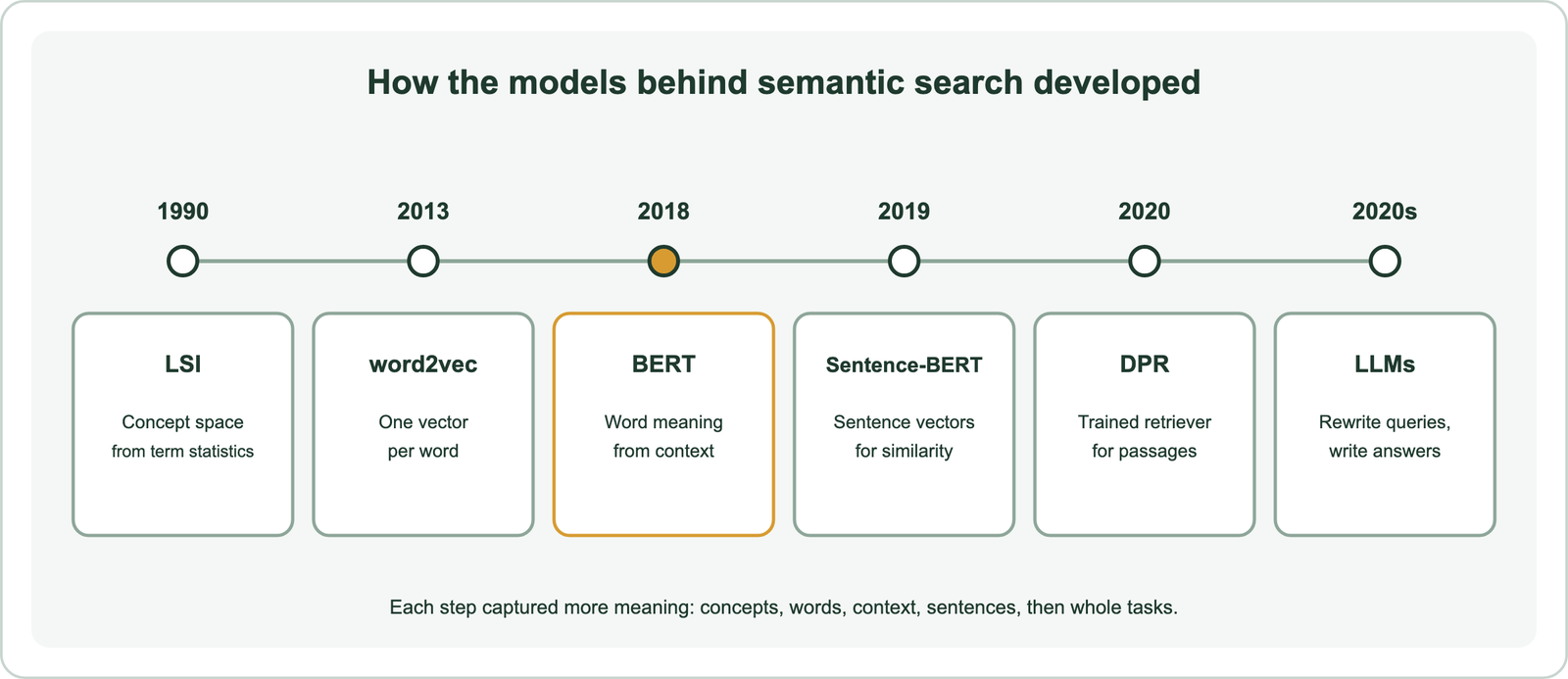
The first step was latent semantic indexing. Deerwester and colleagues described it in 1990 in the Journal of the American Society for Information Science. It mapped terms and documents into a smaller space of underlying concepts, so documents could match a query without sharing its exact words.
The second step was word vectors. Mikolov and colleagues at Google introduced word2vec in 2013. It learned a vector for each word from very large text collections and reached state-of-the-art results on tests of syntactic and semantic word similarity. Its limit was that each word had one vector, whatever its context, so “bank” meant the same thing beside “river” and beside “loan.”
The third step was contextual models. BERT, from Devlin and colleagues in 2018, read text in both directions at once and gave each word a vector shaped by its surroundings. It set new state-of-the-art results on eleven NLP tasks.
The fourth step turned those models into retrievers. Reimers and Gurevych’s Sentence-BERT in 2019 produced whole-sentence embeddings that could be compared with cosine similarity. Karpukhin and colleagues’ Dense Passage Retrieval in 2020 trained separate encoders for questions and passages. On its question-answering datasets, it beat a BM25 baseline by 9 to 19 points in top-20 retrieval accuracy. Embeddings sit at the center of all of this.
How do embedding models give semantic search its meaning?
Embedding models give semantic search its meaning by converting each query and document into a vector whose position reflects what the text is about. Texts with similar meaning end up near each other, and search becomes a question of distance.
The model learns those positions during training. It sees huge numbers of examples and adjusts until related texts land close together and unrelated ones land apart. After training, the model is fixed. It embeds every document once during indexing and every query at search time. The embeddings guide explains the vectors in detail.
The practical consequence is that the model defines what “similar” means. A general model trained on web text knows everyday language well. It may know less about legal clauses, chemical names, or internal product codes. Choosing a model is therefore a search decision, not just an engineering one.
No model is best at everything. Muennighoff and colleagues’ MTEB benchmark, published at EACL 2023, covered 8 tasks, 58 datasets, and 112 languages. It found that no single embedding method dominated across all tasks. Teams therefore test candidate models on their own queries, as the evaluation guide describes. Before teams built these systems themselves, the most visible example ran at web scale.
Why did BERT change web search?
BERT changed web search because it let a search engine read the small words that change a query’s meaning, such as prepositions, in the context of the whole query. Earlier systems often treated those words as noise.
Google described the change in October 2019. Pandu Nayak, a Google Fellow and vice president of Search, wrote that BERT would help Search better understand one in 10 searches in the US in English. His example was the query 2019 brazil traveler to usa need a visa. The word “to” signals a Brazilian traveling to the US. Earlier systems missed that and returned results about US citizens traveling to Brazil.
The example shows what contextual models add. The same words in a different order, or with a different preposition, mean a different need. Nayak framed the goal as letting people search in a way that feels natural instead of typing in keyword-style fragments.
This also answers a common question about semantic search in SEO. Search engines that understand meaning reward pages that answer the real question clearly, not pages that repeat a keyword. Google’s change is also the best-known example of semantic search in practice. Most organizations do not train models at that scale. They assemble several smaller models into one system.
Which machine learning models does a semantic search system use?
A semantic search system typically uses an embedding model for retrieval, a cross-encoder for reranking, and sometimes models for query processing and answer generation. Each model fits one stage.
| Stage | Model type | What it does |
|---|---|---|
| Query processing | Classifier, entity recognizer, or LLM | Detects intent, extracts filters, rewrites queries |
| Retrieval | Embedding model (bi-encoder) | Turns text into vectors for nearest-neighbor search |
| Reranking | Cross-encoder | Rescores the top results by reading query and text together |
| Answering | Large language model | Writes an answer from retrieved passages |
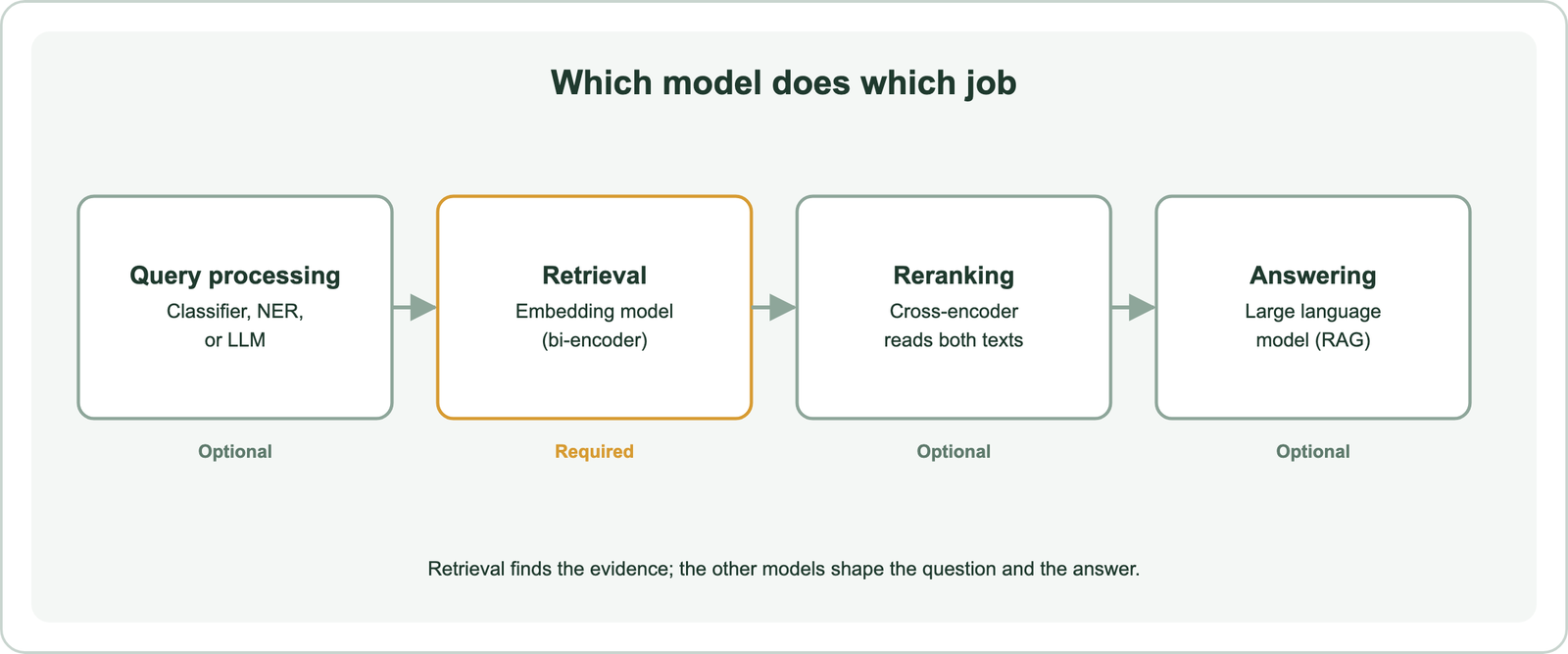
The table shows that “the AI” in a search system is usually several models. Weaviate configures most of them as modules: vectorizers embed data at import and queries at search time, and reranker modules, which its documentation notes are typically cross-encoders, reorder results. Elastic offers a similar path through its semantic_text field and inference API.
The retrieval models guide compares dense, sparse, and late-interaction retrievers. Reranking covers the second stage. To see these pieces assembled in code, the build guide walks through a working example, and semantic search tools compared covers the products. The newest models in that table have changed the most.
How do large language models fit into semantic search?
Large language models fit around semantic search rather than replacing it: they rewrite and plan queries before retrieval and generate answers after it. Retrieval still finds the evidence. The language model shapes the question and the response.
Before retrieval, a language model can expand a vague query, split a compound question, or turn “shoes under $70” into a search plus a price filter. Weaviate’s Query Agent does this with an LLM, and its documentation lists query expansion, query decomposition, and filter construction among its features. Query understanding covers these techniques and their latency cost.
After retrieval, a language model can write an answer from the passages found. That pattern is retrieval-augmented generation. Weaviate’s RAG guide describes it as retrieving relevant data and giving it to a language model as context with the task. Semantic search in an LLM setting therefore means the retrieval step that feeds the model, and its quality limits the answer’s quality. Semantic search use cases covers where this appears in products.
Language models also generate embeddings themselves in some systems, and they can judge relevance during evaluation. Their reach is wide, but so are their costs and their failure modes.
Where does AI-powered semantic search still fail?
AI-powered semantic search still fails on exact terms, unfamiliar domains, and confident wrong matches, because its models learn general patterns rather than rules. Knowing the failures is how teams design around them.
Exact terms are the first gap. An embedding can blur a product code, a part number, or a rare name into nearby but wrong items. Hybrid search fixes this by adding keyword matching, and keyword search explains why literal matching still matters.
Domain shift is the second. Thakur and colleagues’ BEIR benchmark found that BM25 remained a robust baseline across 18 datasets, while dense models often underperformed when moved to new domains. A model trained on web text may not understand a specialist’s vocabulary without testing or fine-tuning.
Confident wrong matches are the third. A vector search always returns its nearest results, even when none is relevant. Similarity is not truth, and a fluent generated answer built on a poor match is still wrong. Thresholds, filters such as metadata filtering, reranking, and measured evaluation keep these failures in check. At scale, memory and cost become limits too, covered in scaling semantic search.
AI powers semantic search through language models that turn text into representations of meaning. NLP supplied the path, from latent semantic indexing to word2vec, BERT, Sentence-BERT, and dense retrievers. Today’s systems combine an embedding model for retrieval, a cross-encoder for reranking, and large language models around the edges. Google’s BERT change showed the value at web scale, and benchmarks such as MTEB and BEIR show the limits. The decision is to pick models by testing them on your own queries, and to pair them with keyword matching, filters, and evaluation where meaning alone is not enough.