Home / Filtering / Metadata Filtering in Semantic Search and Vector Databases
Metadata Filtering in Semantic Search and Vector Databases
Metadata filtering is an information retrieval technique that restricts vector or hybrid search to records whose structured attributes satisfy a condition. Similarity ranks eligible records, while fields such as product, region, role, date, tenant, and version decide eligibility. A system may apply the filter before search, during approximate-index traversal, or after candidates return. Placement changes speed, recall, and result count. The pgvector README gives the clearest shortfall example: a condition matching 10% of rows leaves 4 matches on average when HNSW examines 40 candidates. Reliable filtering therefore depends on indexed fields, correct metadata, trusted conditions, and evaluation across restrictive and broad filters.
Metadata filtering in four facts
- Metadata filtering decides which records qualify, while vector similarity decides their order.
- Weaviate builds an inverted-index allow list and has used ACORN as its default HNSW filter strategy since version 1.34.
- Post-filtering 40 candidates at 10% selectivity leaves 4 expected matches under the pgvector example.
- Typed, indexed metadata fields should be defined before ingestion because several engines require reindexing or re-upserting later.
What does metadata filtering add to vector search?
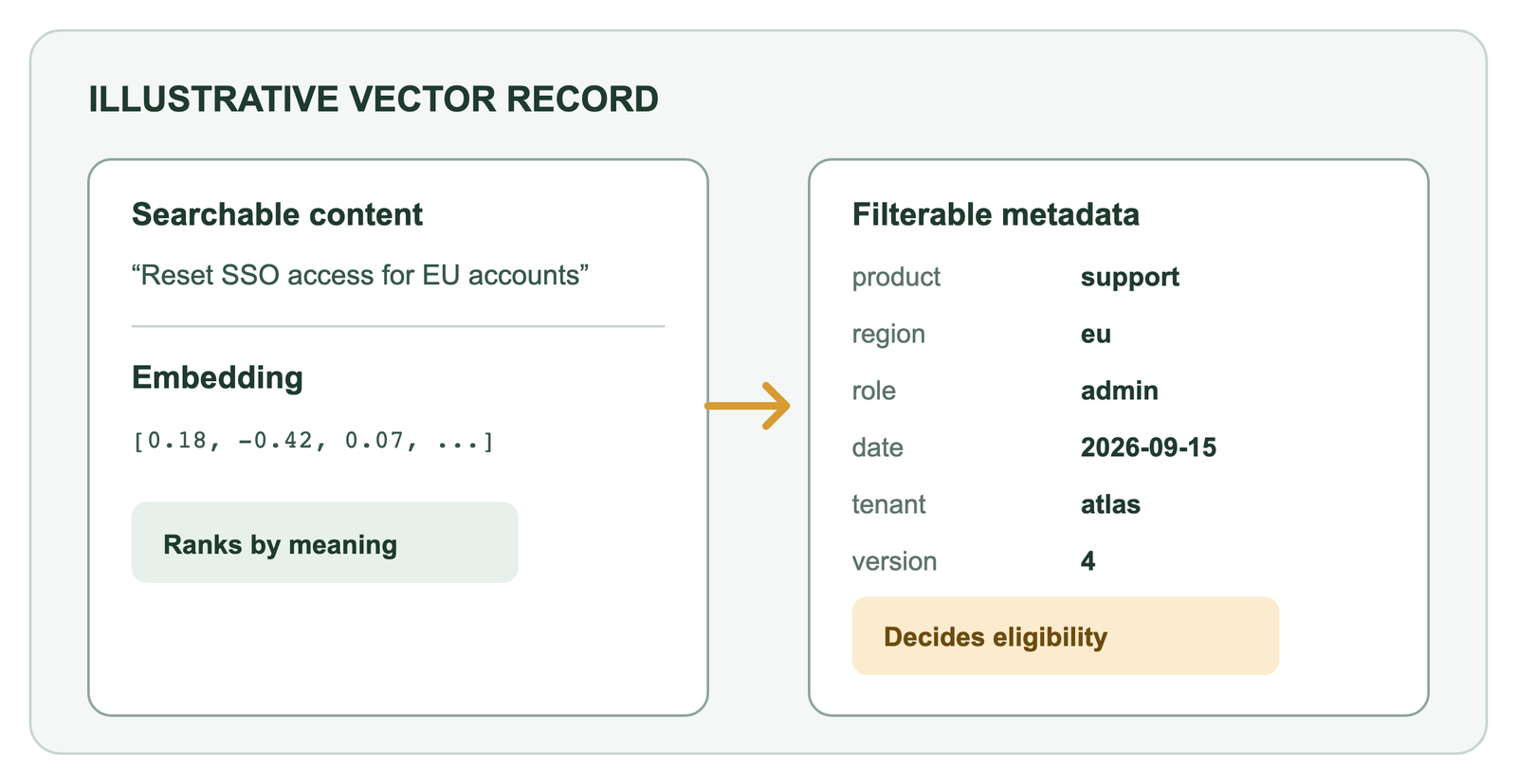
Metadata filtering adds an eligibility rule to vector search: similarity orders records, while the filter decides which records may appear. Weaviate’s official Filters documentation, read October 9, 2026, defines filters as conditions that include or exclude objects. Similarity still ranks eligible records by distance or score. This separates searching and filtering into ordering and eligibility.
Metadata describes a record through structured fields rather than its embedded text. Jenn Riley’s 2017 NISO primer, Understanding Metadata, groups metadata into three types: descriptive, administrative, and structural. Retrieval fields may identify a product, region, role, date, tenant, version, or language. A filter compares those fields through equality, range, membership, or Boolean conditions.
Metadata filtering therefore changes the candidate set, not the meaning represented by an embedding. An illustrative product record could contain a description vector plus fields for category, stock status, region, and release date. Vector search ranks meaning within the permitted records. Hard conditions become necessary when semantic similarity cannot determine which records qualify.
Why does semantic search need metadata filters?
Semantic search needs metadata filters because an embedding represents meaning, not hard business conditions such as stock, region, version, or permission. Qdrant’s official Filtering documentation identifies stock availability, user location, and price range as conditions that embeddings cannot express reliably. A semantically close result may still violate every one of those conditions.
Metadata filters remove ambiguity that similarity cannot settle. AWS solutions architects Corvus Lee and Ahmed Ewis, with data scientist Chris Pecora, describe legal documents that share terminology but belong to different contexts. Their Amazon Bedrock Knowledge Bases article also describes movies with similar plots from different years. Software documents for different operating systems or versions create the same problem. Each case needs semantic relevance and a structured constraint.
Protected and shared collections add two stricter eligibility questions. Permission-aware search limits results to records allowed for the authenticated principal. Multi-tenant semantic search keeps one customer’s records outside another customer’s result set. Weaviate’s multi-tenancy documentation states that each tenant occupies a separate shard. Once a condition exists, retrieval must decide where to apply it.
How does a metadata filter combine with vector similarity?
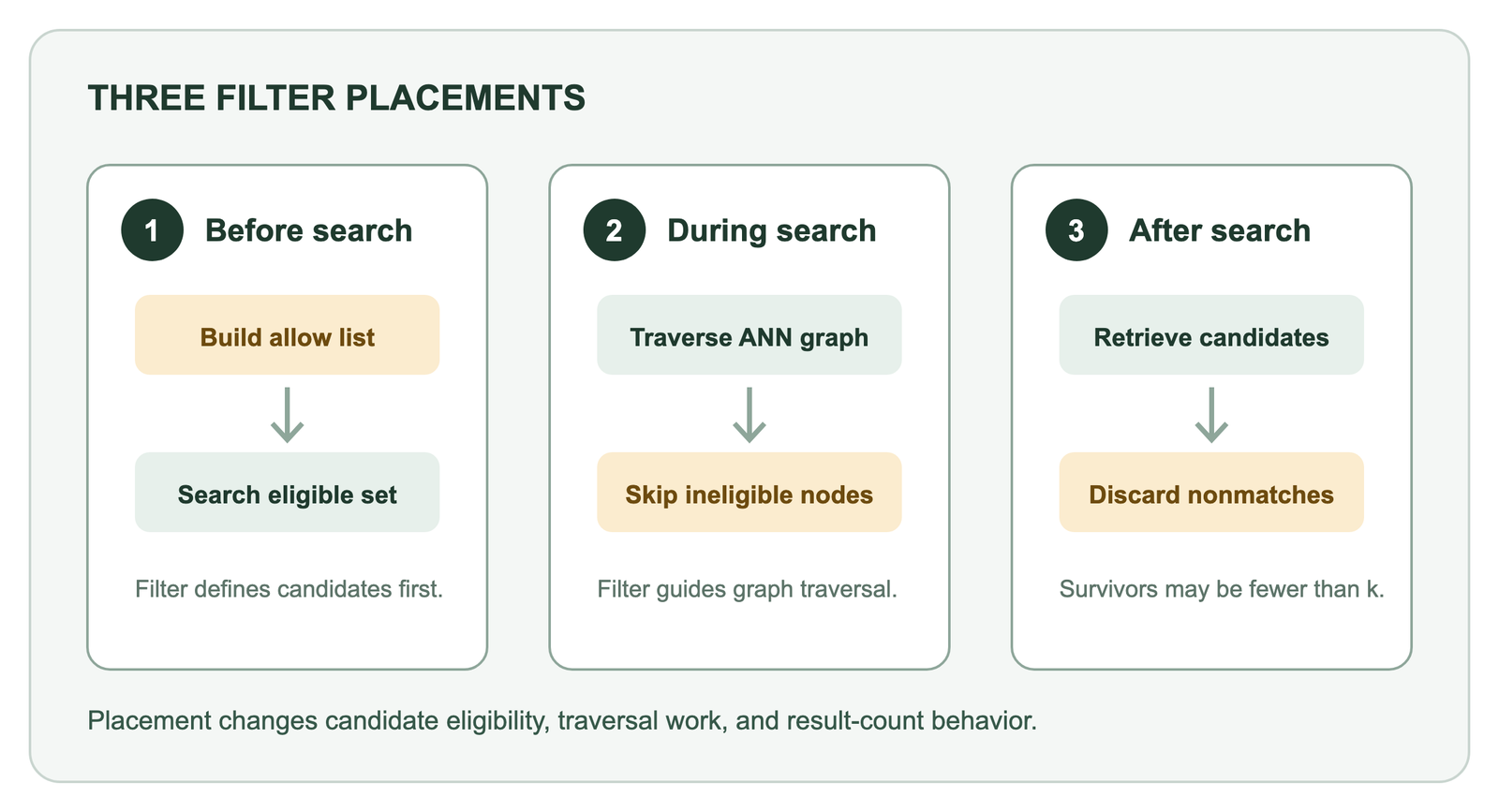
A metadata filter combines with vector similarity at one of three points: before nearest-neighbor search, during graph traversal, or after candidates return. These placements determine which records the similarity process examines and whether rejected candidates receive replacements. The distinction applies to exact and approximate nearest-neighbor search.
Pre-filtering establishes eligibility before the system produces nearest neighbors. Weaviate’s Filtering Concepts documentation says its inverted index creates an allow list and passes that list to HNSW. Patel, Kraft, Guestrin, and Zaharia model exact pre-filtering in the 2024 ACORN paper with a cost of O(sn + K). In that expression, s is selectivity, n is corpus size, and K is requested results. The detailed pre-filtering and post-filtering comparison covers when each placement fits.
Filtering during traversal lets an approximate index use eligibility while exploring its graph. OpenSearch’s official vector-filtering documentation calls this efficient k-NN filtering and applies the condition during vector search. The ACORN paper modifies graph exploration to reach eligible neighborhoods when predicates and vector proximity have weak correlation. This is the central problem addressed by filtered ANN search.
Post-filtering runs similarity search first and removes ineligible records from its returned candidates. Weaviate’s Filtering Concepts documentation identifies incomplete result sets and wasted work among the disadvantages of that order. Post-filtering remains mechanically simple, but a restrictive condition may discard most candidates before filling the requested result count.
Why does post-filtering return fewer results than requested?
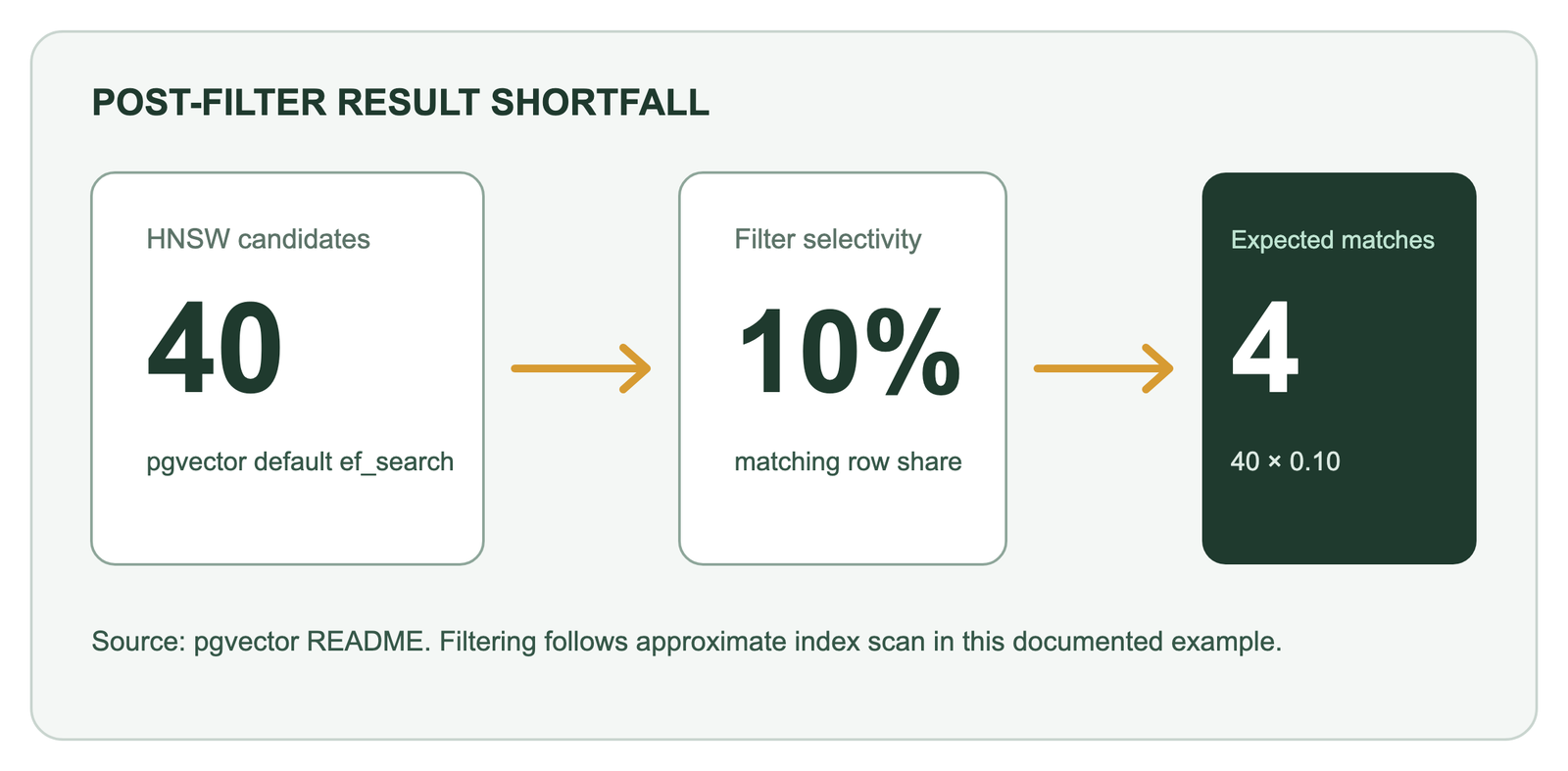
Post-filtering returns fewer results because the metadata condition only examines candidates already returned by approximate vector search. A selective condition may reject most candidates before the application receives them. Weaviate documentation identifies incomplete result sets and wasted vector comparisons as two disadvantages of this sequence. OpenSearch also warns that a post_filter query may return fewer than k results.
The expected survivor count is E = n × s, where n is candidate count and s is selectivity as a decimal. Under an independence assumption, the probability that no candidate survives is P(0) = (1 - s)n. The pgvector README supplies a concrete case. A condition matching 10% of rows leaves 4 results on average when HNSW examines its default 40 candidates. Those inputs produce a calculated 1.48% chance of zero survivors.
Selectivity alone does not guarantee result count because the filter may correlate with the query vector. Patel, Kraft, Guestrin, and Zaharia explain that uniform post-filtering needs approximately K / s candidates to obtain K eligible results. At 10% selectivity, 10 expected survivors require about 100 candidates. Negative correlation may require more work because matching vectors lie away from the graph region reached first.
Amazon S3 documentation reports the same boundary for CLASSIC S3 Vectors indexes. These indexes may return fewer than top K when few candidates match. Increasing candidate depth reduces shortfall but raises distance calculations and latency. The detailed guide to filter selectivity covers how match rate and query correlation change that trade-off.
Expected survivors = candidates × selectivityChance of zero survivors = (1 - selectivity)candidates
Expected survivors:
Expected shortfall:
Chance of zero survivors:
How do vector databases make metadata filtering fast?
Vector databases make metadata filtering fast by indexing filter fields, constructing a compact eligible-record set, and using that set during vector search. Weaviate documentation states that indexFilterable uses Roaring Bitmaps for match conditions. Its numerical and date range index uses Roaring Bitmap slices. These structures perform set intersections without reading every stored metadata object. The mechanism connects metadata filtering to bitmap filters and a conventional inverted index.
Weaviate passes its eligible-object allow list into HNSW and changes strategy when a filter becomes restrictive. Its documentation, checked October 9, 2026, lists ACORN as the default filter strategy since version 1.34. PathSeer became available in version 1.40. Weaviate states that filtered recall is typically no worse than unfiltered recall, but that remains a vendor statement. Collection data and settings determine measured recall.
Qdrant uses payload indexes to estimate filter cardinality before choosing a query plan. Its filterable HNSW adds edges associated with indexed payload values. ACORN has been available since version 1.16.0 for difficult filter combinations. Qdrant documentation recommends creating payload indexes before ingestion. Later indexes do not add filter-aware HNSW edges without rebuilding the graph.
Engines differ in where candidate expansion happens. OpenSearch documents efficient filtering during vector search. pgvector added iterative index scans in version 0.8.0 so an approximate scan may continue until enough filtered rows appear. These execution plans show why a comparison of vector databases with metadata filtering must examine placement, filter indexes, and candidate expansion. A yes-or-no feature label cannot describe those differences.
How do you add metadata filters such as product, region and role to vector search?
To add metadata filters such as product, region and role, store each attribute as a typed field on every chunk, index the field, and attach a filter expression to the vector or hybrid query. Product and region describe business scope. Role describes authorization scope. The application must derive role values from the authenticated server session, not from editable query text or browser parameters.
Metadata filtering requires five ordered implementation steps.
- Define atomic fields. Store product, region, and allowed roles as separate typed properties rather than one combined label or unparsed JSON string.
- Populate every chunk. Copy governing document attributes onto each retrievable chunk so the database can decide eligibility without reconstructing the parent document.
- Index queried fields. Create the engine’s filter index before bulk ingestion when its graph or metadata-index design depends on ingestion order.
- Build trusted conditions. Accept product and region from validated application state. Obtain allowed roles from the authenticated identity and authorization service.
- Submit one retrieval request. Pass conditions with the vector, BM25, or hybrid search query. Verify relevance and result count.
The following original Python example uses Weaviate’s documented client syntax. The official filter documentation confirms that near_text accepts filters. Equality conditions combine with &, while contains_any accepts candidate arrays. The same filter interface also works with Weaviate hybrid and BM25 queries.
from weaviate.classes.query import Filter

def search_support_chunks(
    client,
    query: str,
    product: str,
    regions: list[str],
    authenticated_roles: list[str],
):
    chunks = client.collections.use("SupportChunk")

    scope = (
        Filter.by_property("product").equal(product)
        & Filter.by_property("region").contains_any(regions)
        & Filter.by_property("allowedRoles").contains_any(authenticated_roles)
    )

    response = chunks.query.near_text(
        query=query,
        filters=scope,
        limit=5,
    )
    return response.objects
Filter syntax is not portable across retrieval systems. Official documentation checked October 9, 2026 shows the following equality forms. Weaviate uses client filter objects. Pinecone and S3 Vectors use MongoDB-like operators. Qdrant models Boolean clauses explicitly. Bedrock places the operator outside its key-value object. Haystack and LlamaIndex expose framework formats whose operator support depends on the connected store.
| System | Equality condition for product | Combination model |
|---|---|---|
| Weaviate | Filter.by_property("product").equal("Admin Console") | &, |, and Filter.not_ |
| Pinecone | {"product": {"$eq": "Admin Console"}} | $and and $or |
| Qdrant | FieldCondition(key="product", match=MatchValue(value="Admin Console")) | must, should, and must_not |
| Amazon S3 Vectors | {"product": {"$eq": "Admin Console"}} | $and and $or |
| Cloudflare Vectorize | filter: {"product": "Admin Console"} | Multiple keys form an implicit AND |
| Amazon Bedrock | {"equals": {"key": "product", "value": "Admin Console"}} | andAll and orAll |
| Haystack | {"field": "meta.product", "operator": "==", "value": "Admin Console"} | AND, OR, and NOT |
| LlamaIndex TypeScript | {key: "product", value: "Admin Console", operator: "=="} | Conditions inside preFilters.filters |
A framework adapter does not erase database-specific indexing, typing, or operator limits. The implementation guide for LangChain and LlamaIndex covers adapter wiring in depth. Filter correctness still depends on stored values and engine behavior.
How should metadata fields be designed before filtering starts?
Metadata fields should be designed before ingestion as atomic, typed, indexed attributes with an explicit rule for missing values. Weaviate documentation states that range indexes can be enabled only for new properties. Changing an existing property requires a new collection and data migration. Qdrant recommends creating payload indexes before uploading data. Cloudflare Vectorize excludes previously inserted vectors from a new metadata index until those vectors are upserted again.
Field types must match their future comparisons. Pinecone documentation restricts $gt, $gte, $lt, and $lte to numbers. Cloudflare Vectorize indexes the first 64 bytes of a string value. Prices, timestamps, versions, regions, and roles therefore work better as separate typed fields than as one opaque string. A broader search index schema should decide which fields are embedded, searchable, filterable, or stored only for display.
Missing values need one documented meaning. Weaviate requires null-state indexing for null filters. Qdrant documentation separates IsNull from IsEmpty. Pinecone and Amazon S3 Vectors expose an $exists operator. Tokenization also changes equality behavior. Weaviate’s default word tokenization splits identifiers, while field tokenization preserves an entire identifier. Schema tests should cover absent, empty, malformed, and differently cased values.
When does metadata filtering fail or mislead retrieval?
Metadata filtering fails when metadata is wrong, a constraint excludes useful records, query-to-filter extraction is inaccurate, or an application mistakes filtering for authorization. Weaviate defines a filter as an inclusion or exclusion condition over stored properties. A stale version, region, or role value therefore changes record eligibility before semantic similarity can help. GraphRAG’s Metadata Filtering reference warns that LLM-extracted metadata can be inconsistent and can exclude relevant documents.
Engine limits can also make a valid-looking filter incomplete. Weaviate documentation limits a geo filter to the nearest 800 results. An overly selective condition can also produce zero eligible records. These boundaries need explicit tests because a syntactically accepted filter does not guarantee complete retrieval.
Automatically inferred filters require validation against allowed fields and operators. Amazon Bedrock documentation states that implicit filtering generates a condition from the user query and a supplied metadata schema. That mechanism belongs to query understanding, not access control. A permission-aware search system should build constraints from authenticated server-side state. Stronger multi-tenant isolation may use separate shards, partitions, or tables.
Where is metadata filtering used in semantic search?
Metadata filtering is used in RAG, product search, enterprise document search, multi-tenant software, and faceted navigation. Each use case contains a condition that semantic similarity alone cannot settle. AWS authors Corvus Lee, Ahmed Ewis, and Chris Pecora describe a software-documentation chatbot filtered by operating system or application version. These patterns let RAG retrieval restrict evidence before sending chunks to a language model.
Product search uses structured constraints for attributes such as price, location, and stock availability. Qdrant’s filtering documentation names all three as features that embeddings cannot express reliably. A query may retrieve suitable products while excluding unavailable inventory or items outside a price range. The same fields power faceted semantic search, where selected categories constrain the set. The semantic product search pattern combines hard conditions with vague shopping intent.
Enterprise search applies the same separation to department, project, document type, release, and permission fields. The AWS example uses work groups, business units, project IDs, release versions, and source types to narrow organizational content. Metadata filtering determines which records qualify, while vector or hybrid retrieval ranks qualified records by relevance.
How do you test whether metadata filtering improves retrieval?
Test metadata filtering by measuring filtered recall@k against eligible ground truth, result-count shortfall, and latency across selectivity buckets. Patel, Kraft, Guestrin, and Zaharia define filtered recall in the 2024 ACORN paper against ground-truth neighbors that satisfy the predicate. This makes recall@k a direct test of whether relevant eligible records survived retrieval. A separate ANN recall comparison shows what approximate search missed relative to exact search over the same eligible set.
Evaluation should hold query set, filter predicate, requested k, and relevance judgments constant while changing filtering strategy. OpenSearch documentation illustrates selectivity levels of 2.5%, 38%, and 80% in its filtered-search guidance. Testing restrictive, middle, and broad filters exposes failures hidden by one average. Record returned-result count beside latency. A fast query returning fewer than k eligible results has not completed the same task.
Recall results also need source-specific interpretation. Weaviate documentation states that its filtered recall is typically not worse than unfiltered recall. That remains a vendor statement rather than a guarantee for another corpus or engine. A full semantic search evaluation should segment failures by filter field, selectivity, and query type. Database choice follows measured behavior, not a feature checklist.
Metadata filtering makes structured eligibility and semantic relevance work together without confusing their jobs. Typed fields express product, region, date, role, tenant, and version rules. Vector similarity orders the records that remain. Placement, selectivity, and query correlation determine whether that combination returns enough relevant results at acceptable latency. Testing filtered recall, result shortfall, and latency turns those mechanics into a defensible implementation choice.