Home / Keyword search / The Vocabulary Mismatch Problem in Search
ExplainerThe Vocabulary Mismatch Problem in Search
The vocabulary mismatch problem is the gap between the words a person uses to search and the words a relevant document uses, which makes keyword search miss documents that answer the query. A user types “cancel my subscription” while the help article says “end your membership”, and an exact-match engine finds nothing in common. The problem is not rare: George Furnas and colleagues showed in 1987 that two people pick the same word for the same thing less than 20 percent of the time. Synonyms, abbreviations, spelling variants, jargon and different languages all widen the gap. Fixes have accumulated over decades: stemming, synonym lists, query expansion, document expansion, latent semantic indexing, learned sparse models and dense embeddings. Embeddings close most of the gap by matching meaning, but they can miss rare exact terms that keyword search handles well. Hybrid search, which combines both, is the usual answer.
The vocabulary mismatch problem in four facts
- Vocabulary mismatch happens when a query and a relevant document use different words for the same idea.
- Furnas and colleagues found in 1987 that two people choose the same term for an object less than 20 percent of the time.
- Weaviate’s documentation shows vector search matching “very dark” or “ebony” to “black”, which keyword search cannot do.
- Weaviate’s documentation also shows vector search returning “cherry tomato” for “jackfruit”, where hybrid search helps.
What is the vocabulary mismatch problem in search?
The vocabulary mismatch problem in search is the failure to retrieve a relevant document because the query and the document describe the same thing with different words. The document exists and answers the need, but no query word appears in it.
Keyword search, described in what is keyword search, finds documents through shared tokens. If a user searches “laptop won’t turn on” and the right article says “notebook fails to boot”, none of the meaningful words overlap. The article never enters the candidate list, so no ranking function can rescue it.
The term comes from information retrieval research, where it describes one of the main causes of low recall. It is distinct from ranking problems. A ranking problem puts a found document in the wrong place; a vocabulary mismatch means the document is never found at all.
Users rarely notice the failure directly. They see poor results, rephrase, or give up, and assume the content does not exist. That invisibility is why the problem persists in many search systems for years. Its scale was measured in a classic study.
How common is vocabulary mismatch between users and documents?
Vocabulary mismatch is very common: in the study by George Furnas and colleagues, two people chose the same word for the same object less than 20 percent of the time. Most pairs of people describe the same thing differently.
Furnas, Thomas Landauer, Louis Gomez and Susan Dumais published “The vocabulary problem in human-system communication” in Communications of the ACM in 1987. They asked people to name objects and commands in several domains and measured how often different people agreed on a term. Agreement was low across all of them, which they called the vocabulary problem.
The implication for search is direct. A document is written in one person’s vocabulary and searched in another’s. If authors and searchers usually choose different words, then any system that relies only on shared words will miss many relevant documents.
The same research group went on to develop latent semantic indexing, one of the first attempts to match by meaning rather than exact words, described in latent semantic indexing. The forms the mismatch takes explain why so many fixes exist.
What forms does vocabulary mismatch take?
Vocabulary mismatch takes several forms: synonyms, word forms, abbreviations, spelling variants, professional jargon, broader or narrower terms, and different languages. Each needs a different kind of fix.
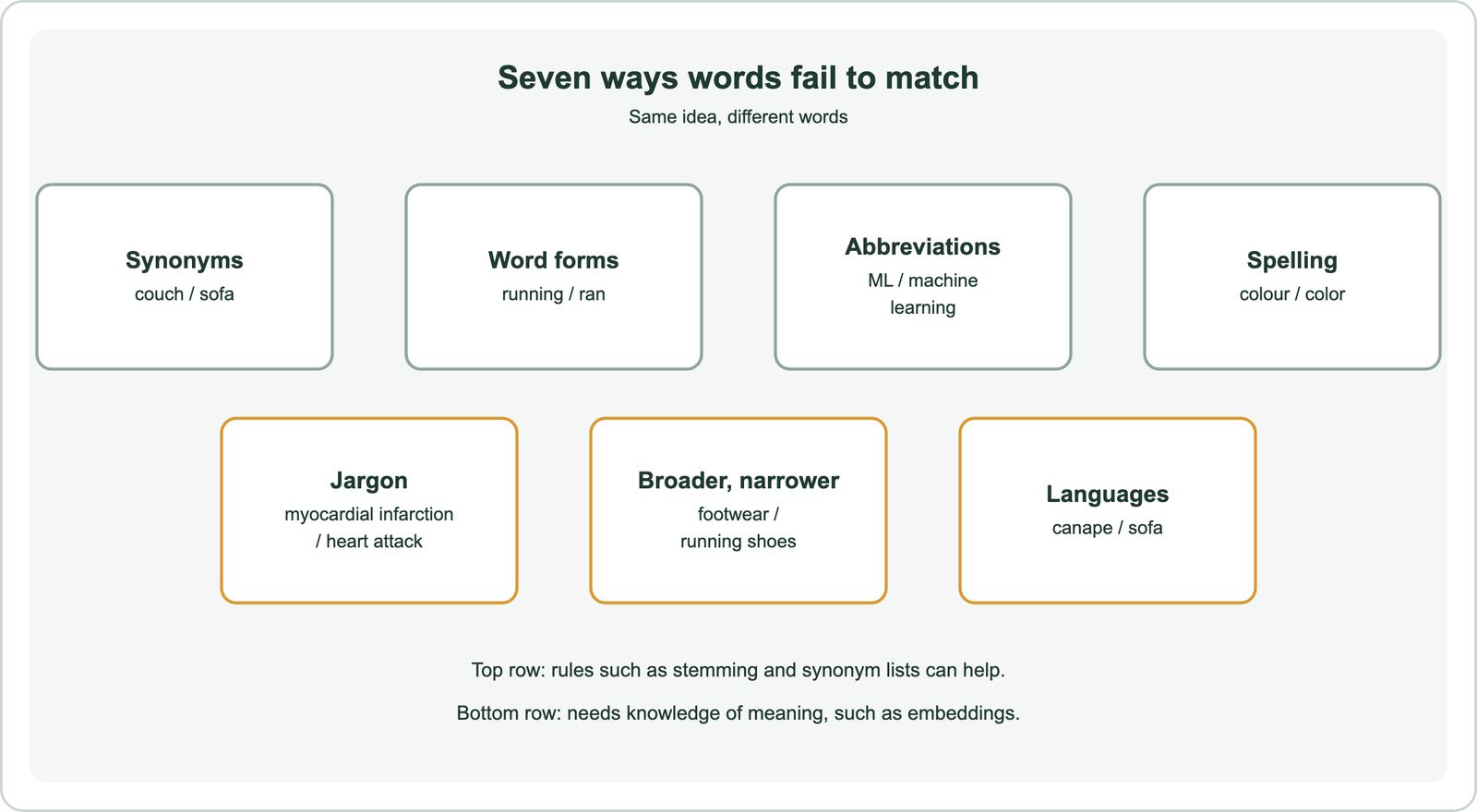
Synonyms are the classic case: “couch” and “sofa”, “cancel” and “end”. Word forms differ only in endings, such as “running” and “ran”. Abbreviations pair “ML” with “machine learning”. Spelling variants pair British and American forms, or common misspellings.
Jargon creates a gap between experts and everyone else. A doctor writes “myocardial infarction”; a patient searches “heart attack”. Broader and narrower terms are subtler: a search for “footwear” may need documents that only say “running shoes”. Different languages are the widest gap of all.
Word forms and spelling are the easiest to fix with rules. Synonyms and jargon need knowledge of meaning. The broader-term and language cases need even more. The traditional fixes work from the narrow end of that range.
How do stemming, synonym lists and query expansion address mismatch?
Stemming, synonym lists and query expansion address mismatch by changing the words being matched: stemming merges word forms, synonym lists add equivalent terms, and query expansion adds related words to the query. All of them stay within exact matching.
Stemming reduces “running” and “runs” to “run”, so word forms match. It does nothing for different words, as covered in stemming and lemmatization. Synonym lists map “couch” to “sofa” at index or query time. They are precise and predictable, but someone has to write and maintain them, and they miss whatever they do not list.
Query expansion adds terms automatically. Pseudo-relevance feedback runs the query, takes frequent terms from the top results, and adds them to a second query. Thesaurus-based expansion pulls related terms from a resource such as WordNet. Both can drift: an added term that is related but not equivalent brings in off-topic documents. The techniques are covered in query expansion.
These fixes work best for known, stable vocabularies, such as product catalogues with curated synonyms. They struggle with open-ended natural language. The ranking functions they feed, such as BM25 and TF-IDF, still only reward shared words. A different family of fixes works on the documents instead of the query.
How do document expansion and learned sparse models help?
Document expansion and learned sparse models help by adding likely query words to documents ahead of time, or by learning term weights that include related words, while keeping an inverted index. They bring some meaning into keyword matching.
Document expansion predicts the questions a document answers and appends them to its text before indexing. Doc2query, from Rodrigo Nogueira and colleagues in 2019, used a sequence-to-sequence model to generate such questions. A help article about “ending your membership” might gain the generated question “how do I cancel my subscription”, so the user’s words now appear in the index.
Learned sparse retrieval goes further. Models such as SPLADE produce a sparse vector over the vocabulary for each document and query, assigning weight to words that are not literally present but are strongly related. The result still runs on an inverted index, keeping keyword-style efficiency and transparency, as described in sparse retrieval.
Both approaches need a trained model and extra indexing work, and both are limited to the vocabulary the model learned. They narrow the gap without abandoning words as the unit of matching. Dense embeddings abandon words entirely.
How do embeddings close the vocabulary gap?
Embeddings close the vocabulary gap by representing queries and documents as vectors of meaning, so texts with different words but the same sense land close together. Matching no longer depends on shared tokens.
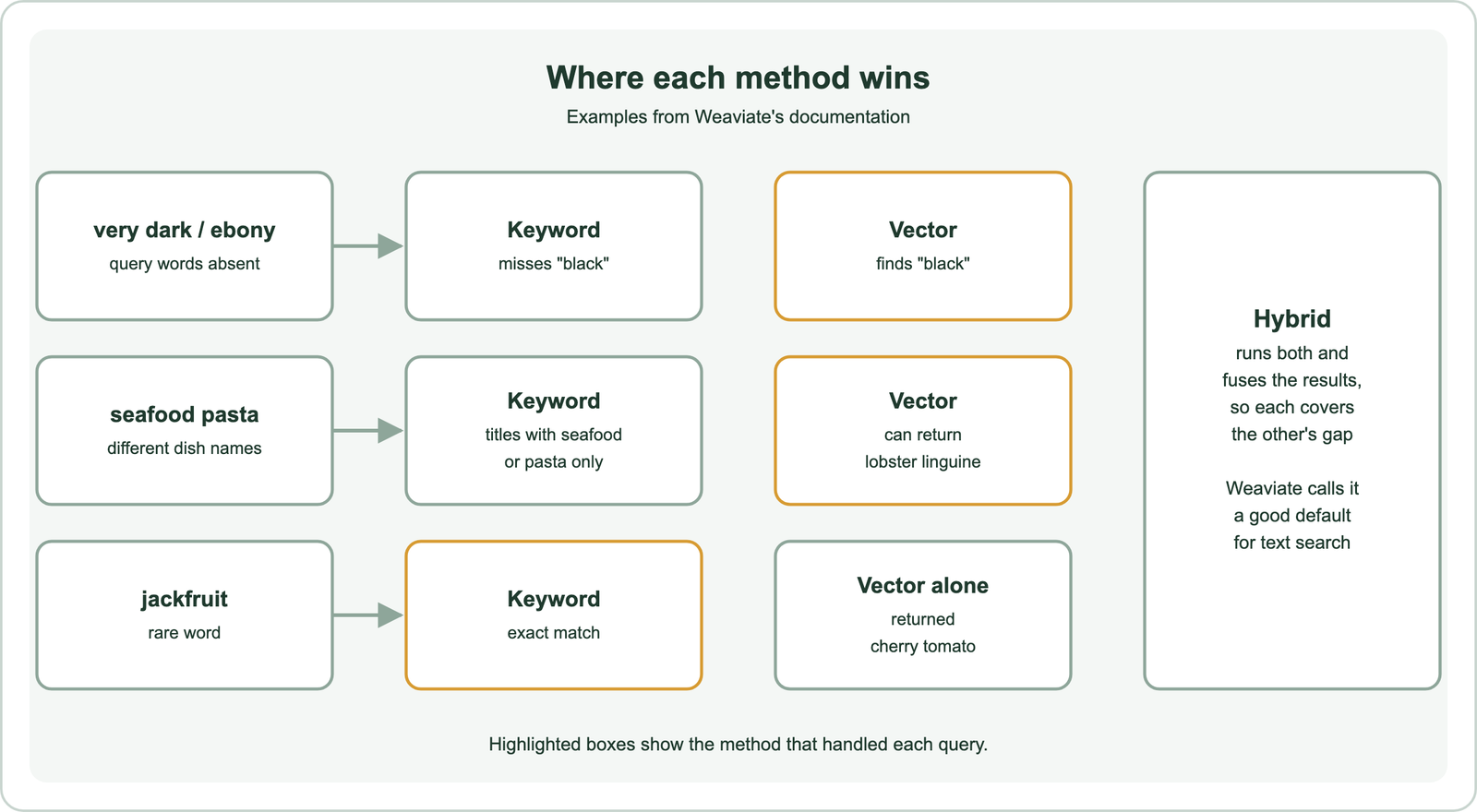
Weaviate’s search documentation gives a direct example. In a small set of animal descriptions, a keyword search for “black” finds descriptions containing “black”. A vector search also finds them for queries such as “very dark”, “noir” or “ebony”, because the embedding captures meaning rather than exact words. Weaviate’s blog on Vertex AI gives another: a vector search for “seafood pasta” can return a lobster linguine recipe, while keyword search returns only titles containing “seafood” or “pasta”.
Embeddings learn these relationships from large amounts of text in which synonyms and paraphrases share contexts, as explained in how semantic search handles synonyms and related terms. Multilingual models extend the bridge across languages.
Embeddings have their own blind spot. Weaviate’s Wikipedia tutorial notes that a vector search for “jackfruit” found “cherry tomato” as the top result, because a rare word may be poorly represented and pull in merely related items. Exact terms such as product codes, names and error strings suffer the same way. That is why the best fix combines methods.
Why is hybrid search the usual fix for vocabulary mismatch?
Hybrid search is the usual fix for vocabulary mismatch because it runs keyword and vector search together, so documents found by either path can reach the results. Each method covers the other’s weakness.
The vector side finds documents that use different words for the query’s meaning. The keyword side anchors rare exact terms the embedding may blur. Weaviate’s search documentation describes hybrid search as fusing both into one ranking and calls it a good default for text search. In the jackfruit example, Weaviate’s tutorial recommends a hybrid query to bring keyword matches back into the results.
The balance is adjustable. In Weaviate, the alpha parameter weights the vector side against the keyword side, so collections full of codes and names can lean towards keywords while conversational content leans towards vectors. Tuning is covered in balancing keyword and vector scores, and the method in hybrid search.
Hybrid search does not remove the need for the older fixes in every case. Curated synonyms still help for brand names and internal terms an embedding model never saw. Fine-tuned embeddings help for specialised fields. The combination depends on where the mismatch appears in your data.
How do you find vocabulary mismatch in your own search?
You find vocabulary mismatch in your own search by looking for queries with no results or quick reformulations, and checking whether relevant documents exist that use different words. Logs reveal most of it.
Zero-result queries are the clearest signal. If users search “end membership” and get nothing while an article titled “cancel your subscription” exists, the gap is visible. Reformulations are the next signal: a user who searches one phrase, then another, then clicks a result has shown you two vocabularies for the same need. These signals are covered in online search metrics and analytics.
Offline, build a test set with queries in users’ own words and judged relevant documents. Compare recall for keyword search, vector search and hybrid search on it. A large gain from vector search over keyword search points to vocabulary mismatch. The full method is in how to evaluate semantic search.
Fixing the specific gaps found this way often beats a general change. A handful of synonyms or a domain-tuned model may solve the worst queries. The underlying index structures are described in the inverted index and full-text search.
The vocabulary mismatch problem is the gap between the words people search with and the words documents use. It is common: Furnas and colleagues found people agree on a term less than 20 percent of the time. Keyword search misses relevant documents across that gap. Stemming, synonym lists, query expansion, document expansion and learned sparse models narrow it within exact matching, and embeddings bridge it by matching meaning, at the cost of blurring rare exact terms. Hybrid search, as in Weaviate, combines keyword and vector retrieval so each covers the other, and logs of zero-result and reformulated queries show where the gap remains.