Home / Tools / Semantic Search Tools and Platforms Compared
Semantic Search Tools and Platforms Compared
Semantic search tools are the databases, engines, managed services, and libraries that store embeddings and retrieve items by meaning, usually alongside keyword search. They differ less in whether they can run a vector query and more in what surrounds it. Some generate embeddings for you, some expect your own vectors. Some fuse keyword and vector results with one parameter, others with a configurable ranking language. Some are open source and self-managed, others are billed services with their own cost model. Weaviate, Elasticsearch, OpenSearch, Vespa, Meilisearch, and Manticore Search are complete search systems. Annoy is a nearest-neighbor library that leaves everything else to the application. The right choice depends on the workload, the team that will operate it, and a measured test on real queries.
Semantic search tools in four facts
- Semantic search tools range from complete search systems to nearest-neighbor libraries that provide only vector lookup.
- Most complete tools combine keyword and vector retrieval through a documented hybrid control.
- Embeddings can come from a built-in vectorizer, a hosted inference service, or the application itself.
- No tool is best without a test on real queries, relevance judgments, and a keyword baseline.
What is a semantic search tool, and what counts as one?
A semantic search tool is any component that stores representations of content and retrieves the closest ones to a query by meaning. That definition covers very different products. Weaviate’s search documentation describes vector search as one mechanism inside a larger system. A complete system can also add keyword retrieval, filters, fusion, reranking, and access controls. The broader idea is covered in what semantic search is.
Product classes help before any vendor names:
- Vector databases store objects with vectors and serve vector, keyword, and hybrid queries.
- Search engines with vector support add dense retrieval to a mature full-text engine.
- Managed search services run either kind for you and bill by usage or resources.
- Site-search products package retrieval with a ready interface for a website.
- Nearest-neighbor libraries provide only the index and lookup, inside an application.
The list separates what a product does from what it is called. A library such as Annoy and a platform such as Weaviate both answer “which vectors are closest.” Only the platform also stores the source objects, filters them, and fuses keyword evidence. Spotify’s Annoy README describes a static index stored in files and shared across processes through memory mapping. It does not describe lexical retrieval, hybrid fusion, or filtering. That gap is a scope difference, not a quality judgment.
Two neighboring terms cause most confusion. Vector search is the operation of finding the closest vectors, and every tool compared here performs it. Retrieval-augmented generation is a pattern that feeds retrieved material to a language model, and Weaviate’s documentation treats retrieval as one component of it. Semantic search can run without any generator, and semantic search in RAG covers the case where one is added. Keyword search remains a separate retrieval method that most complete tools also provide. Those boundaries matter as soon as the products sit in one table.
How do the main semantic search tools compare?
The main semantic search tools compare most clearly on product class, retrieval modes, embedding source, deployment, and cost basis. The table uses each vendor’s own documentation, read on October 9, 2026. Features and pricing change, so each cell describes the documented approach rather than a ranking.
| Tool | Class | Hybrid control | Embeddings | Deployment | Managed cost basis |
|---|---|---|---|---|---|
| Weaviate | Vector database | alpha from 0 to 1 | Vectorizer modules or supplied vectors | Embedded, Docker, Kubernetes, Weaviate Cloud | Vector dimensions, storage, backups |
| Elasticsearch | Search engine | Full-text, semantic, and hybrid queries | semantic_text or inference API | Serverless, hosted, self-managed | Storage, search capacity, ingest, infrastructure fee |
| OpenSearch | Search engine | Search pipeline with normalization or RRF | Ingest-pipeline embedding processors or supplied vectors | Self-managed: Docker, Kubernetes, Helm, packages | Depends on the host |
| Vespa | Search engine | Rank profiles and expressions | Built-in embedders or supplied vectors | Open source, Kubernetes, Vespa Cloud | Allocated vCPU, memory, disk, GPU memory |
| Meilisearch | Search engine | semanticRatio from 0.0 to 1.0 | Embedder providers or user-provided vectors | Self-hosted MIT edition or Cloud | Usage-based or resource-based |
| Manticore Search | Search engine | hybrid_match() with RRF | Local or remote models | Self-managed: packages, Docker, Helm | Self-hosted infrastructure |
| Annoy | ANN library | None | Application supplies vectors | Inside the application | None (library) |
The table shows two broad groups. Six tools are complete search systems that combine keyword and vector evidence. Annoy is a lookup component that a team would build around. Within the complete systems, the real differences sit in how hybrid ranking is controlled and who produces the vectors.
How do semantic search tools combine keyword and vector retrieval?
Semantic search tools combine keyword and vector retrieval by running both and fusing the results, but each exposes the fusion differently. Hybrid retrieval matters because pure vector search can blur names, codes, and error strings. The hybrid search guide explains the general method.
Weaviate’s hybrid documentation says it runs vector search and BM25 keyword search in parallel and then fuses the two result sets. Its alpha parameter runs from 0, keyword only, to 1, vector only, and Weaviate advises setting it explicitly when weighting matters. Relative score fusion has been its default fusion method since version 1.24.
Meilisearch uses a similar single dial. Its documentation defines semanticRatio 0.0 as keyword only, 1.0 as vector only, and anything between as hybrid. Manticore Search takes a different route. Its manual describes hybrid_match(), which runs BM25, embeds the same query, runs a nearest-neighbor search, and fuses both lists with reciprocal rank fusion.
Beyond Weaviate’s single dial, OpenSearch and Vespa expose more machinery. OpenSearch builds hybrid search from a search pipeline: a normalization processor combines scores, or a score-ranker processor applies reciprocal rank fusion. It supports filtering before or after scoring. Vespa’s hybrid tutorial combines lexical retrieval and nearestNeighbor retrieval with Boolean operators, then ranks with rank profiles. Those expressions can mix BM25, vector closeness, business attributes, and a global reranking phase. More control means more tuning, which is worth it only when a simple dial cannot express the ranking a product needs.
Where do the embeddings in a semantic search tool come from?
Embeddings in a semantic search tool come from one of three places: a built-in vectorizer, a hosted inference service, or the application itself. That choice decides who manages the model, who pays for inference, and what happens when the model changes. The embeddings guide covers how the vectors themselves work.
Weaviate supports both paths. Its configuration guide says objects can carry vectors supplied directly or use a vectorizer module that generates them. Elastic recommends its semantic_text field as the simplest workflow, with the inference API and direct model deployment as lower-level options. Manticore Search can call local embedding models or remote providers, and remote models need an API key.
Annoy sits at the other end. It accepts vectors and indexes them, and the application must produce every vector before the build. Annoy’s README also says that once an index is built or saved, no more items can be added. A changing catalog therefore needs periodic rebuilds.
A built-in vectorizer keeps the import and query paths consistent, because the same configuration embeds both. Bring-your-own vectors give full model choice, but the application must embed queries with the same model it used for content. Either way, changing the model means re-embedding every stored item. That reindexing cost belongs in the comparison alongside hosting.
How do deployment and cost drivers differ across semantic search tools?
Deployment and cost drivers differ across semantic search tools because each vendor bills a different resource and leaves a different share of operations to the team. Self-managed tools cost infrastructure and staff time. Managed services cost a metered bill. The figure shows which layers move to the provider.
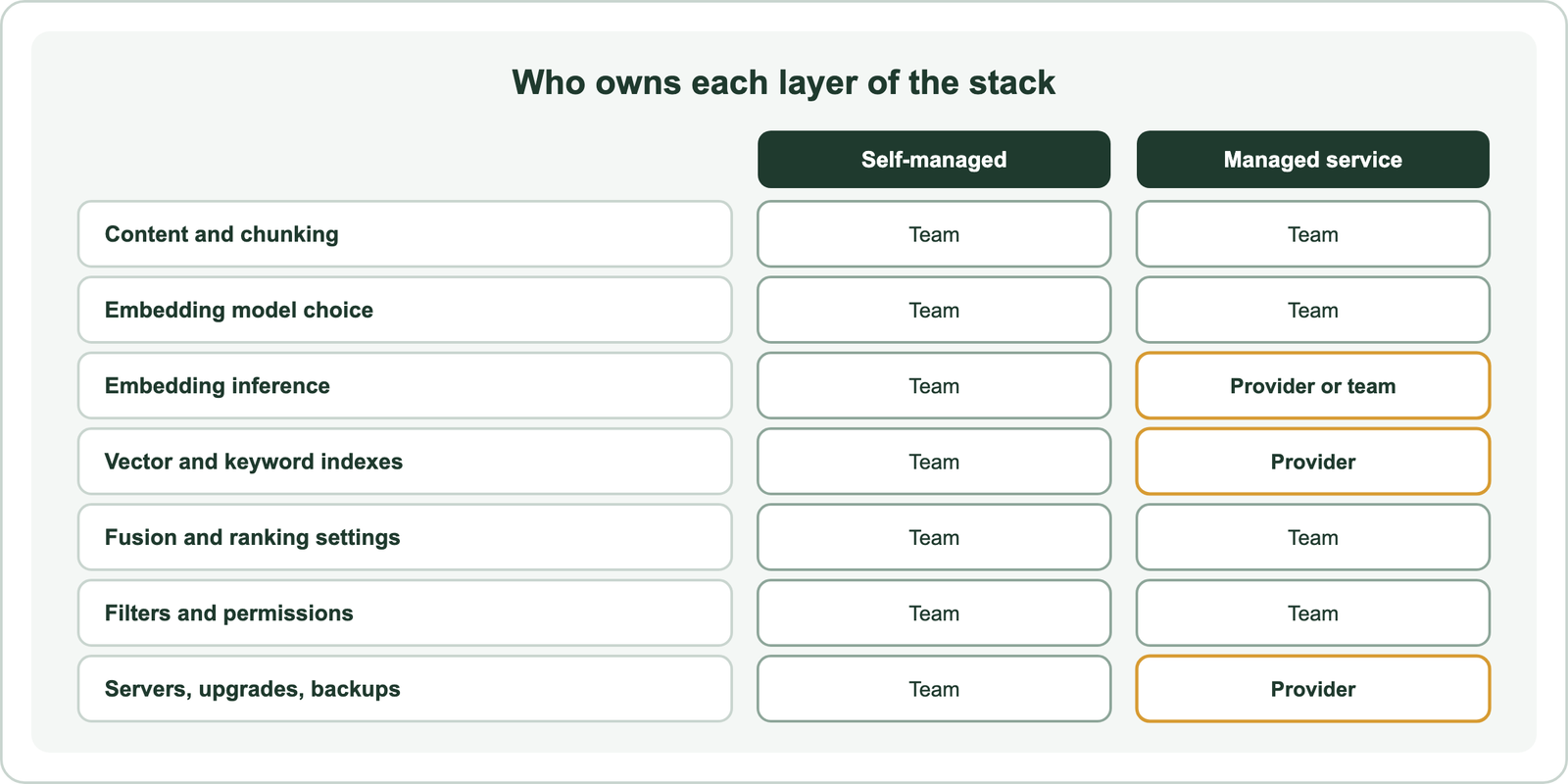
Weaviate lists embedded, Docker Compose, self-managed Kubernetes, Weaviate Cloud, DigitalOcean Managed Weaviate, and hybrid SaaS options. Weaviate Cloud prices by vector dimensions, storage, and backups. Vector dimensions equal object count times dimensionality times replication factor, adjusted for index type and compression. Elastic offers serverless, hosted, and self-managed models, and its serverless vector database bills storage, reserved search capacity, ingest volume, and an infrastructure fee.
Vespa Cloud charges for allocated vCPU, memory, disk, and GPU memory per hour, and it automates provisioning, node replacement, autoscaling, and upgrades. Meilisearch Cloud offers usage-based or resource-based billing. Its MIT-licensed Community Edition carries no usage charge, but self-hosting makes the operator responsible for upgrades, backups, scaling, and monitoring. OpenSearch is Apache 2.0 licensed and installs through Docker, Kubernetes, Helm, and system packages, so its cost depends on where it runs.
Prices change often, so compare billing dimensions rather than list prices. Those dimensions only make sense against a specific workload.
How does a team match a semantic search tool to its workload?
A team matches a semantic search tool to its workload by checking that its retrieval controls, embedding path, and operating model fit what that workload needs. Weaviate’s search guide gives the base rule: vector search for wording gaps or non-text data, keyword search for literal terms, and hybrid search for text that must handle both. Workload decides which tool expresses that rule most simply.
A product team that wants semantic, keyword, and filtered retrieval in one managed or self-hosted database suits a vector database such as Weaviate. Weaviate also serves keyword search, but a team that already runs Elasticsearch or OpenSearch for logs or full-text search can add vector fields without a new system. Ranking-heavy products that mix relevance with business signals suit Vespa’s rank expressions. Small teams adding search to an app or site often prefer Meilisearch’s single ratio. An offline batch job that only needs similar items from a fixed set can use Annoy.
Deeper buying guides split these cases. Enterprise semantic search platforms cover permissions, connectors, and governance. Open-source semantic search engines cover self-hosting and licensing. Semantic search APIs cover hosted endpoints that hide the index. Semantic site search tools cover packaged search for websites. Matching a class is a starting point, so the next step is narrowing to a short list.
How should a team shortlist semantic search tools?
A team should shortlist semantic search tools by applying hard constraints first, then matching retrieval needs, then keeping two or three candidates for a measured test. Feature lists invite endless comparison. Constraints remove most options quickly.
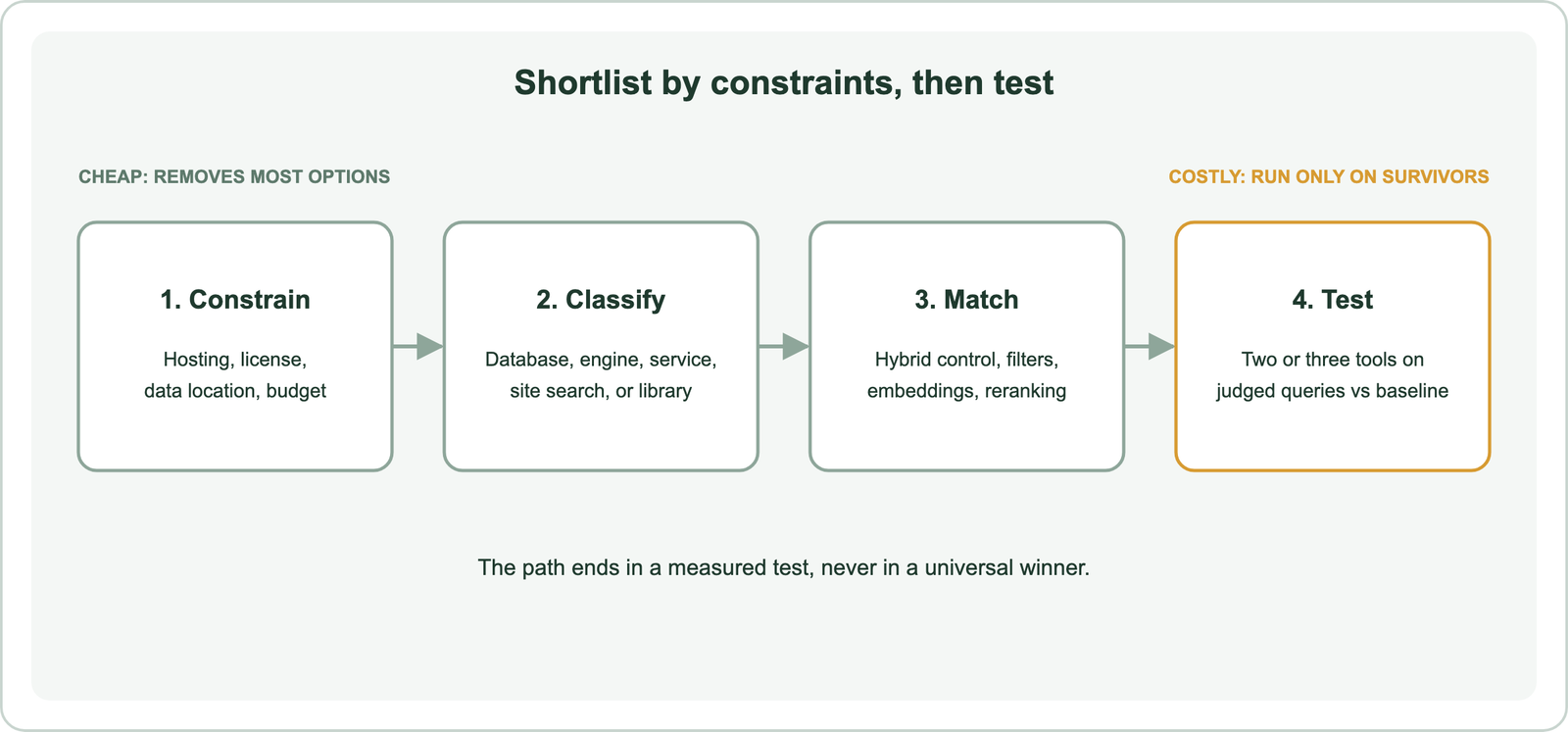
The path runs in four steps:
- Constrain by hosting, licensing, data location, and budget model.
- Classify the need as a database, engine, managed service, site-search product, or library.
- Match retrieval needs: hybrid control, filtering, embedding path, and reranking.
- Test the two or three survivors on the same queries and judgments.
The order matters because the first step is cheap and the last step is expensive. A team that must self-host under an open-source license removes every managed-only option at step one. A team without staff to run clusters may remove every self-managed option instead. Only the survivors deserve a test.
How should a team evaluate semantic search tools before choosing?
A team should evaluate semantic search tools on its own queries, with relevance judgments, a keyword baseline, and latency measured under realistic load. The OpenSearch Project’s guidance on optimizing hybrid search states the inputs: a query set, relevance judgments, and a search configuration. It adds that the best setup depends on data, user behavior, and domain.
Run each candidate on the same corpus, filters, and result depth. Include a keyword-only configuration as the baseline, because hybrid retrieval should beat it before it earns its extra cost. Measure recall and ranking quality on the judgments, then record latency and resource use. The evaluation guide explains how to build judgments, and the build guide covers a first implementation.
Count the cost of leaving as well as the cost of joining. Exporting objects is easy only if vectors and metadata stay portable. Changing the embedding model forces a full re-embed in any tool. Ranking logic written in one tool’s expression language must be rewritten for another. Weaviate’s search documentation adds a reminder for any tool: reranking can reorder results but cannot recover an object that first-stage retrieval missed. Test the whole pipeline, not one stage. A semantic search consultant can run this evaluation, but the consultant supplies expertise, not a retrieval product, and the same judged test still decides.
Semantic search tools store embeddings and retrieve by meaning, but the useful comparison is everything around that vector lookup. Weaviate, Elasticsearch, OpenSearch, Vespa, Meilisearch, and Manticore Search are complete search systems that fuse keyword and vector evidence through different controls. Annoy is a library that leaves storage, filtering, and keyword search to the application. Embedding source, deployment model, and billing dimensions separate the complete systems further. The decision is to narrow the field by constraints, keep two or three candidates, and choose the one that beats a keyword baseline on judged queries at an acceptable latency and cost.