Home / Comparisons / Semantic Search vs the Semantic Web: Not the Same Thing
ComparisonSemantic Search vs the Semantic Web: Not the Same Thing
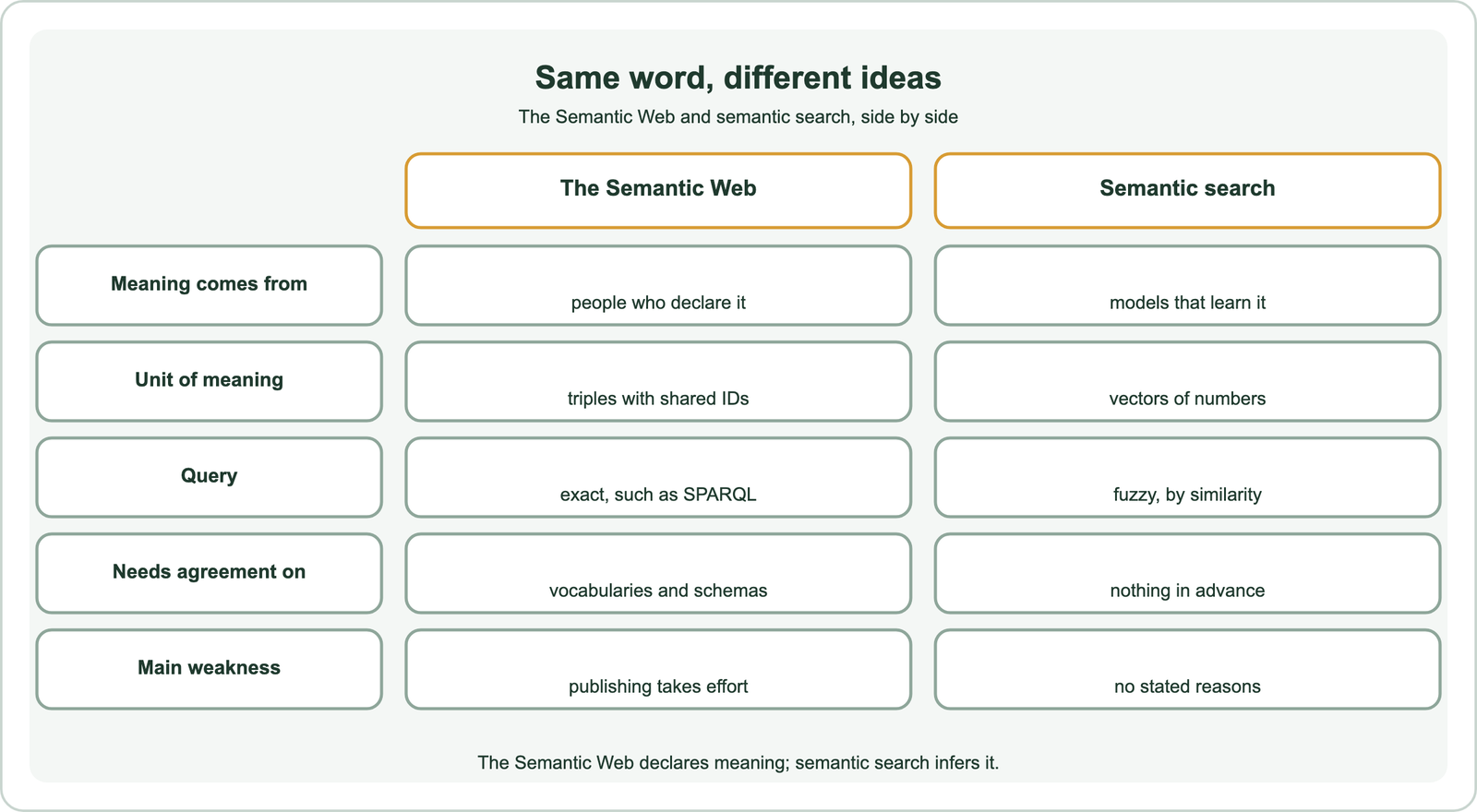
Semantic search and the Semantic Web are different things: semantic search finds information by meaning, while the Semantic Web is a set of standards for publishing machine-readable data. Semantic search usually works with embeddings. Both use the word “semantic”, but they get meaning from opposite places. On the Semantic Web, people declare meaning explicitly. They describe things as triples, using shared vocabularies such as RDF, OWL and schema.org, and query them exactly with SPARQL. In semantic search, a model learns meaning from text, and queries match content by similarity, with no agreement on terms needed in advance. Tim Berners-Lee, James Hendler and Ora Lassila described the Semantic Web in Scientific American in 2001. Today the two meet in practice: schema.org markup feeds search engines and knowledge graphs, while embeddings handle the free text around it. Weaviate’s founder has written that the Semantic Web inspired its design.
Semantic search vs the Semantic Web in four facts
- The Semantic Web declares meaning with shared vocabularies; semantic search infers meaning with trained models.
- Semantic Web data is stored as subject, predicate and object triples, using standards such as RDF and SPARQL.
- Weaviate’s history article says its data model was inspired by the RDF structure used by schema.org.
- Weaviate’s founder names the need for people to agree on naming standards as the Semantic Web’s main challenge.
What is the difference between semantic search and the Semantic Web?
The difference is that semantic search is a retrieval technique that matches meaning, while the Semantic Web makes data machine-readable through shared, explicit definitions. One is about searching, the other about publishing.
Semantic search takes a query and returns content that means the same thing, even when the words differ. A query for “wine for seafood” can find a description that says “good with fish”. It usually works by turning text into vectors with an embedding model and finding nearest neighbours, as described in semantic search vs vector search.
The Semantic Web aims to make the web’s data understandable to machines by describing it in standard, linked formats. A product page would not only show text about a shoe. It would also state, in machine-readable form, that this is a Product, made by a Brand with a given identifier, at a given price. Software could then combine facts from many sites reliably.
The shared word hides opposite approaches. In the Semantic Web, meaning is explicit and agreed in advance. In semantic search, meaning is implicit, learned from large amounts of text. The confusion is common because both promise that computers will “understand” content. The Semantic Web came first.
What is the Semantic Web?
The Semantic Web is an extension of the web in which data is published with explicit, machine-readable meaning, using W3C standards such as RDF for data, OWL for ontologies and SPARQL for queries. Its goal is a web of linked data, not only linked pages.
The idea was popularised by an article titled “The Semantic Web” by Tim Berners-Lee, James Hendler and Ora Lassila in Scientific American in 2001. It described software agents that could read structured data across sites to book appointments or compare options. The W3C then developed the standards to make that possible.
RDF, the Resource Description Framework, represents every fact as a triple: a subject, a predicate and an object, each ideally identified by a URI so that different sites refer to the same thing. OWL, the Web Ontology Language, defines classes and relationships, such as that every Brand is an Organization. SPARQL queries RDF data much as SQL queries tables. Linked Data principles encouraged publishers to link their identifiers to others.
The model is close to that of knowledge graphs, which store entities and typed relationships, as described in semantic search vs knowledge graph search. Semantic search grew from a different line of work.
How does semantic search work?
Semantic search works by representing queries and content as vectors from a trained model and returning the content whose vectors are closest to the query’s vector. Meaning comes from patterns the model learned, not from declared definitions.
Weaviate’s article on vector embeddings explains it with the wine example. A keyword search, or even a synonym search, for “wine for seafood” will not find a wine described as “good with fish”. A meaning-based search should understand that fish is similar to seafood and that “good with X” means “for X”. Embeddings place those texts close together, so nearest neighbour search finds the wine.
Nobody has to agree on vocabulary first. The model learned from text that “fish” and “seafood” appear in similar contexts. That makes semantic search easy to apply to messy, unstructured content: support tickets, documents, product descriptions, anywhere people write freely. Its contrast with exact term matching is covered in semantic search vs keyword search and BM25 vs vector search.
The cost is explicitness. A vector does not say why two things match, and it cannot guarantee that a returned product really has a given brand or price. Weaviate’s own history shows how one person weighed these trade-offs.
How does the Semantic Web relate to the origins of semantic search?
The Semantic Web relates to the origins of semantic search by setting the goal of machine-understandable data, while its practical difficulties pushed some builders towards learned meaning instead of agreed definitions. Weaviate’s origin story shows both sides.
In Weaviate’s history article, founder Bob van Luijt writes that he fell in love with the Semantic Web, but saw its challenge in the need for people to agree on naming conventions and standards. He asked what would happen if people no longer had to agree, and machines could work out the concept that data represents.
The article describes testing that idea with word vectors. Searching the space near “apple” returned both fruit-related words and words about the company. Searching near a point between “apple” and “fruit” gave much better results, disambiguating by moving through the vector space. The team concluded they could store data objects in a semantic space rather than a row-column structure or a graph.
The Semantic Web still shaped the design. The same article says the search for a data model led to the RDF structure used by schema.org, which inspired how Weaviate represents objects, though Weaviate is not itself RDF-based. That mix of structured objects and learned vectors is how the two ideas meet today.
Where do the Semantic Web and semantic search meet today?
The Semantic Web and semantic search meet today in systems that use structured data for exact facts and embeddings for the free text around them. schema.org markup and knowledge graphs carry the Semantic Web’s legacy.
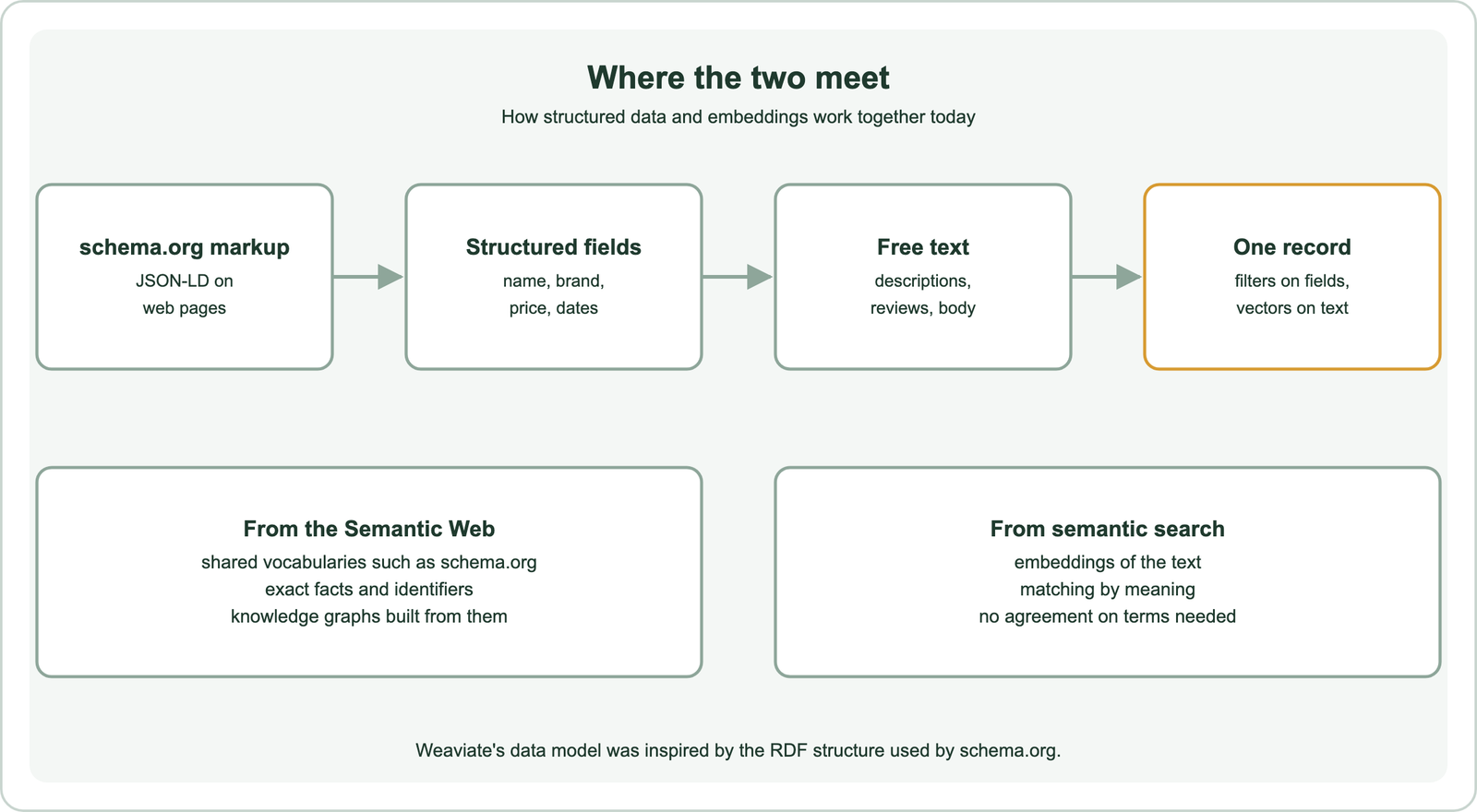
The most visible success of Semantic Web ideas is schema.org, a shared vocabulary launched in 2011 by major search engines. Sites embed it in pages, often as JSON-LD, to describe products, recipes, events, organisations and more. Search engines use the markup for rich results and to populate knowledge graphs.
The full vision of agents reasoning over a web of linked data arrived only in part. Publishing correct, linked RDF takes effort, and most content is still unstructured text. Embeddings filled much of that gap, because they work on text as written.
Modern search systems take the practical middle. Structured fields such as brand, price and date sit beside free text such as descriptions and reviews. Filters handle the fields exactly; vectors handle the text by meaning. Natural-language interfaces that accept mixed questions are covered in natural language search. The pattern is short in code.
How do you combine structured data and semantic search in Weaviate?
You combine structured data and semantic search in Weaviate by mapping structured fields, such as those in schema.org JSON-LD, to filterable properties and searching the descriptive text by vector. One query then uses both kinds of meaning.
import json
from weaviate.classes.query import Filter

jsonld = json.loads("""{
  "@context": "https://schema.org",
  "@type": "Product",
  "name": "Trail Runner 2",
  "brand": {"@type": "Brand", "name": "Acme"},
  "description": "Lightweight shoe with a grippy sole for muddy mountain paths."
}""")

products = client.collections.use("Product")   # properties: name, brand, description
products.data.insert({"name": jsonld["name"],
                      "brand": jsonld["brand"]["name"],
                      "description": jsonld["description"]},
                     vector=description_vector)       # embedding of the description

res = products.query.near_vector(
    near_vector=query_vector,                          # e.g. "shoes for wet hiking trails"
    filters=Filter.by_property("brand").equal("Acme"), # exact, from the markup
    limit=3,
)
The brand comes from the markup and is filtered exactly. The description is embedded, so a query such as “shoes for wet hiking trails” can match “grippy sole for muddy mountain paths” without shared words. With a vectorizer configured, near_text replaces near_vector and Weaviate embeds both sides. The pattern was run on a toy collection as an API check and returned the product.
Relationships between records can be stored too, for example linking products to brands, which moves the design towards a knowledge graph. Weaviate is a vector database rather than an RDF store, a distinction related to search engine vs vector database and pgvector vs a dedicated vector database. The approaches also differ in how they handle mistakes.
Which strengths and weaknesses does each approach have?
The Semantic Web offers precision and explicit facts at the cost of publishing effort, while semantic search offers coverage of unstructured text at the cost of stated reasons. Each fails differently.
Structured data fails by omission. If a site never published that a product is waterproof, a SPARQL query cannot find it. If two publishers use different vocabularies without links, their data does not join. When the data exists, though, answers are exact and explainable.
Semantic search fails by approximation. It finds content similar to the query even when no one structured it, but similarity is not always relevance. Weaviate’s academy notes that vector search can be less predictable, giving the example of “Sister Act” appearing for the query “action”. It also cannot prove a fact such as a price. The broader relationship between finding text and generating answers is covered in semantic search vs RAG.
These failure modes are complementary, which is why combinations work. Exact fields catch what similarity blurs; similarity catches what nobody structured. The similarity side itself has several names, untangled in semantic search vs similarity search.
Do you need the Semantic Web to build semantic search?
You do not need Semantic Web technology to build semantic search; embeddings and a vector database are enough for most applications, and structured fields can be added as ordinary properties. RDF stores suit specific needs.
For site search, document search, support search or RAG, start with embeddings over the text and hybrid search for exact terms. Add structured properties such as dates, categories and brands as you have them, and filter on them. Nothing in that stack requires RDF, OWL or SPARQL.
Semantic Web standards earn their place when data must be shared across organisations with agreed identifiers, when reasoning over ontologies is needed, or when you publish data for others. Publishing schema.org markup on your own pages remains useful for how search engines understand them, whatever search you run internally.
The two ideas are best treated as layers. Explicit structure where you have it, learned meaning where you do not. That combination delivers much of what the original Semantic Web article hoped for, through a different route.
Semantic search and the Semantic Web share a word but not a method. The Semantic Web, described by Berners-Lee, Hendler and Lassila in 2001, declares meaning with shared vocabularies and triples, using RDF, OWL and SPARQL. Semantic search infers meaning with embeddings and matches by similarity, with no prior agreement on terms. Weaviate’s founder saw the Semantic Web’s need for agreement as its main challenge, and built on learned vectors while drawing on schema.org’s RDF structure for the data model. Today they meet in systems that filter exactly on structured fields and search free text by meaning.