Home / Comparisons / Semantic Search vs Vector Search: Are They the Same?
ComparisonSemantic Search vs Vector Search: Are They the Same?
Semantic search and vector search are not the same: vector search is a mechanism that finds the nearest vectors to a query, while semantic search is a goal, returning results that match a query’s meaning. They are often used as synonyms because most semantic search today runs on vector search over embeddings. Weaviate’s own definition draws the line clearly: semantic search describes the user experience, vector search the technical mechanism. The difference shows when the vectors carry no meaning. In a small test, vector search over character patterns ranked “automatic mobile app updates” first for the query “automobile repair,” while vector search over a language model’s embeddings ranked “car maintenance guide” first. Same mechanism, different results: the meaning comes from the model.
Semantic versus vector search in four facts
- Vector search is nearest neighbor search over vectors; it works on text, images, audio, or any numbers.
- Semantic search is the aim of matching meaning and intent, usually built on vector search.
- Vector search is only semantic when the embedding model captures meaning.
- Semantic search can also use knowledge graphs or learned sparse models, not only dense vectors.
Are semantic search and vector search the same?
Semantic search and vector search are not strictly the same, though in everyday use the terms overlap so much that many people treat them as one. The relationship is one of goal and mechanism.
Weaviate’s explainer on vector search gives both the formal and the practical view. Formally, vector search is the process of arranging vector embeddings into an index to perform similarity searches. Semantic search builds on it to return results based on the meaning of text rather than exact terms. In practice, the explainer notes, the two are often used interchangeably.
Another Weaviate article sums up the distinction in one line. Semantic search describes the user experience, while vector search describes the technical mechanism behind it. A person experiences semantic search when “affordable family car” finds a review of a budget minivan. Underneath, a vector search found the nearest embeddings.
The overlap is real but incomplete in both directions. Vector search can serve goals that have nothing to do with language meaning, and semantic search can be built without dense vectors. Each side deserves a precise definition first, starting with the mechanism.
What exactly is vector search?
Vector search is a method that represents items and queries as vectors of numbers and returns the stored items whose vectors are closest to the query vector. Closeness is measured by a distance metric such as cosine or Euclidean distance.
The process has three parts. An embedding model or other method turns each item into a vector. An index, usually approximate, such as HNSW, organizes the vectors for fast lookup. At query time, the query becomes a vector and the index returns its nearest neighbors. Weaviate’s explainer notes that approximate nearest neighbor algorithms can return results in milliseconds, citing a dataset of 28 million Wikipedia paragraphs.
Nothing in that process requires language. Weaviate’s documentation stresses that vector search is not limited to text: it works on images, video, and audio. It also works on product features, user behavior, or sensor readings. Any data that can become a list of numbers can be searched this way. Vector search and similarity search cover the mechanics in depth. The goal it most often serves has its own definition.
What is semantic search?
Semantic search is search that aims to understand the meaning and intent of a query and return results that match that meaning, even when they share no words with it. It is defined by what it achieves, not by how.
Weaviate’s example is a wine described as “good with fish.” A keyword search for “wine for seafood” misses it, and even a synonym list may too. A meaning-based search should understand that fish relates to seafood and that “good with” means “for.” That is semantic search: matching intent, not strings.
Today, semantic search is almost always built on vector search over text embeddings, which is why the terms blur. But the goal is broader than any one method. It can include query understanding, entity recognition, and ranking signals that have nothing to do with vectors. What semantic search is covers the full picture. The clearest way to see the gap between the two terms is to break the link between vectors and meaning.
Does vector search always find meaning?
Vector search does not always find meaning; it finds whatever similarity its vectors encode, so it is only semantic when the embedding model captures meaning. A small test makes this concrete.
We ran the same nearest neighbor search over four short documents with two kinds of vectors. The first kind counts three-letter character sequences, a vector that captures spelling but no meaning. The second is the all-MiniLM-L6-v2 sentence embedding model. The query was “automobile repair.”
| Document | Character-pattern vectors (cosine) | Language model embeddings (cosine) |
|---|---|---|
| car maintenance guide | 0.000 (last) | 0.614 (first) |
| fixing a broken vehicle engine | 0.042 | 0.573 |
| automotive paint colors | 0.337 | 0.410 |
| automatic mobile app updates | 0.438 (first) | 0.128 (last) |
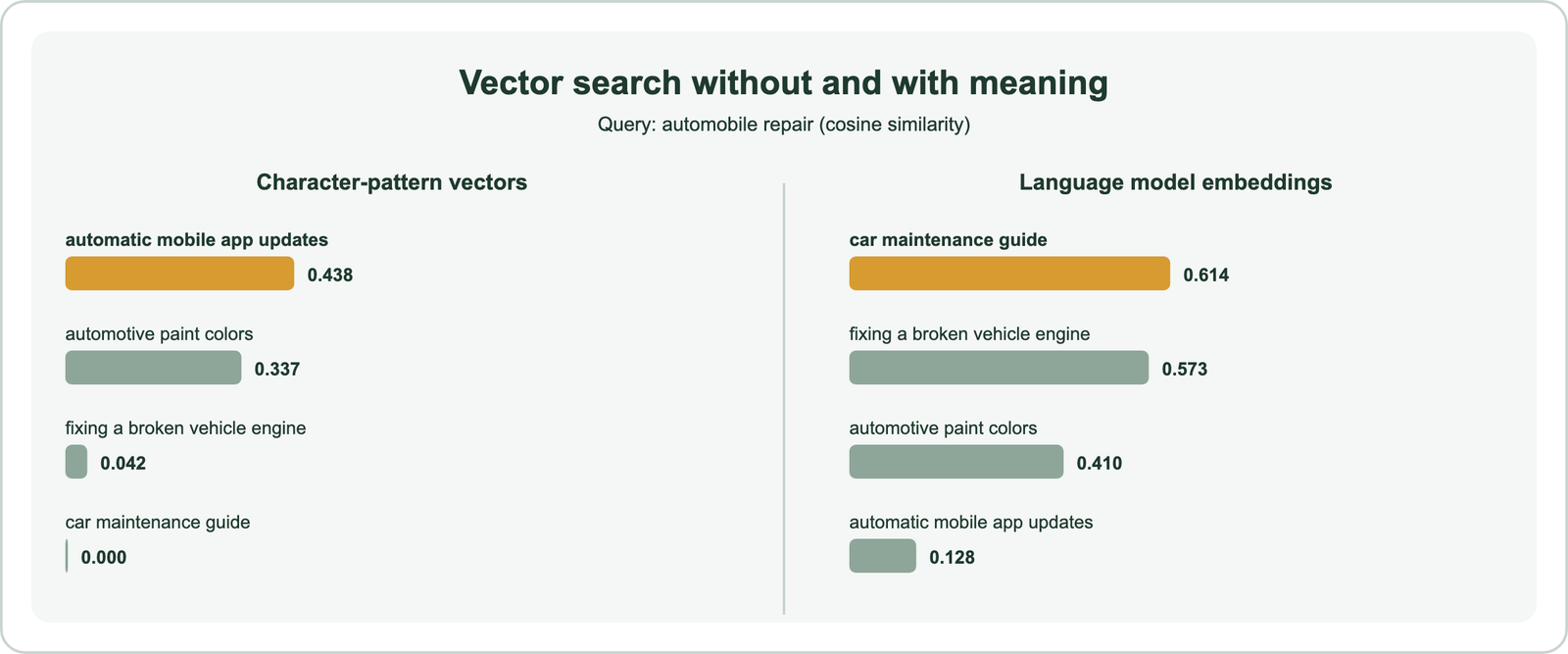
Both columns are vector search. Only the second is semantic search. The character vectors matched “auto” and “mobile” in “automatic mobile app updates,” a spelling coincidence, and gave “car maintenance guide” a score of zero. The language model placed car maintenance and engine repair closest, because it learned that automobiles are cars. Weaviate’s explainer makes the same point in general terms: search quality depends crucially on the quality of the model. The reverse question is whether meaning can come without vectors.
Can semantic search work without vector search?
Semantic search can work without dense vector search, using methods such as knowledge graphs, structured data, query understanding, or learned sparse models. Vectors are the dominant method today, not the only one.
The phrase “semantic search” predates embeddings. In 2003, Guha, McCool, and Miller published a paper titled “Semantic Search” at the WWW conference, describing search that used the Semantic Web’s structured data and ontologies to understand what a query was about. That approach relied on explicit relationships, not vector distances.
Several non-vector routes to meaning remain in use:
- Knowledge graphs: entities and their relationships let a system know that a city is in a country or a drug treats a condition, as semantic versus knowledge graph search explains.
- Query understanding: classifying intent, recognizing entities, and expanding queries with related terms, as in query understanding.
- Learned sparse models: SPLADE, from Formal and colleagues, expands texts with related terms in a sparse, keyword-style index, as covered in sparse vectors.
In practice, strong systems blend these with dense vectors. With the two terms separated, it helps to place them next to their neighbors.
How do keyword, vector, semantic, and hybrid search differ?
Keyword, vector, semantic, and hybrid search differ in what they match: keyword search matches words, vector search matches vector closeness, semantic search aims at meaning, and hybrid search combines keyword and vector results. Two of these are mechanisms; one is a goal; one is a combination.
| Term | Type | Matches on | Typical method | Strength |
|---|---|---|---|---|
| Keyword (lexical) search | Mechanism | Shared words | Inverted index with BM25 | Exact terms, codes, names |
| Vector search | Mechanism | Vector closeness | Embeddings in an ANN index | Any data that can be embedded |
| Semantic search | Goal | Meaning and intent | Usually vector search over text embeddings | Synonyms, paraphrase, natural questions |
| Hybrid search | Combination | Words and vectors together | Keyword and vector results fused | Covers both kinds of failure |
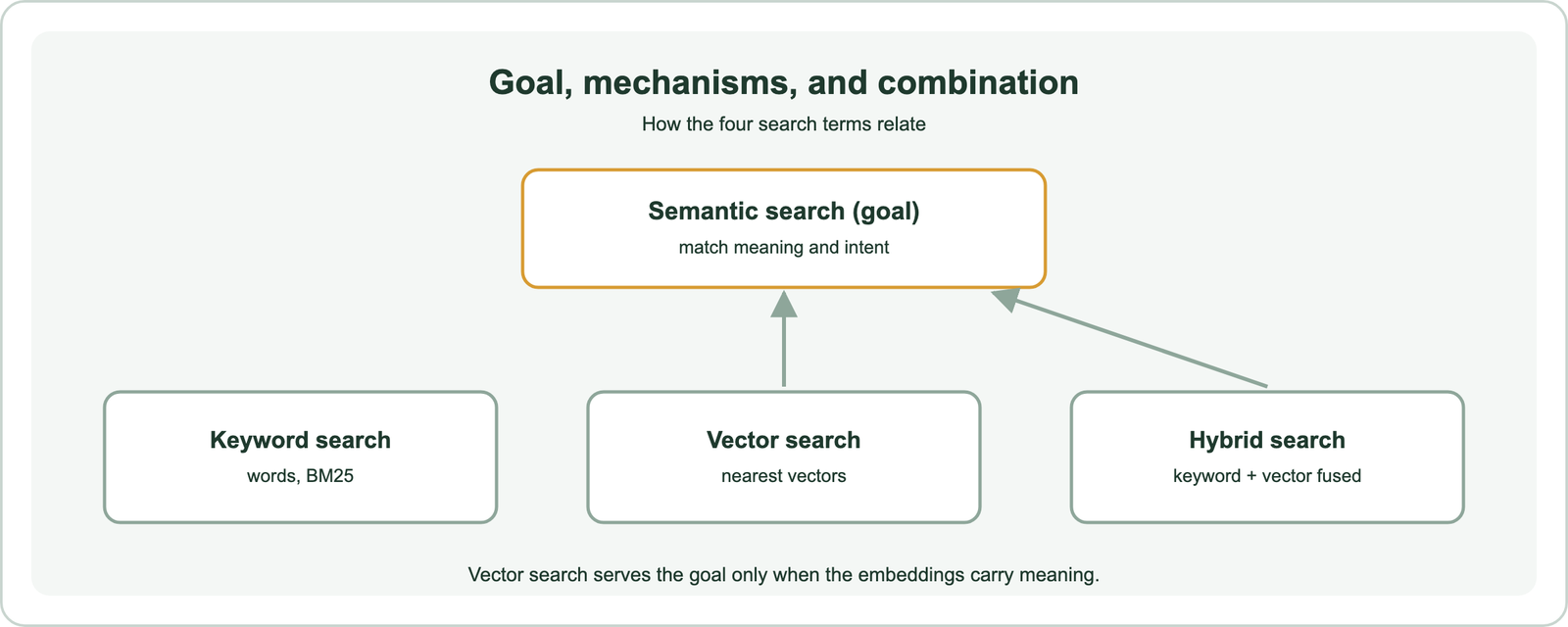
The four terms often appear together in comparisons, which is why the table separates mechanism from goal. A team can build keyword search, vector search, or hybrid search; whether the result counts as semantic search depends on how well it matches meaning.
Lexical search is another name for keyword search. Hybrid search is the usual production answer: in Weaviate, a single hybrid query runs BM25 keyword search and vector search, then fuses them, with alpha setting the balance. Semantic versus keyword search, hybrid versus vector search, and what hybrid search is go deeper. AI assistants raise the same question in a new form.
Does ChatGPT use semantic search?
ChatGPT’s file search feature does use semantic search: OpenAI’s documentation says it retrieves from uploaded files through semantic and keyword search, using vector stores. The language model itself is a different thing.
OpenAI’s file search guide describes the feature as letting models retrieve information from a knowledge base of uploaded files “through semantic and keyword search.” Files are added to what OpenAI calls vector stores. That is a hybrid retrieval setup, the same pattern as RAG systems built on any vector database.
Answering from its training data is a separate process. A language model generates text from patterns it learned; it does not search an index for those answers. When an assistant searches documents or the web, it uses a retrieval tool, and that tool is where semantic or keyword search happens. Semantic search versus RAG explains how retrieval and generation fit together. Building that retrieval layer means choosing a database.
What are the top vector databases for semantic search?
The vector databases most often used for semantic search include Weaviate, Pinecone, Milvus, Qdrant, and Chroma, alongside vector support in general databases such as PostgreSQL with pgvector and Elasticsearch. Which is best depends on your scale, hosting, and features.
Rankings change, so features matter more than a list. For semantic search, look for an approximate index such as HNSW, filters that work inside the vector search, hybrid search with BM25, built-in or bring-your-own embedding models, and real-time updates. Weaviate offers all of these, with vectorizer integrations that embed text automatically and a hybrid query that fuses keyword and vector results.
General databases with vector features suit teams that want one system. Weaviate’s own guidance notes that vector extensions make sense if you have already bet on a relational or NoSQL system. Semantic search tools compared and databases that support hybrid search compare options in detail. Whatever the tool, the terminology question has a practical edge.
When does the difference between the terms matter?
The difference between semantic search and vector search matters when you choose models, debug poor results, or search data that is not text. In casual talk, the overlap is harmless.
It matters for debugging most of all. If results are bad, the vector search may be working perfectly while the embeddings fail to capture meaning for your domain. The test above is an extreme case, but the same failure happens subtly when a general model meets specialist vocabulary. The fix is a better model, often a domain-specific embedding, not a different index.
It matters for non-text data, where “semantic” may not fit at all. Searching product images by visual similarity or users by behavior is vector search, but calling it semantic search can mislead. And it matters for planning: a semantic search goal may need keyword matching, filters, and reranking on top of vectors, as how semantic search works lays out. Related comparisons include BM25 versus vector search and semantic versus similarity search.
Vector search is the mechanism, finding the nearest vectors to a query; semantic search is the goal, finding results that match meaning. They blur because semantic search usually runs on vector search over text embeddings. The test showed the gap plainly: the same vector search ranked a spelling coincidence first with meaningless vectors and the right answer first with a language model. Semantic search can also use knowledge graphs and learned sparse models. The practical step is to treat the embedding model as the source of meaning, test it on your own queries, and add keyword matching through hybrid search where exact terms count.