Home / Comparisons / Semantic Search vs RAG: Retrieval vs Generation
ComparisonSemantic Search vs RAG: Retrieval vs Generation
Semantic search returns the documents or passages that best match a query’s meaning; retrieval-augmented generation, or RAG, takes those retrieved passages and has a language model write an answer from them. Semantic search is a retrieval method. RAG is a pattern that uses retrieval, often semantic or hybrid search, as its first step and generation as its second. “RAG search” usually means a search experience that answers a question in prose, with sources, rather than listing links. Choose semantic search when users want to browse, compare or verify sources, or need exact records. Choose RAG when they want one direct answer and the sources are trustworthy. RAG’s answers can be no better than what retrieval finds, so a RAG system is only as good as its search. Weaviate supports both: near_text and hybrid queries for search, and generative queries for RAG.
Semantic search vs RAG in four facts
- Semantic search outputs a ranked list of documents; RAG outputs a generated answer.
- RAG was named by Lewis and colleagues in 2020, combining a retriever with a text generator.
- RAG’s quality is capped by retrieval: a missing or wrong passage leads to a wrong or vague answer.
- Weaviate’s generate queries run a search and pass the results to a language model in one call.
What is the difference between semantic search and RAG?
The difference between semantic search and RAG is the output: semantic search returns relevant documents, while RAG returns a written answer generated from relevant documents. RAG contains a search step; semantic search does not contain generation.
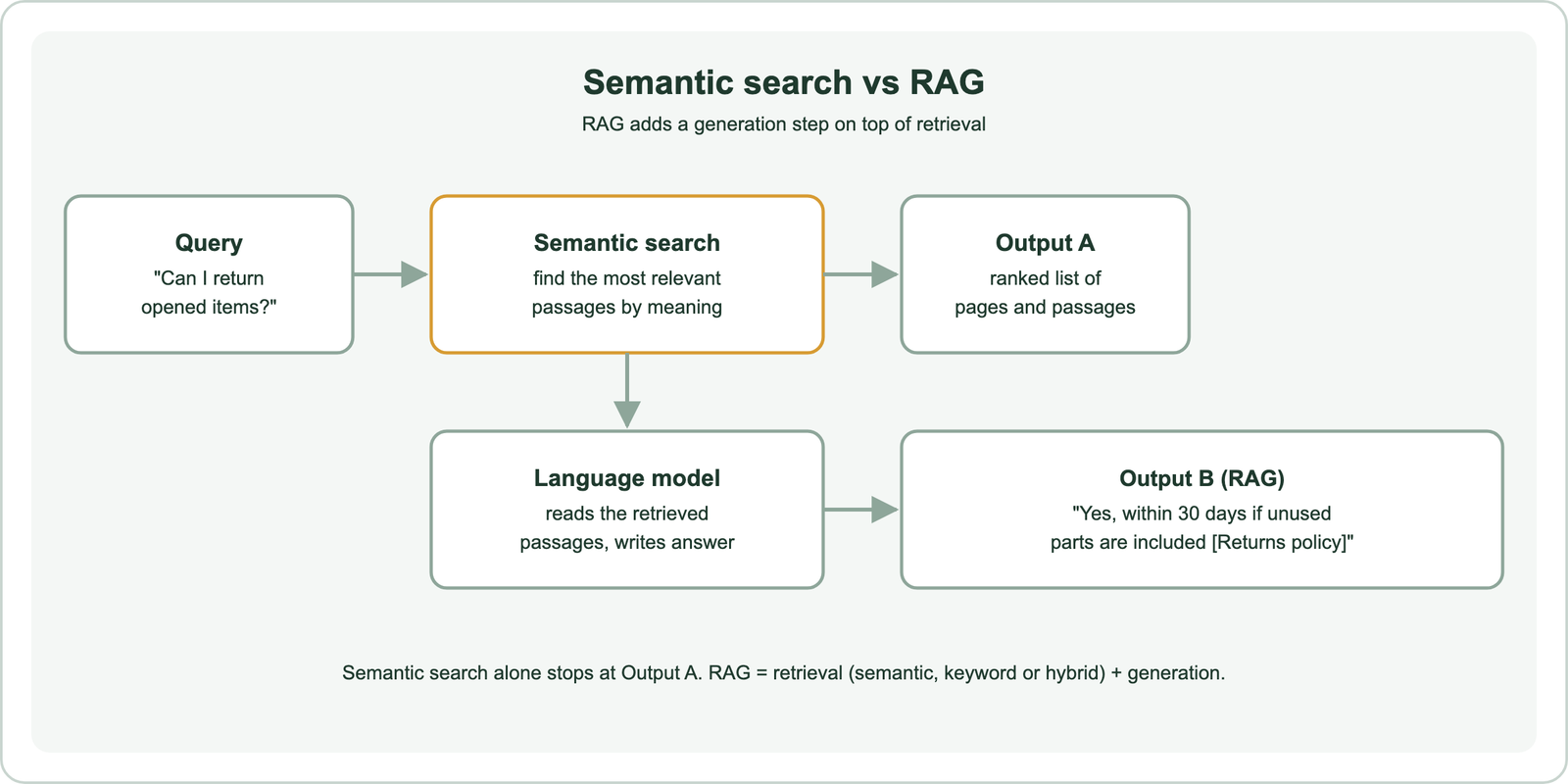
Semantic search matches by meaning rather than exact words, as covered in semantic search vs keyword search. Its result is a list the user reads and chooses from. RAG goes one step further. The top passages are inserted into a prompt, and a language model writes an answer grounded in them, usually with citations back to the sources.
The two are not rivals. RAG depends on search, and many products show both: a generated answer first and the source results after it. The real decision is whether to add generation on top of search, and for which queries. Some products route by query type: questions get a generated answer, while short keyword queries and product names get a plain result list.
What is RAG search?
RAG search is a search experience that answers a question directly by retrieving relevant passages and generating a response from them, typically with links to the passages used. It is how many AI assistants and answer engines work.
Lewis and colleagues introduced retrieval-augmented generation in 2020, pairing a dense retriever with a sequence-to-sequence generator. Today the pattern usually means a vector or hybrid search over a document collection followed by a call to a large language model. The model is told to answer from the provided context, which reduces made-up answers and lets the system work with private or recent information the model was never trained on.
The retrieval step can be any method: semantic, keyword or hybrid. Semantic search in RAG covers how retrieval choices shape answers. The word “search” in RAG search refers to the user’s experience: they search, and they get an answer instead of a list.
Why does RAG depend on semantic search?
RAG depends on semantic search because the language model can only use what retrieval gives it; if the right passage is not retrieved, the answer will be wrong, vague or unsupported. Retrieval quality caps answer quality.
A language model in a RAG system sees only the few passages placed in its prompt. If retrieval misses the passage that holds the answer, the model either says it does not know or, worse, fills the gap from general knowledge. Better retrieval therefore improves RAG more than prompt tweaks do. Hybrid search, reranking and good chunking all feed directly into answer quality.
This is why RAG evaluation checks retrieval separately from generation. Context relevance and recall measure whether the right passages arrived; faithfulness measures whether the answer sticks to them. Semantic search vs vector search and BM25 vs vector search cover the retrieval choices that matter most.
When should you use semantic search instead of RAG?
You should use semantic search instead of RAG when users need to see, compare or verify sources, when they look for specific records, or when a generated summary could mislead. Use RAG when one direct answer serves them better.
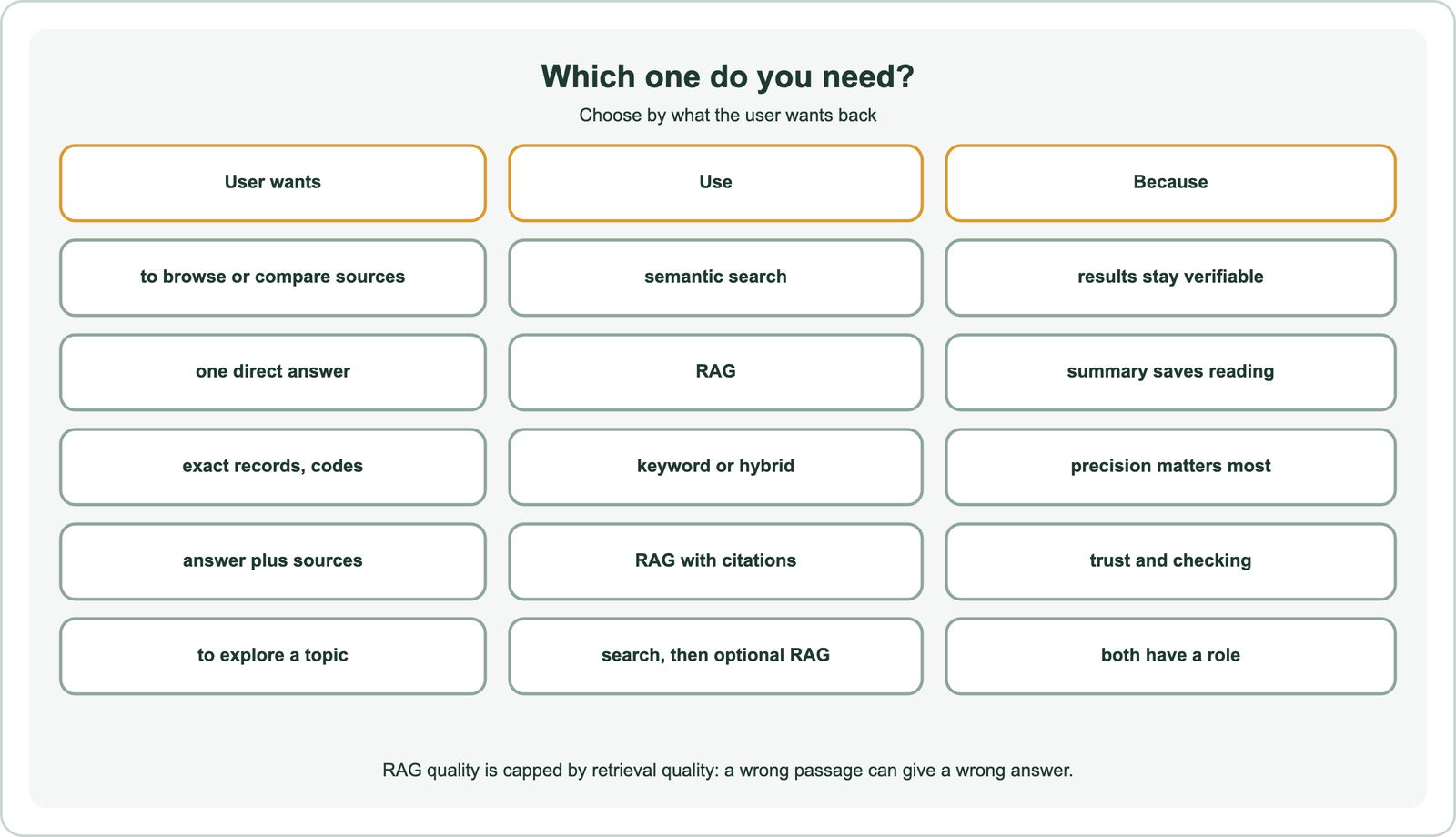
Research, legal and compliance work often needs the sources themselves, not a summary, because the exact wording matters. Product search needs lists to browse and compare. Lookups of codes, names or records need precision, which keyword and hybrid search give. In these cases semantic search, possibly with filters and facets, is the better product.
Questions with one answer spread across a few documents suit RAG, such as “what is the refund window for annual plans?” Support centres, internal knowledge bases and documentation assistants often fit this pattern. Even then, show sources so users can check, and fall back to search results when retrieval finds nothing strong.
How do you improve retrieval for a RAG system?
You improve retrieval for a RAG system with the same levers as semantic search: better chunking, hybrid search, reranking, metadata filters and a suitable number of passages. Each change shows up directly in answer quality.
Chunk documents so each passage holds one complete idea, small enough to be specific and large enough to stand alone. Use hybrid search so exact names, product codes and error messages are found, not just paraphrases. Rerank the top candidates with a cross-encoder so the few passages that reach the prompt are the best ones. Add filters for facts such as product version, region or date, so the model never sees outdated or irrelevant documents.
The number of passages matters too. Too few and the answer may miss a needed detail; too many and the prompt fills with noise, raising cost and the chance of mixing facts. Start with a handful, measure, and adjust. Semantic search in RAG covers these choices in depth.
Evaluate the two halves separately. For retrieval, check whether the passages needed for each test question appear in the top results. For generation, check whether the answer is correct and supported by those passages. A drop in answer quality with good retrieval points to the prompt or model; a drop with poor retrieval points back to search.
How do semantic search and RAG compare on cost and risk?
Semantic search and RAG compare on cost and risk in one direction: RAG adds a language model call per query, more latency, and the risk of a fluent but wrong answer. Search alone is cheaper and easier to verify.
A semantic search query costs a query embedding and an index lookup. A RAG query adds a generation call whose cost and time grow with the context and answer length. RAG also adds failure modes: the model may misread a passage, merge facts from two documents, or answer when it should say it does not know. Citations and instructions to answer only from context reduce, but do not remove, these risks.
Search has its own risk: users may not find the answer even when it is in the results. Measure both on the same questions, and track how often users click through to a source after reading a generated answer. Natural language search covers queries phrased as questions, which suit both approaches.
How do you run semantic search and RAG in Weaviate?
You run semantic search in Weaviate with near_text or hybrid queries, and RAG with the generate namespace, which runs the same search and passes the results to a configured language model. The search settings are shared.
# semantic search: a ranked list
results = docs.query.hybrid(query="Can I return opened items?", limit=5)

# RAG: the same search, plus a generated answer from the results
answer = docs.generate.hybrid(
    query="Can I return opened items?",
    limit=5,
    grouped_task="Answer the question using only these passages. Cite titles.",
)
print(answer.generative.text)
A grouped task sends all retrieved objects to the model together and returns one answer. A single prompt runs the model once per object, useful for summarising or translating each result. The language model is set in the collection’s generative configuration, with integrations for providers such as Anthropic, OpenAI, Cohere, Google and local Ollama models. Because the search part is identical, improvements to retrieval carry straight into the generated answers.
How does RAG relate to other search comparisons?
RAG relates to other search comparisons as a layer on top of retrieval: the choices between keyword, vector, hybrid and graph retrieval all happen before generation. Each comparison affects what the model sees.
Whether to store vectors in a search engine, a dedicated vector database or Postgres is covered in search engine vs vector database and pgvector vs dedicated vector database. Structured facts may come from a graph instead, as compared in semantic search vs knowledge graph search. Older ideas of machine-readable meaning are covered in semantic search vs the semantic web.
For the retrieval method itself, semantic search vs similarity search clarifies the terms. Whatever the stack, the order of work is the same: get retrieval right first, then decide where generation adds value.
Semantic search finds the documents that best match a query’s meaning and returns them as a list; RAG retrieves passages the same way and has a language model write an answer from them. RAG depends on search, and its answers are capped by retrieval quality. Use semantic or hybrid search when users need sources, comparisons or exact records. Use RAG, with citations, when one direct answer serves them better. In Weaviate, hybrid or near_text queries give the list, and generate queries add the answer on top of the same search.