Home / What Is a Semantic Search Engine? Components and How It Ranks
ExplainerWhat Is a Semantic Search Engine? Components and How It Ranks
A semantic search engine is a search system that finds results by meaning rather than by exact words, using an embedding model, a vector index, and a ranking layer. The embedding model turns every document and every query into a vector that encodes what the text is about. The vector index finds the stored vectors closest to the query quickly. Most engines also keep a keyword index, so exact names and codes still match, and a ranking layer that fuses, boosts, or reranks the results. Google moved web search in this direction with its Knowledge Graph in 2012 and BERT in 2019. Today the same components power site search, enterprise search, and the retrieval step behind AI assistants. The quality of a semantic search engine depends mostly on its embedding model, while its speed depends mostly on its index.
Semantic search engines in four facts
- A semantic search engine combines an embedding model, a vector index, and a ranking layer.
- Most semantic search engines also keep a keyword index so exact names and codes still match.
- Google’s Knowledge Graph launched in 2012 with over 500 million objects and 3.5 billion facts.
- Search quality depends mainly on the embedding model, and search speed mainly on the index.
What is a semantic search engine?
A semantic search engine is software that retrieves and ranks content by how closely its meaning matches a query, even when the two share few words. A search for “cheap flights to the coast” can return a page about “low-cost beach getaways.”
Google Cloud describes semantic search as focusing on contextual meaning and intent rather than only literal keyword matching. A semantic search engine is the system that delivers that behavior. It can be a web search engine, a site search box, an internal document finder, or the retrieval step inside an AI assistant.
The idea of searching by meaning predates modern AI, but practical engines arrived with embedding models. Weaviate’s explanation of vector embeddings lays out the core loop. The engine computes an embedding for each object as it is stored, places the embeddings in an index, embeds each query with the same model, and finds the closest vectors.
A semantic search engine is also called a similarity search engine or a nearest-neighbor search engine when the focus is the mechanism rather than the language use. The what is semantic search guide covers the concept, and how semantic search works follows the full pipeline. Understanding an engine starts with its parts.
What are the components of a semantic search engine?
A semantic search engine has five main components: an embedding model, an object store, a vector index, a keyword index, and a ranking layer. Weaviate’s architecture shows them in one system: each shard holds object storage, an inverted index, and a vector index.
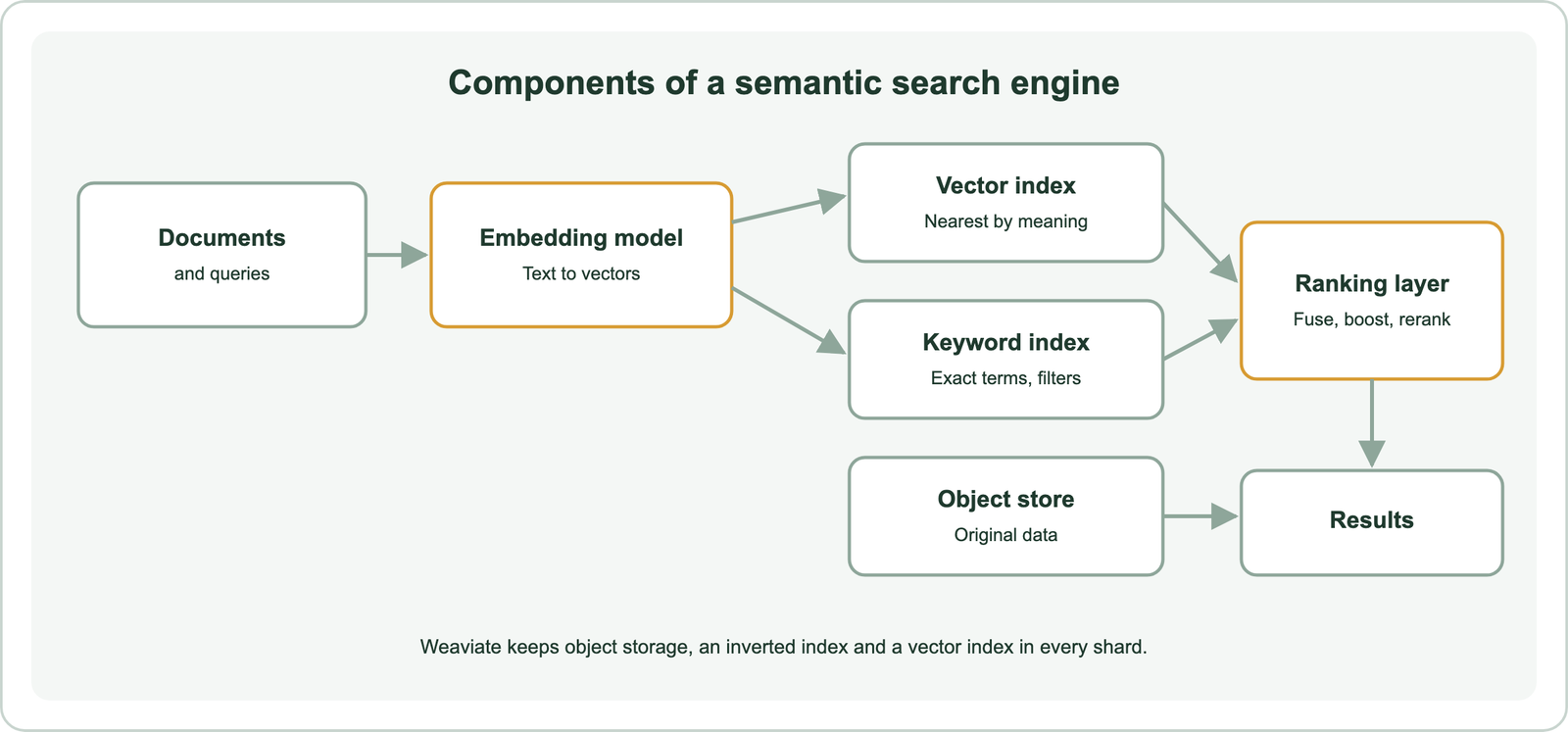
Each component has one job:
- Embedding model: turns documents and queries into vectors that encode meaning.
- Object store: keeps the original data and metadata for display and filtering.
- Vector index: finds the nearest vectors quickly, usually with an approximate method.
- Keyword index: an inverted index that matches exact terms and supports filters.
- Ranking layer: fuses, boosts, and reranks candidates into the final order.
The list shows why a semantic search engine is more than a vector lookup. Weaviate’s training material describes its indexes in detail. Vector indexes such as HNSW serve similarity, a searchable inverted index serves BM25 keyword search, and filterable indexes serve property filters. The first two are on by default. A library that offers only the vector index is a component, not an engine. The vector index guide covers that part in depth. The ranking layer decides what users actually see.
How does a semantic search engine rank results?
A semantic search engine ranks results by vector similarity first, then usually refines the order with keyword fusion, boosts, or a reranking model. Weaviate’s search documentation lays out these stages and what each is for.
| Stage | What it matches | Use it when |
|---|---|---|
| Vector search | Meaning, through vector distance | Query and data wording differ, or data is not text |
| Keyword (BM25) | Exact terms | Names, codes, or error strings must appear |
| Hybrid | Both, fused into one ranking | One query must handle both; a good default for text |
| Boost | Re-scores the results | Recency, popularity, or category should count |
| Rerank | Re-orders with a model | Precision at the top matters more than latency |
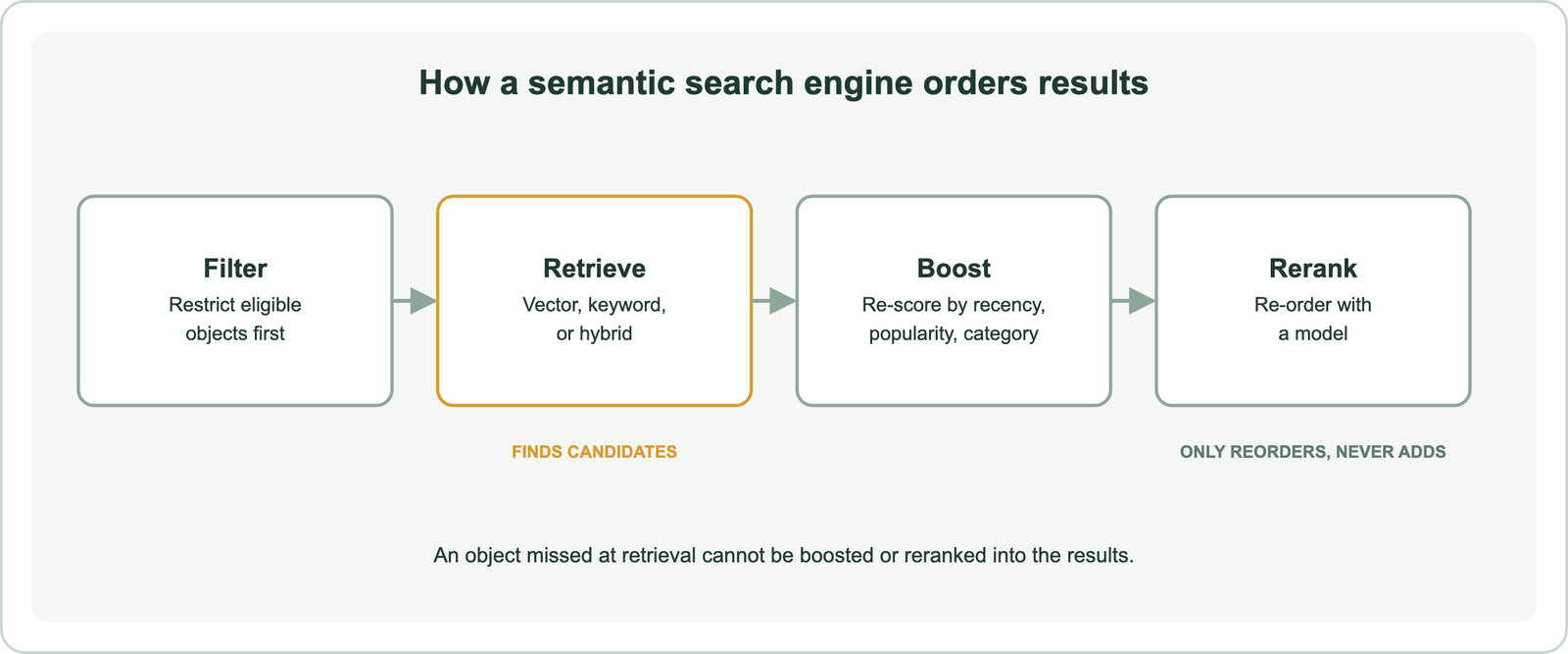
The table separates retrieval from refinement. Vector, keyword, and hybrid search find candidates. Boost and rerank only reorder them. Weaviate’s documentation is explicit that neither boost nor rerank can add a result the first search did not return, and that filters, not boosts, should remove objects that must not appear.
This layered design is how engines balance meaning with exactness. Hybrid search and reranking explain the two most important refinements. The layers also explain how semantic engines differ from older ones.
How is a semantic search engine different from a keyword search engine?
A semantic search engine differs from a keyword search engine by matching meaning through embeddings, while a keyword engine matches the words themselves through an inverted index. The difference shows when users and documents use different words.
A keyword engine ranks documents that contain the query’s terms, weighted by statistics such as BM25. It excels at exact identifiers and fails when a relevant document uses synonyms. A semantic engine finds related meaning but can blur exact codes. That is why most modern engines run both and fuse the results.
The terms “semantic search” and “vector search” are often mixed up. Vector search is the operation of finding nearby vectors. Similarity search is the general task of finding close items, for any data type. Semantic search is the user-facing goal of retrieving by meaning, usually built on vector search plus keyword matching and ranking. The semantic versus keyword search and semantic versus vector search comparisons cover both boundaries.
The keyword search guide explains the older half of the stack. The best-known engine shows how both halves combine at scale.
Is Google a semantic search engine?
Google is a search engine that uses semantic techniques among many ranking systems, rather than a pure semantic search engine. It moved steadily toward meaning over the 2010s.
Two public milestones mark the shift. In May 2012, Google’s Amit Singhal introduced the Knowledge Graph with the phrase “things, not strings.” At launch it held over 500 million objects and more than 3.5 billion facts about how they relate. Search could then recognize entities, such as a person or a place, rather than only matching text.
In October 2019, Google’s Pandu Nayak announced that BERT would help Search better understand one in 10 English searches in the US. BERT reads words in context, which lets the engine handle prepositions and phrasing that keyword matching treats as noise. How AI powers semantic search covers that change in more depth.
Google still uses many other signals, including links, freshness, and page quality. Calling it semantic describes part of its method, not all of it. AI assistants raise a similar question.
Does ChatGPT use semantic search?
ChatGPT-related tools can use semantic search, but it is not accurate to say every ChatGPT answer comes from one semantic search engine. The verifiable part is narrower.
OpenAI’s API documentation describes a File Search tool that retrieves from uploaded files using semantic and keyword search. That is a semantic search engine in the sense used here: it embeds content, retrieves by meaning, and also matches keywords. It verifies one specific tool, not the whole system behind every response.
The broader pattern is retrieval-augmented generation. A semantic search engine finds relevant passages, and a language model writes an answer from them. Weaviate’s documentation describes this as one of the main uses of a vector database. Semantic search in RAG covers that pipeline, and semantic search use cases lists where it appears.
In both web search and AI assistants, the model inside the engine decides how well it understands meaning. That raises the question of which model to use.
Which AI model is best for a semantic search engine?
No single AI model is best for every semantic search engine; the best model is the one that ranks your own queries best within your cost and latency limits. Public benchmarks narrow the field but do not decide it.
The MTEB benchmark, published by Muennighoff and colleagues at EACL 2023, tested text embedding models across 8 tasks, 58 datasets, and 112 languages. Its authors found that no particular embedding method dominated across all tasks. A model that leads on one kind of retrieval can trail on another.
Practical constraints narrow the choice further. The model must cover the languages users search in, fit the domain vocabulary, and produce vectors small enough to store affordably. It may need to run on your own hardware if data cannot leave your network. Weaviate’s explanation of vector embeddings states the stakes plainly: search quality depends crucially on the model, and speed on the database.
The reliable method is a small test. Shortlist a few models, embed a sample of real content, run judged queries, and compare recall and ranking quality. The evaluation guide and embeddings guide cover the steps. Real engines show how these choices come together.
What are examples of semantic search engines?
Examples of semantic search engines include web search engines that use language models, enterprise and site search products, and open-source vector databases used to build custom engines. They differ mainly in who builds and runs them.
Web search is the most familiar example, through systems like Google’s Knowledge Graph and BERT. Site and enterprise search products package semantic retrieval for a website or company documents. AI assistants use semantic retrieval to ground their answers.
For teams building their own engine, open-source vector databases provide the core. Weaviate is an open-source vector database released under the BSD 3-Clause license. It stores objects with their embeddings and supports semantic, keyword, and hybrid search in one system. Other open-source engines and libraries exist as well, and semantic search tools compared sets them side by side. Open-source projects of this kind are usually hosted on GitHub with example applications.
An engine can also be small. A single Python script with an embedding model and a vector index is a working semantic search engine for a few thousand documents. Scale, ranking, and operations are what separate a demo from a production engine.
How do you build or choose a semantic search engine?
You build or choose a semantic search engine by deciding who runs the infrastructure, then testing candidate setups on your own queries. Building gives control; buying gives speed.
A short sequence keeps the choice grounded:
- Define the content, the queries, and the rules such as permissions and filters.
- Choose who runs it: a hosted search API, a managed vector database, or self-hosted software.
- Pick an embedding model by testing a shortlist on judged queries.
- Enable hybrid search so exact terms still match.
- Add reranking only if tests show it improves the top results.
The steps work for any engine, from a small site search to a large knowledge base. The build guide walks through a working Weaviate example in Python. For growth, scaling semantic search covers memory and sharding.
The search box is only part of the engine. Many queries benefit from cleanup and rewriting first, which query understanding covers, and results benefit from structured constraints, covered in metadata filtering.
A semantic search engine finds results by meaning, using an embedding model, a vector index, a keyword index, and a ranking layer that fuses, boosts, and reranks. Google moved web search toward meaning with the Knowledge Graph in 2012 and BERT in 2019, and AI assistants now use the same retrieval to ground their answers. The model decides quality and the index decides speed. The decision is to pick an engine by who will run it, test models on your own queries, and keep keyword matching beside meaning so exact terms never get lost.