Home / Use cases / Semantic Search for Research Papers
ExplainerSemantic Search for Research Papers
Semantic search for research papers finds scientific literature by concept, so a researcher can describe an idea in plain words and retrieve papers that discuss it under different terminology. It works by embedding each paper’s title and abstract, and often its sections, then comparing those vectors with the embedding of the query. Keyword search still matters for exact terms such as gene names, chemical formulas, method acronyms and author names, so most systems run both in a hybrid query. Filters on year, field and venue keep results in scope. Citation counts and recency can then nudge the order without hiding newer or less cited work. Every result should keep its DOI or arXiv ID so readers can open and cite it. Weaviate’s search concepts list academic paper search as a typical case for hybrid search, combining keyword relevance with semantic similarity.
Research paper search in four facts
- The same scientific idea is often named differently across fields, which keyword search misses.
- Weaviate’s docs give academic paper search as an example where hybrid search fits.
- Citation counts span orders of magnitude, so a log transform keeps them from dominating ranking.
- Weaviate’s Boost, added in 1.38, promotes highly cited or recent papers without excluding others.
What is semantic search for research papers?
Semantic search for research papers is retrieval of scientific articles by meaning, using embeddings of their titles, abstracts and text, usually combined with keyword search and bibliographic filters. It complements the Boolean and keyword search that literature databases have long offered.
Researchers search literature for several reasons. They look for prior work before starting a project, for evidence behind a claim, for methods they can reuse and for papers that cite or extend a known result. Some searches are exact, such as a paper title or an author. Many are conceptual, such as “ways to reduce memory use in attention” or “effects of sleep loss on memory consolidation”.
Conceptual searches are where embeddings help. A paper may never use the words in the query, yet describe the same idea. An embedding model that has learned scientific language can match the two. Hybrid search keeps the exact matches that researchers also need.
Literature search is one of many semantic search use cases. It stands out for its long documents, specialised vocabulary and the importance of citations as a signal of relevance and trust.
How does semantic search work when looking for research papers?
Semantic search for research papers turns each paper and each query into vectors with the same embedding model, then returns the papers whose vectors are closest to the query vector. Hybrid search adds keyword matching for exact terms.
At indexing time, each paper is split into the parts worth searching. The title and abstract are the most common, because they summarise the paper in a few hundred words. Full-text systems also embed sections or paragraphs. Each part gets a vector, stored alongside metadata such as authors, year, venue, field and identifiers.
At query time, the researcher’s question is embedded with the same model. The search engine finds the nearest vectors and returns the papers they belong to, often grouped so one paper does not fill the page with several sections. In a hybrid query, a BM25 search runs in parallel and the two result lists are fused, so a query naming a specific protein or algorithm still ranks papers containing that exact name highly. The general mechanism is described in semantic search in RAG and across the site’s how-it-works guides.
The result is a list ranked by relevance to the idea, not only by shared words. A researcher can also paste an abstract as the query, which finds papers similar to it, a quick way to explore related work.
Why is scientific literature hard to search?
Scientific literature is hard to search because terminology differs across fields and decades, key terms are often acronyms or symbols, and papers are long documents stored as PDFs. Each problem needs a different fix.
Terminology drifts. The same concept may have different names in statistics, computer science and biology, and names change as fields mature. A keyword search in one field’s vocabulary misses papers written in another’s. This is the scientific version of the vocabulary mismatch problem.
Exact terms carry meaning. Gene and protein names, chemical identifiers, dataset names and method acronyms must match exactly, and an embedding model may treat two different acronyms as similar. Keyword search handles these reliably, which is why hybrid search fits research papers better than vector search alone.
Documents are long and structured. A paper has a title, abstract, sections, figures, tables, equations and references. Most embedding models accept only a limited amount of text at once, so the paper must be split. PDFs also need parsing, which can garble equations and tables. Weaviate’s PDF ingestion articles and its multimodal recipe, which embeds whole PDF pages as images, show two ways to handle this. Parsing is covered in more depth in semantic search over documents and PDFs.
Which embedding models work best for scientific papers?
Embedding models work best for scientific papers when they have been trained on scientific text or on signals such as citations, and when they perform well on your own field’s queries. General models are a reasonable start; domain models can do better.
Citation signals are a natural training source. SPECTER, introduced by Cohan and colleagues in 2020, learns paper embeddings from the citation graph: a paper should be closer to the papers it cites than to unrelated ones. The same work released SciDocs, a benchmark of document-level scientific tasks. Benchmarks for scientific retrieval also include SciFact, a set of scientific claims paired with abstracts, which is part of the BEIR collection.
Field matters more than benchmark rank. A model strong on computer science abstracts may be weaker on clinical papers, and the reverse. The safest approach is to build a small test set of real queries from your users and compare candidate models on it, as described in domain-specific embeddings. Fine-tuning on your own pairs is the next step if no model fits.
Weaviate supports many embedding providers through its model integrations, and it can also store vectors you compute yourself. That lets a team use a specialised scientific model while keeping Weaviate’s hybrid search, filters and ranking features.
How do you build a research paper search pipeline?
You build a research paper search pipeline by collecting papers with their metadata, parsing them into abstracts and sections, embedding each part, and indexing vectors, keyword fields and citation counts together. Queries then combine filters, hybrid search and a ranking boost.
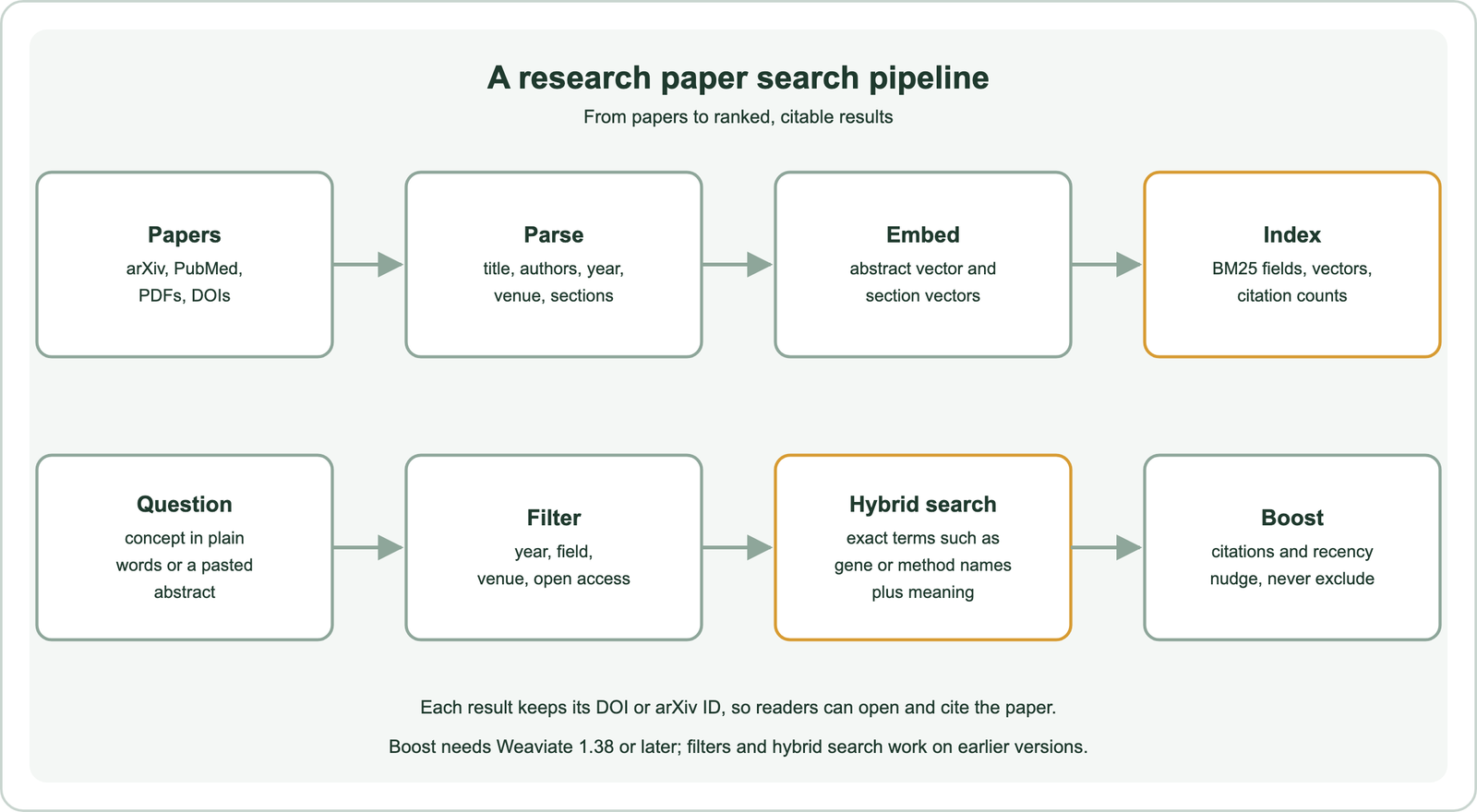
Data collection usually starts from an API or a dump. Weaviate’s n8n workflow article fetches machine learning abstracts from the arXiv API each week, using the cs.LG and stat.ML categories. It sets a chunk size of 2,000 characters to keep one chunk per abstract. Its multimodal RAG recipe uses a dataset of PDF pages from the 40 most cited AI papers on arXiv in a stated period, embedded page by page.
Granularity is the main design choice. Abstract-level records are simple and work well for finding papers. Section or paragraph records let a search find a specific method or result inside a long paper. A paper-level vector can be built from its paragraph vectors; Weaviate’s ref2vec-centroid module computes an object’s vector as the centroid of the vectors it references, and Weaviate’s blog suggests it for scientific papers.
Metadata makes the results usable. Store year, venue, field, authors, open access status and a persistent identifier on every record. Filters on these fields run before ranking, so a search limited to recent papers or one field never shows out-of-scope results.
How should citations affect ranking?
Citations should nudge ranking rather than decide it, with counts dampened by a log transform so a few very highly cited papers do not push everything else down. Relevance to the query should remain the main signal.
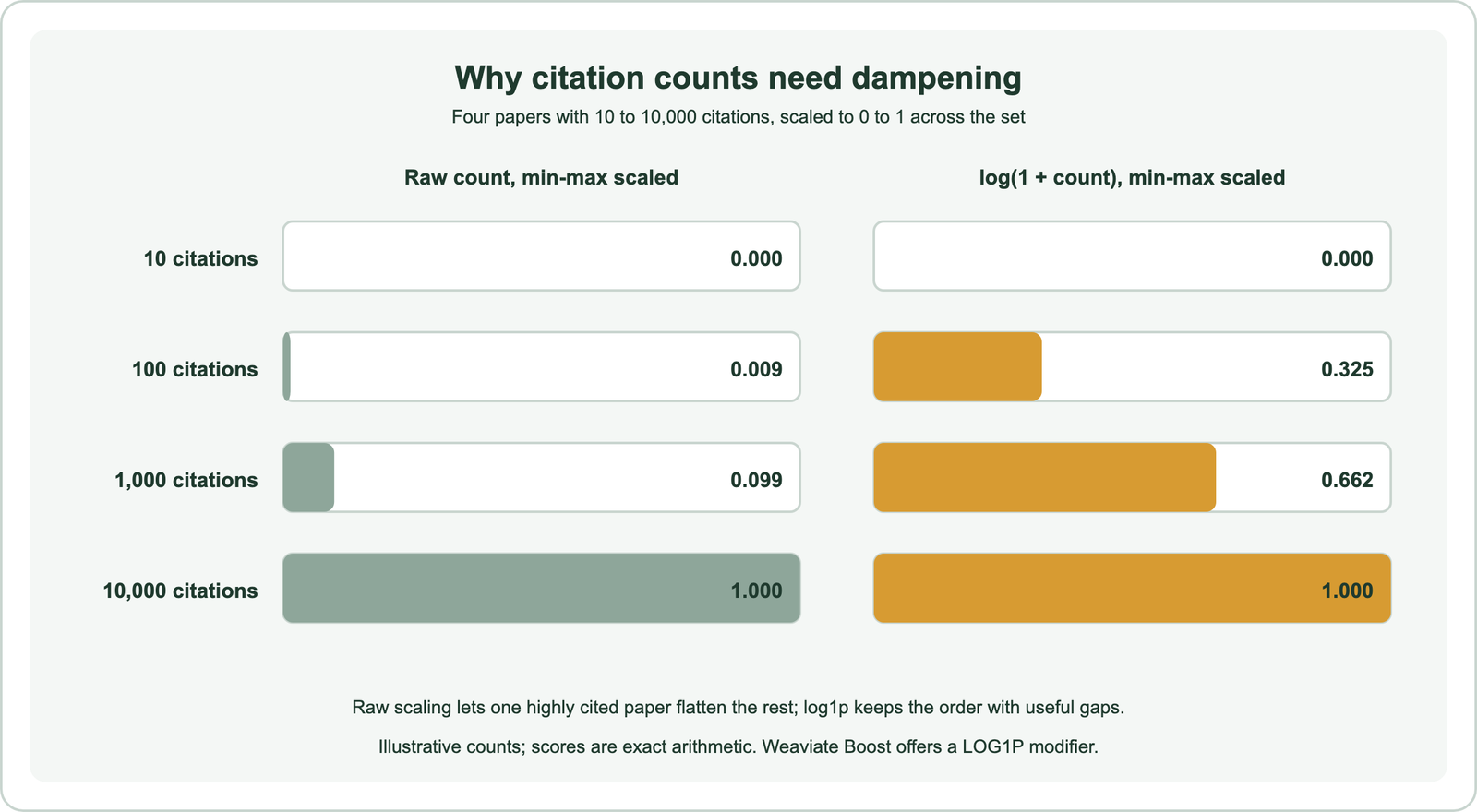
Citation counts are a useful signal of influence, but they span several orders of magnitude. With raw counts scaled to the range 0 to 1, a paper with 10,000 citations scores 1 and a paper with 1,000 scores only 0.099. A log transform, log(1 + count), keeps the order but gives the 1,000-citation paper 0.662. Weaviate’s Boost feature offers exactly this LOG1P modifier for numeric properties, and its documentation describes it as long-tail dampening.
Recency pulls the other way. New papers have had no time to collect citations, so a citation boost alone buries them. Weaviate’s Boost can blend a time decay on the publication date with the citation signal, each with its own weight. Boost is a soft ranker: it rescores a candidate pool, 100 by default, and never removes papers that do not match.
Keep the boost weight modest. Weaviate’s default blend gives the boost half the final score, a weight of 0.5. For literature search, a lower weight keeps relevance in charge, so a highly cited but off-topic paper does not outrank the right one.
How do you add citation-aware ranking in Weaviate?
You add citation-aware ranking in Weaviate by passing a Boost that blends a log-dampened citation count with a recency decay to a filtered hybrid query. The snippet follows Weaviate’s Boost documentation and needs server 1.38 or later.
from datetime import timedelta
from weaviate.classes.query import Boost, Filter

papers = client.collections.use("Paper")   # title, abstract, year, field, citations, published, doi

res = papers.query.hybrid(
    query="reducing memory use in transformer attention",
    alpha=0.6,
    query_properties=["title^2", "abstract"],
    filters=Filter.by_property("field").equal("cs.LG"),
    boost=Boost.blend(
        [
            Boost.numeric_property("citations", modifier=Boost.Modifier.LOG1P, weight=1.0),
            Boost.time_decay("published", origin="now", scale=timedelta(days=365), weight=1.0),
        ],
        weight=0.3,      # relevance keeps 70% of the final score
        depth=200,
    ),
    limit=10,
)
for o in res.objects:
    print(o.properties["year"], o.properties["doi"], o.properties["title"])
The filter keeps results in one field, the hybrid query matches both exact terms and meaning, and the boost lifts well cited and recent papers within the candidate pool. The code was written from Weaviate’s Boost documentation and was not run locally, because the local test server predates version 1.38.
Without Boost, the same signals can be applied by a reranking step in the application, or with a cross-encoder reranker for relevance followed by a small citation adjustment.
How does RAG work over research papers?
RAG over research papers retrieves the most relevant passages from a paper collection and gives them to a language model, which writes an answer grounded in those passages and cites them. The retrieval step decides whether the answer is right.
The term itself comes from a research paper: Lewis and colleagues introduced retrieval-augmented generation in 2020, pairing a dense retriever with a generator. In literature tools, the pattern answers questions such as which methods have been tried for a problem, with each claim linked to a paper. Weaviate’s n8n example goes a step further, with an agent that queries a collection of arXiv abstracts and writes a weekly summary of research trends.
Citations make or break trust. Every statement should trace to a retrieved passage with its DOI or arXiv ID, and passages should be long enough to carry their context. Hybrid retrieval keeps exact method and dataset names from being lost, a point covered in semantic search in RAG.
How does paper search compare with other search use cases?
Research paper search is closest to patent search and code search, where specialised vocabulary, exact identifiers and long structured documents appear together. Ideas transfer between them.
Patent and legal search shares the prior-art problem and the need for deep recall. Semantic code search shares the mix of exact names and descriptive queries. Enterprise and internal document search shares PDF parsing and long documents, and B2B semantic search shares technical buyers who type exact codes.
Other use cases share less. Semantic recommendations can suggest related papers, but rarely need citations in the answer. Semantic product search for ecommerce, semantic site search, customer support and help center search and image, video and audio search deal with shorter content and less specialised language.
How should research paper search be evaluated?
Research paper search should be evaluated with real researcher queries judged by domain experts, measuring both precision at the top and recall at the depth researchers actually read. Public benchmarks are a starting point, not a verdict.
Collect queries from your users and have experts mark the relevant papers. Literature reviews favour recall, since missing a key paper is costly, while quick lookups favour precision in the first few results. Measure both, as described in recall at k and precision at k.
Check the citation boost separately. Compare results with and without it, and look for relevant new papers that it pushed down. Track queries with exact terms, such as gene or dataset names, on their own, since a change in alpha can quietly hurt them.
Semantic search for research papers finds literature by concept, matching ideas across fields that name them differently. Embed titles, abstracts and sections, and use hybrid search so exact terms such as gene names, methods and authors still match. Filter by year, field and venue before ranking. Let citations and recency nudge the order through a log-dampened boost, such as Weaviate’s Boost with LOG1P, while relevance keeps most of the weight. Keep a DOI or arXiv ID on every result for citation, use the same retrieval for RAG over papers, and evaluate with expert-judged queries at the depth researchers read.