Home / Comparisons / Semantic Search vs Keyword Search: Differences and When to Use Each
ComparisonSemantic Search vs Keyword Search: Differences and When to Use Each
Semantic search retrieves by represented meaning, while keyword search retrieves by analyzed terms and lexical evidence. Keyword search is strongest when literal text matters, such as an identifier, name, or controlled term. Semantic search helps when a query describes an idea with words absent from relevant content. Neither method wins every workload. Selection depends on query segments, relevance judgments, operating cost, and required explanations. Teams should compare both methods on the same corpus and filters, then combine them when one workload contains exact evidence and vocabulary variation.
Semantic search vs keyword search in four facts
- Keyword search uses analyzed terms and an inverted index rather than requiring every query to match a raw exact string.
- Semantic search is a retrieval goal, while vector search is one mechanism that can support that goal.
- Exact identifiers favor lexical evidence, while paraphrases and descriptive questions often favor meaning-aware retrieval.
- A controlled test on one judged query set is more reliable than declaring either retrieval family universally better.
What is the difference between semantic search and keyword search?
Semantic search matches represented meaning, while keyword search matches analyzed terms and scores lexical evidence. Weaviate Documentation describes keyword search as BM25F retrieval over an inverted index. Elastic Docs explains that full-text analysis can lowercase, stem, or remove stop words before indexing. Keyword retrieval therefore means more than strict exact-string matching.
Semantic retrieval instead uses signals that represent what a query and document mean. Google Cloud defines semantic search more broadly than vector search. A vector-search system compares represented content by distance, but other meaning-aware signals can also serve the semantic goal. The vector-search comparison explains that boundary in detail.
The practical differences concern evidence, failure, cost, and explanation. A lexical result can often be traced to matched terms and field statistics. A semantic result depends on its representation, model, chunk boundaries, and retrieval configuration. Meaning-aware retrieval can bridge vocabulary gaps, while lexical retrieval preserves literal evidence that dense representations may soften.
Google Search does not fit one retrieval-family label. Google’s ranking explainer says its systems use multiple signals, including query words, relevance, usability, source expertise, location, settings, and language models for intent. SEO is also not only keyword use. Google Search Essentials separately defines technical requirements, spam policies, and key practices. These distinctions make each mechanism easier to compare.
How does keyword search match and rank documents?
Keyword search analyzes text into tokens, finds those tokens in an inverted index, and ranks candidates with lexical evidence such as BM25. Weaviate Documentation says its BM25 query string is tokenized before the inverted index is searched. Elastic Docs describes an analysis stage that can apply lowercasing, stemming, and stop-word removal.
An inverted index contains a term dictionary and postings lists. Each dictionary entry points to documents containing that token. Elastic Docs notes that postings can also hold term frequency and position. This structure makes a literal identifier, product code, or distinctive name useful evidence when its analyzed form remains available in the index.
Ranking turns those matches into an ordered result list. Elastic uses Okapi BM25 as its default similarity. BM25 considers term frequency, document frequency, and document length. Weaviate uses BM25F, which extends lexical scoring across properties. Neither description implies that every repeated word should rank well, because term rarity and document context also influence lexical evidence.
The mechanism is language-independent at the application layer. A Python client, browser interface, or service endpoint can send the same conceptual query path: analyze, retrieve postings, score, and rank. Implementation code belongs in a build guide, while the keyword-search guide covers analyzers and lexical ranking more deeply. That lexical path sets up the contrasting semantic mechanism.
How does semantic search retrieve meaning rather than words?
Semantic search represents query and content meaning, then ranks candidates with semantic similarity or other meaning-aware signals. In dense retrieval, the query and documents become vectors, and nearby candidates are retrieved. Weaviate Documentation describes vector search as returning objects whose vectors are most similar to the query vector.
Embeddings are one representation used by dense retrieval. They let different surface forms occupy related regions in a representation space. The embeddings guide explains how those representations are produced. Vector similarity remains one mechanism, not a complete definition of semantic search, according to Google Cloud’s semantic-search boundary.
Results depend on more than the distance calculation. Model choice affects which relationships the representation preserves. Chunking determines what context becomes one retrievable unit. Corpus language and domain determine whether the model encounters familiar concepts. A descriptive query can therefore retrieve a useful passage without shared terms, yet also return a soft conceptual neighbor that misses the required detail.
Thakur and coauthors’ 2021 BEIR paper evaluates lexical, sparse, dense, late-interaction, and reranking systems across different tasks and domains. Its heterogeneous results show why model behavior should be tested on the target corpus. The semantic-search mechanism guide follows the full representation and retrieval path. That path favors specific query patterns rather than every query.
When does a query favor keyword search?
Keyword search favors queries whose literal form is evidence, including identifiers, quoted phrases, names, and controlled vocabulary. These patterns reward retrieval that preserves visible term matches. Their advantage is conditional: relevance judgments must treat the literal string as meaningful evidence, not as incidental text.
Four query patterns commonly create that condition:
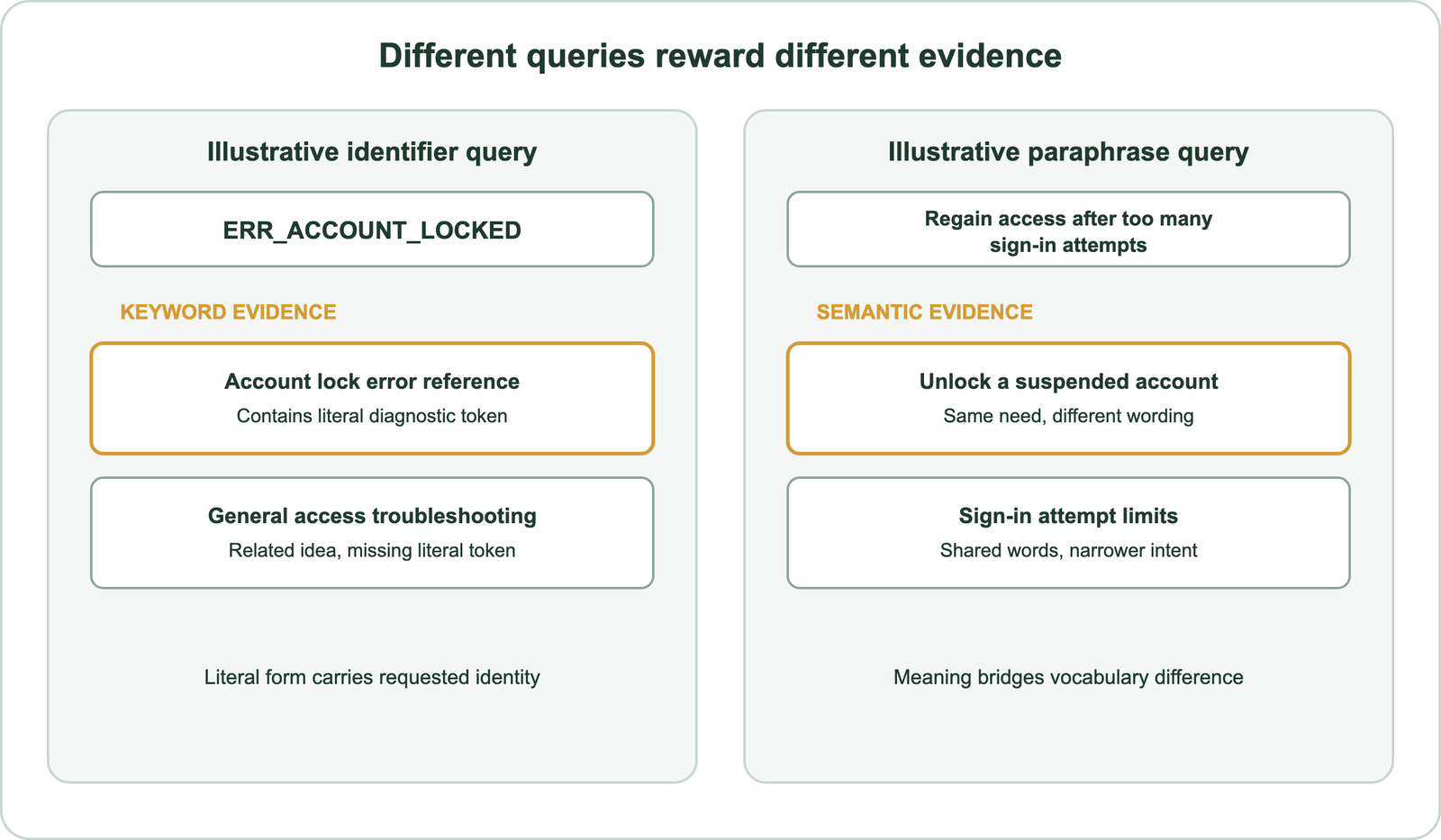
- Identifiers: An illustrative query such as
ERR_ACCOUNT_LOCKEDshould find records containing that exact diagnostic token. - Quoted phrases: A required phrase can distinguish a policy clause or title from documents that contain separate component words.
- Names: A person, product, organization, or place may require literal spelling as primary evidence.
- Controlled vocabulary: A catalog label or approved subject term can carry a stable domain meaning.
These cases do not make lexical search identical to raw string matching. Analysis still controls how terms enter the index. Lowercasing can preserve a match across capitalization, while stemming may merge grammatical variants. Identifier fields often need an analyzer that does not split meaningful punctuation or code segments. Elastic’s analysis documentation makes that configuration dependency explicit.
Consider an illustrative catalog query for SKU-BLUE-MUG. The code itself carries stronger evidence than a broad conceptual resemblance to drinkware. A semantic candidate might discuss blue cups yet omit the requested stock unit. The keyword-search guide develops these exact-term patterns. The opposite case appears when relevant language differs from query language.
When does a query favor semantic search?
Semantic search favors paraphrases, descriptive questions, and vocabulary gaps where relevant content may not repeat query terms. These queries express a need through concepts rather than a required token. Meaning-aware retrieval can connect alternate wording when its model and corpus represent that relationship well.
Three patterns expose this advantage. A paraphrase restates the same need with different terms. A descriptive question explains symptoms, properties, or goals instead of naming the target. A vocabulary gap appears when users and authors use different domain language. Dense retrieval can place those forms near relevant content even when lexical overlap is weak.
Semantic matching still has boundaries. Domain shift can weaken a model that represents general language better than specialized terminology. Chunk scope can separate a key statement from the context needed to interpret it. A nearby concept may look semantically plausible while failing a product, date, location, or policy constraint. Metadata filters and lexical evidence may be needed to preserve those requirements.
An illustrative paraphrase query, “How can I regain access after too many sign-in attempts?”, may need a passage titled “Unlock a suspended account.” Shared intent matters more than repeated wording in that case. Weaviate’s vector documentation supports the similarity mechanism, while BEIR shows performance still varies by task. Semantic-search use cases show where these patterns appear in workloads. Their failures require diagnosis before replacing a retrieval method.
How do keyword and semantic search fail?
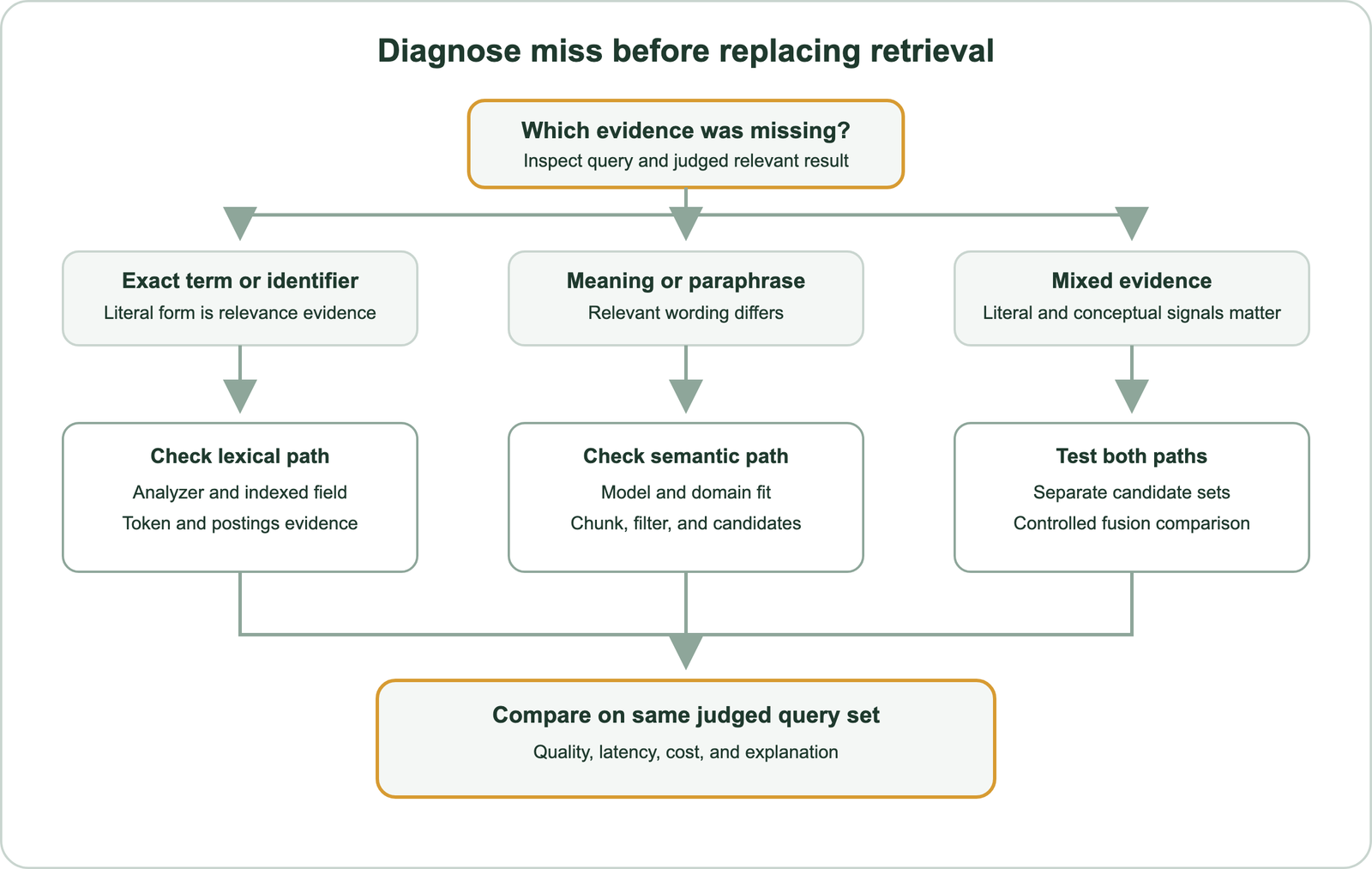
Keyword search fails on vocabulary mismatch, while semantic search fails on representation mismatch and soft conceptual neighbors. Both methods can also fail before ranking begins. Diagnosis should locate the failing stage: input, indexing, candidate retrieval, filtering, or final ranking.
A lexical miss may start with tokenization, stemming, stop-word handling, or a field omitted from the index. Synonyms can bridge known wording differences, while field boosts can favor the right evidence. These changes can also introduce noise. Elastic’s analysis and BM25 documentation shows why analyzer behavior and scoring configuration should be inspected before abandoning lexical retrieval.
A semantic miss may come from an embedding model that poorly represents the domain. It may come from a chunk boundary that removes necessary context. Approximate neighbor settings can affect candidate retrieval, while a metadata filter can exclude an otherwise relevant result. Semantic scores can also be harder to explain because resemblance is distributed through a learned representation.
Storage, compute, and freshness affect both families differently. Lexical indexes store terms and postings. Dense systems store vectors and a search structure, then must refresh representations when content changes. Exact operating costs depend on the corpus, model, index, and service design, so a universal cost ranking would mislead. Scaling guidance covers those constraints. Once failure stage is known, teams can choose rather than guess.
When should you choose semantic search or keyword search?
Choose semantic search or keyword search by query segments and relevance judgments, not by a universal accuracy claim. Thakur and coauthors call BM25 a robust baseline in BEIR. Their cross-domain results also show that retrieval behavior changes across tasks and architectures. Segment-level choice is a bounded inference from that heterogeneity.
A defensible decision follows five steps:
- Sample: Collect real queries that represent expected traffic and important edge cases.
- Label: Record which results satisfy each query under one written relevance policy.
- Baseline: Run a configured lexical method before attributing improvement to a more complex system.
- Segment: Separate identifiers, paraphrases, mixed requests, and ambiguous needs instead of averaging away their differences.
- Compare: Measure quality, latency, operating cost, and explanation needs under the same corpus and filters.
Precision matters when irrelevant results impose a high review cost. Recall matters when missing a relevant result is costly. Explainability may favor visible lexical evidence, while vocabulary variation may favor semantic representation. No single dimension decides every application. The acceptable tradeoff belongs to the product’s users and risk model.
The evaluation guide explains how to create judgments and controlled comparisons. Its method turns query behavior into evidence for selection. Mixed segments can then justify a controlled hybrid test rather than forcing one family across the entire workload.
When should keyword and semantic search be combined?
Combine keyword and semantic search when one workload contains both exact evidence and vocabulary variation. Hybrid retrieval preserves literal signals while adding candidates based on represented meaning. It is useful when query segments overlap or when a single query contains an identifier plus a descriptive need.
Weaviate Documentation defines hybrid search as fusion of a keyword BM25F result set with a vector result set. Both retrievers produce candidates, then a fusion method combines their rankings or scores. Configuration controls their relative influence. That structure differs from assuming semantic retrieval automatically contains reliable lexical matching.
Combination adds a tuning surface. Teams must decide how candidate sets are formed, how evidence is fused, and which query segments benefit. It can add compute and latency because more than one retrieval path runs. It can also hide a weak component if evaluation reports only one aggregate result rather than separate lexical, semantic, and hybrid outcomes.
A mixed support query might contain a literal error token followed by a natural-language symptom. Keyword evidence can preserve the code, while semantic evidence retrieves differently worded remediation text. This is an illustrative pattern, not a claim that fusion always improves ranking. The hybrid-search guide explains weighting and fusion after candidate retrieval. Controlled testing determines whether added complexity earns its place.
How do you test semantic search against keyword search?
Test keyword, semantic, and combined retrieval on the same corpus, filters, judged queries, and result depth. A controlled comparison changes retrieval method while holding evaluation conditions constant. Otherwise, a corpus update or filter difference can look like a ranking improvement.
Start with judgments created under one relevance policy. Segment queries into identifiers, paraphrases, mixed requests, and ambiguous needs. Run each retrieval configuration against the same indexed content. Record configuration, model, chunking, analyzer, and filters so a regression can be reproduced. Inspect individual failures alongside aggregate metrics.
Recall@k measures whether relevant results appear within a chosen result depth. nDCG@k also reflects graded relevance and ordering within that depth. The value of k must follow the product surface rather than an arbitrary universal setting. Information-retrieval metrics defines both measures and their interpretation.
Quality is only one decision input. Measure response latency and operating cost under representative load, then record explanation requirements for important results. BEIR supports cross-domain caution and a strong lexical baseline, not a guaranteed winner for a private corpus. Compare segment results, investigate regressions, and repeat after material corpus or model changes. That evidence closes the choice.
Semantic search and keyword search differ in the evidence they retrieve: represented meaning versus analyzed terms. Keyword search remains the clear baseline for literal identifiers, names, phrases, and controlled vocabulary. Semantic search addresses paraphrases, descriptions, and vocabulary gaps when its representation fits the domain. Mixed workloads may justify hybrid retrieval, but only a controlled test on shared judgments can confirm that choice. The decision is therefore not which method sounds more advanced, but which method serves each query segment with acceptable quality, cost, latency, and explanation.